CNNs reuse small filters across an image through local connectivity and weight sharing, requiring far fewer parameters than fully connected networks.

Duration of the online course: 6 hours and 1 minutes
New
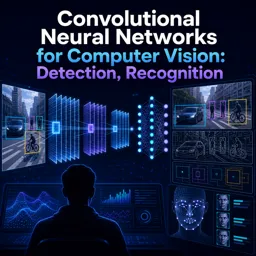
Build computer vision skills with a free CNN course—learn detection and recognition techniques, from convolution basics to YOLO and face ID, with a certificate option.
Want to teach machines to see and understand images? This free online course dives into Convolutional Neural Networks (CNNs), the foundation behind many modern computer vision systems used for object detection, image recognition, face verification, and even neural style transfer. You will build intuition for why convolutions scale so well to large images, how filters capture visual patterns such as edges and textures, and how design choices like padding, stride, pooling, and volumetric convolutions shape what a network can learn.
As you progress, you will connect the core building blocks to practical, battle-tested architectures. You will explore why classic network designs matter, what made very deep networks finally trainable, and how ideas like skip connections, bottleneck layers, and multi-branch modules help models become both stronger and more efficient. Along the way, the course emphasizes the kind of reasoning used in real projects: choosing proven baselines, adapting open-source implementations responsibly, and applying transfer learning to reach high performance even when data or training time is limited. You will also see how data augmentation can improve robustness by exposing a model to the variety it will face in the real world.
From there, the focus shifts from recognizing a whole image to pinpointing what is inside it. You will learn how localization augments classification with additional outputs, how detection systems evaluate predictions using IoU, and why post-processing steps like non-max suppression are essential for turning dense candidate predictions into clean final boxes. Modern detection approaches are covered conceptually, helping you understand the key tradeoffs between sliding-window style computation, region proposal pipelines, and single-shot methods such as YOLO.
The final part broadens your toolkit with techniques for identity and similarity learning, including one-shot learning for face recognition using Siamese networks and triplet loss. You will also look inside CNN representations to understand what different layers tend to respond to, then apply that insight to neural style transfer, where optimization balances content and style statistics to generate new images. By the end, you will be able to reason clearly about CNN design choices, evaluation signals, and the components that power detection and recognition systems—skills that transfer directly to many AI and machine learning roles in technology.

Explore the best free online Deep Learning courses and build practical skills in neural networks, CNNs, RNNs, transformers, computer vision, and AI. Learn at your own pace with expert-led lessons, hands-on projects, and real-world examples. Every course is free and includes a certificate to help you advance your career in machine learning and artificial intelligence.

Explore free online Computer Vision courses with certificates and build practical skills in image processing, object detection, facial recognition, deep learning, OpenCV, and neural networks. Learn at your own pace from beginner to advanced levels, strengthen your AI expertise, and earn a certificate to showcase your career-ready knowledge.

6 hours and 1 minutes of online video course

Digital certificate of course completion (Free)

Exercises to train your knowledge

100% free, from content to certificate
How do convolutional neural networks reduce the number of parameters needed for image recognition?
CNNs reuse small filters across an image through local connectivity and weight sharing, requiring far fewer parameters than fully connected networks.
What is the purpose of non-max suppression in object detection?
Non-max suppression removes overlapping duplicate bounding boxes, retaining the highest-confidence prediction for each detected object.
How does transfer learning help when training a CNN with limited image data?
It starts from a model pretrained on a large dataset, then fine-tunes selected layers for the new task, reducing data and training requirements.
Ready to get started?Download the app and get started today.
Install the app now
to access the course
Over 5,000 free courses
Programming, English, Digital Marketing and much more! Learn whatever you want, for free.

Study plan with AI
Our app's Artificial Intelligence can create a study schedule for the course you choose.

From zero to professional success
Improve your resume with our free Certificate and then use our Artificial Intelligence to find your dream job.
You can also use the QR Code or the links below.




Free CourseDeep Learning With PyTorch
5

(6)

3h39m

19 exercises

Free CourseMachine Learning tutorial
5
(1)
10h20m
6 exercises

Free CourseGoogle Prompting Essentials
4.8

(4)
3h24m
10 exercises

Free CourseData Science
4.8
(4)
5h58m
38 exercises

Free CourseArtificial intelligence
4.7
(68)
12h40m
7 exercises
Free CourseFundamentals of Artificial Intelligence
4.6
(11)
25h26m
34 exercises
Free CourseGenerative AI
4.6
(5)
1h43m
11 exercises

Free CourseMachine Learning for complete beginners
4.6
(9)
1h09m
17 exercises

Free CourseGoogle AI Essentials
4.5
(17)
3h40m
13 exercises

Free CourseArtificial Intelligence Masterclass: Search, Logic, Machine Learning and Deep Learning
4.5
(8)
31h57m
57 exercises
Carry knowledge in your pocket.
Download the Cursa app.
There are hundreds of free courses available, with a free certificate of completion that is saved in your mobile image gallery.
Download the app to access the Course Completion Certificate for Free.


+ 10 million
students

Free and Valid
Certificate

60 thousand free
exercises

4.8/5 rating in
app stores

Free courses in
video and ebooks