The course covers image classification, CNNs, backpropagation, optimization, attention, object detection, segmentation, 3D vision, video analysis, and generative models.

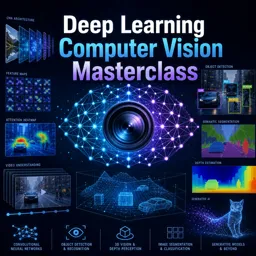
Duration of the online course: 48 hours and 19 minutes
3.8


(4)
Build real computer vision skills with a free deep learning course—CNNs, detection, segmentation, and training tips to boost your AI portfolio fast.
Developing reliable computer vision systems is no longer reserved for large research labs. With today’s tools and hardware, you can train models that recognize images, locate objects, segment scenes, and even learn meaningful representations from data—if you understand the foundations that make deep learning work. This course guides you from core principles to modern practices, connecting the why behind the math with the how of real-world model building.
You’ll start by framing the key ideas in image recognition, then build intuition for classifiers, optimization, and the training loop that powers neural networks. Instead of treating models like black boxes, you’ll learn how choices such as validation strategy, hyperparameters, activations, and learning rate schedules impact performance and stability. Along the way, you’ll strengthen your grasp of backpropagation and computational graphs so you can reason about gradients, debug training issues, and make improvements confidently.
As you progress, convolutional networks take center stage. You’ll explore why convolutions and nonlinearities are essential, how widely used CNN architectures evolved, and what residual connections accomplish when models get deep. Practical awareness of compute also matters: understanding why GPUs accelerate matrix operations helps you make better decisions about tooling, efficiency, and scaling experiments.
The course goes beyond classification to the broader computer vision toolkit. You’ll develop the mental model behind object detection outputs, the transition from detection to segmentation, and the alignment ideas that improved region-based methods. You’ll also gain perspective on 3D vision representations and how video data is commonly fed into deep networks, preparing you to work with temporal and spatial complexity.
To round out your skill set, you’ll touch on attention and sequence modeling concepts, learn how modern methods interpret and visualize what networks attend to, and build a clearer distinction between discriminative and generative modeling. You’ll see how objectives such as the KL term in VAEs shape learned representations, and you’ll get a practical overview of reinforcement learning goals and framing. By the end, you’ll have a cohesive understanding of the ideas that fueled the computer vision deep learning boom and the confidence to apply them to projects, portfolios, and advanced study.

Explore the best free online Deep Learning courses and build practical skills in neural networks, CNNs, RNNs, transformers, computer vision, and AI. Learn at your own pace with expert-led lessons, hands-on projects, and real-world examples. Every course is free and includes a certificate to help you advance your career in machine learning and artificial intelligence.

Explore free online Computer Vision courses with certificates and build practical skills in image processing, object detection, facial recognition, deep learning, OpenCV, and neural networks. Learn at your own pace from beginner to advanced levels, strengthen your AI expertise, and earn a certificate to showcase your career-ready knowledge.

48 hours and 19 minutes of online video course

Digital certificate of course completion (Free)

Exercises to train your knowledge

100% free, from content to certificate
What computer vision topics are covered in the Deep Learning Computer Vision Masterclass?
The course covers image classification, CNNs, backpropagation, optimization, attention, object detection, segmentation, 3D vision, video analysis, and generative models.
Why are GPUs faster than CPUs for training computer vision deep learning models?
GPUs can perform many matrix and tensor operations in parallel, making them highly efficient for the large-scale computations used in neural networks.
What is ROI Align used for in object detection and segmentation?
ROI Align precisely preserves spatial alignment when extracting region features, avoiding the coordinate rounding errors introduced by ROI Pool.
Ready to get started?Download the app and get started today.
Install the app now
to access the course
Over 5,000 free courses
Programming, English, Digital Marketing and much more! Learn whatever you want, for free.

Study plan with AI
Our app's Artificial Intelligence can create a study schedule for the course you choose.

From zero to professional success
Improve your resume with our free Certificate and then use our Artificial Intelligence to find your dream job.
You can also use the QR Code or the links below.



Free CourseDeep Learning With PyTorch
5
(6)

3h39m

19 exercises

Free CourseMachine Learning tutorial
5
(1)
10h20m
6 exercises

Free CourseGoogle Prompting Essentials
4.8
(4)
3h24m
10 exercises

Free CourseData Science
4.8
(4)
5h58m
38 exercises

Free CourseArtificial intelligence
4.7
(68)
12h40m
7 exercises

Free CourseFundamentals of Artificial Intelligence
4.6
(11)
25h26m
34 exercises
Free CourseGenerative AI
4.6
(5)
1h43m
11 exercises

Free CourseMachine Learning for complete beginners
4.6
(9)
1h09m
17 exercises

Free CourseGoogle AI Essentials
4.5
(17)
3h40m
13 exercises
Free CourseArtificial Intelligence Masterclass: Search, Logic, Machine Learning and Deep Learning
4.5
(8)
31h57m
57 exercises
Carry knowledge in your pocket.
Download the Cursa app.
There are hundreds of free courses available, with a free certificate of completion that is saved in your mobile image gallery.
Download the app to access the Course Completion Certificate for Free.


+ 10 million
students

Free and Valid
Certificate

60 thousand free
exercises

4.8/5 rating in
app stores

Free courses in
video and ebooks



Course comments: Deep Learning Computer Vision Masterclass
Sneha Yadlapure
best
Pratheep
super