AlexNet’s ImageNet competition win in 2012 demonstrated that deep CNNs trained on GPUs could dramatically improve image-classification accuracy.

Duration of the online course: 19 hours and 30 minutes
New
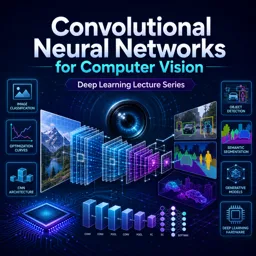
Build real-world computer vision skills with a free CNN course—learn image classification, training tricks, and modern architectures, plus practice questions.
If you want to understand how machines learn to see, this course is a practical path into convolutional neural networks (CNNs) and the ideas that made modern computer vision possible. You will move from the big picture of visual recognition to the engineering details that determine whether a model actually trains, generalizes, and performs well on real images. Along the way, the material connects core theory with the intuition you need to make good choices when building and tuning deep learning systems.
You will start by grounding CNNs in the breakthrough moment that accelerated their adoption for image classification, then build a clear mental model of image classification pipelines and evaluation. The course emphasizes good experimental habits, including how to think about data splits and why certain shortcuts can quietly invalidate results. From there, you will dive into loss functions and optimization, developing an understanding of what the model is truly minimizing and how gradients drive learning.
As neural networks enter the picture, you will learn why non-linear activations are essential for expressive models, and why some classic activations can make deep networks harder to train. The training-focused lectures explore common failure modes, practical stabilization techniques, and modern optimizers, clarifying details such as why moment estimates need correction early in training. You will also see how hardware and software choices matter, with a clear explanation of why GPUs excel at the operations that dominate deep learning workloads.
Once the fundamentals are in place, the course shifts to widely used CNN architectures and the design patterns behind them, highlighting how smart architectural changes can cut parameters while preserving or improving accuracy. You will then broaden your toolkit to cover tasks beyond classification, including detection and segmentation, and develop intuition for what outputs a vision model should produce when the goal is pixel-level understanding.
To deepen understanding, the lectures explore ways to visualize and interpret what networks learn, then expand into generative models, recurrent networks, and deep reinforcement learning, giving you a sense of how vision connects to sequence modeling and decision-making. Efficiency and deployment considerations are addressed through discussions of memory access and inference hardware, and you will also learn why adversarial examples work and how adversarial training improves robustness. Throughout, short exercises help you check understanding and turn key concepts into usable skill.

Explore the best free online Deep Learning courses and build practical skills in neural networks, CNNs, RNNs, transformers, computer vision, and AI. Learn at your own pace with expert-led lessons, hands-on projects, and real-world examples. Every course is free and includes a certificate to help you advance your career in machine learning and artificial intelligence.

Explore free online Computer Vision courses with certificates and build practical skills in image processing, object detection, facial recognition, deep learning, OpenCV, and neural networks. Learn at your own pace from beginner to advanced levels, strengthen your AI expertise, and earn a certificate to showcase your career-ready knowledge.

19 hours and 30 minutes of online video course

Digital certificate of course completion (Free)

Exercises to train your knowledge

100% free, from content to certificate
What was the 2012 breakthrough that made convolutional neural networks widely adopted for image classification?
AlexNet’s ImageNet competition win in 2012 demonstrated that deep CNNs trained on GPUs could dramatically improve image-classification accuracy.
Why are 1×1 convolutions used before 3×3 and 5×5 filters in Inception networks?
They reduce channel depth before costly convolutions, lowering parameters and computation while adding nonlinearity.
How does FGSM create adversarial examples for CNN classifiers?
FGSM perturbs an input by a small amount in the sign direction of the loss gradient, causing the classifier to make an incorrect prediction.
Ready to get started?Download the app and get started today.
Install the app now
to access the course
Over 5,000 free courses
Programming, English, Digital Marketing and much more! Learn whatever you want, for free.

Study plan with AI
Our app's Artificial Intelligence can create a study schedule for the course you choose.

From zero to professional success
Improve your resume with our free Certificate and then use our Artificial Intelligence to find your dream job.
You can also use the QR Code or the links below.




Free CourseDeep Learning With PyTorch
5

(6)

3h39m

19 exercises

Free CourseMachine Learning tutorial
5
(1)
10h20m
6 exercises

Free CourseGoogle Prompting Essentials
4.8

(4)
3h24m
10 exercises

Free CourseData Science
4.8
(4)
5h58m
38 exercises

Free CourseArtificial intelligence
4.7
(68)
12h40m
7 exercises
Free CourseFundamentals of Artificial Intelligence
4.6
(11)
25h26m
34 exercises
Free CourseGenerative AI
4.6
(5)
1h43m
11 exercises

Free CourseMachine Learning for complete beginners
4.6
(9)
1h09m
17 exercises

Free CourseGoogle AI Essentials
4.5
(17)
3h40m
13 exercises

Free CourseArtificial Intelligence Masterclass: Search, Logic, Machine Learning and Deep Learning
4.5
(8)
31h57m
57 exercises
Carry knowledge in your pocket.
Download the Cursa app.
There are hundreds of free courses available, with a free certificate of completion that is saved in your mobile image gallery.
Download the app to access the Course Completion Certificate for Free.


+ 10 million
students

Free and Valid
Certificate

60 thousand free
exercises

4.8/5 rating in
app stores

Free courses in
video and ebooks