Duration of the online course: 18 hours and 22 minutes
2.5
(2)
Build real problem-solving skill in mechanics with this free online course: master motion, forces, energy and rotation through clear lessons and practice.
In this free course, learn about
Use vectors vs scalars; magnitude/direction, components, unit vectors, coordinate changes
Apply derivatives/integrals to relate position, displacement, velocity, and acceleration in 1D/2D
Solve projectile motion and relative motion problems using reference frames
Apply Newton’s 1st–3rd laws with free-body diagrams; inertial vs non-inertial frames
Model forces: gravity, normal, tension, friction (static/kinetic), springs (Hooke’s law)
Solve pulley/rope constraints, tension relations, and systems of connected bodies
Analyze circular motion with polar coordinates; angular kinematics and centripetal acceleration
Compute work, power, kinetic energy; use work–energy theorem and conservative forces
Use potential energy and energy conservation; interpret energy state/potential diagrams
Use momentum and impulse for systems, recoil, rockets with variable mass, and thrust
Solve elastic/inelastic collisions in 1D/2D; center-of-mass frame and energy changes
Rigid-body rotation: torque, cross product, rotational KE, moment of inertia, parallel-axis
Angular momentum, angular impulse, conservation; gyroscopes and precession concepts
Rolling without slipping: translation+rotation relations, friction’s role, contact point velocity
About the free online course
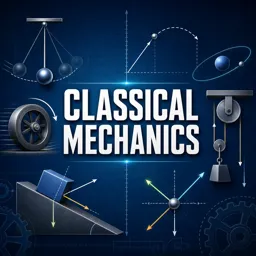
Strengthen your core mechanical reasoning and learn to turn real-world motion into clear, solvable models. This free online course in Classical Mechanics develops the professional skill of analyzing how objects move and why they move that way, using the same framework that underpins mechanical and industrial basics—from machines and transport to robotics, tooling and product design. Instead of memorizing formulas, you build intuition for physical systems and gain a repeatable method to set up problems, choose assumptions, and reach results you can trust.
You start with the language of mechanics: vectors, coordinate systems and representations that let you describe position, velocity and acceleration in one and two dimensions. From there, you connect kinematics to dynamics by applying Newton’s laws, learning how to select reference frames, interpret interactions between bodies, and translate forces into equations of motion. Along the way you practice drawing and reasoning with free-body diagrams so that each term in an equation has a physical meaning rather than being a symbol to copy.
As the course progresses, you develop fluency with gravity, friction, tension, springs and resistive forces, and you see how constraints from ropes, pulleys and connected bodies shape what a system can do. You then expand into circular motion and rotation, building the bridge from translation to rigid-body dynamics with torque, angular velocity, angular momentum and moment of inertia. Energy methods add a second powerful lens: work, power, conservative and non-conservative forces, potential energy and mechanical energy conservation become tools for solving problems efficiently when force-based approaches get messy.
Momentum and impulse bring yet another perspective, helping you analyze collisions, recoil and systems of particles, and reinforcing the habit of selecting the right conservation principle for the situation. By working through guided examples and targeted exercises, you’ll learn to validate units, check limiting cases, and interpret answers in context—skills that translate directly into engineering workflows, technical interviews, and advanced study in physics or mechanical engineering.
Course content
Video class: 8.01SC Classical Mechanics Introduction02m
Exercise: What is the primary focus of MIT's Physics 8.01 course?
Video class: 0.1 Vectors vs. Scalars01m
Exercise: What distinguishes vectors from scalars?
Video class: 0.2 Vector Operators02m
Exercise: What happens to a vector when multiplied by a negative scalar?
Video class: 0.3 Coordinate Systems and Unit Vectors01m
Exercise: What is the purpose of using unit vectors in a 2D coordinate system?
Video class: 0.4 Vectors - Magnitude and Direction00m
Exercise: How can a vector be described?
Video class: 0.5 Vector Decomposition into components01m
Exercise: How can a vector in two dimensions be represented using unit vectors?
Video class: 0.6 Going Between Representations01m
Exercise: How do you find the x-component of a vector given its magnitude and angle?
Video class: 1.0 Week 1 Introduction (8.01 Classical Mechanics)02m
Exercise: _What is the difference between kinematics and dynamics?
Video class: 1.1 Coordinate Systems and Unit Vectors in 1D03m
Exercise: What is the correct statement about the 1D Cartesian coordinate system described in motion analysis?
Video class: 1.2 Position Vector in 1D02m
Exercise: What does the component x(t) of the position vector represent in this context?
Video class: 1.3 Displacement Vector in 1D03m
Exercise: What does a positive displacement vector indicate in the context of the runner's movement?
Video class: 1.4 Average Velocity in 1D02m
Exercise: What is the definition of average velocity in terms of displacement and time?
Video class: 1.5 Instantaneous Velocity in 1D05m
Exercise: What represents the instantaneous velocity at a specific time?
Video class: 1.7 Worked Example: Derivatives in Kinematics03m
Exercise: What is the velocity of the rocket during thrust?
Video class: 2.1 Introduction to Acceleration03m
Exercise: _At the highest point of the object's motion, was its acceleration zero or non-zero?
Video class: 2.2 Acceleration in 1D04m
Exercise: What is the definition of instantaneous acceleration?
Video class: 2.3 Worked Example: Acceleration from Position03m
Exercise: What is the unit of the constant b in the position function?
Video class: 2.4 Integration22m
Exercise: What mathematical process is used to find velocity from acceleration?
Video class: 3.1 Coordinate System and Position Vector in 2D02m
Exercise: How is an object described in a Cartesian coordinate system during two-dimensional motion?
Video class: 3.2 Instantaneous Velocity in 2D06m
Exercise: What defines the direction of the instantaneous velocity in two-dimensional motion?
Video class: 3.3 Instantaneous Acceleration in 2D05m
Video class: 3.4 Projectile Motion06m
Exercise: _What is the equation for the position of an object in the y direction as a function of time during projectile motion, assuming no air resistance?
Video class: 3.5 Demo: Shooting an Apple00m
Video class: 3.5 Demo: Relative Motion Gun00m
Video class: PS.1.1 Three Questions Before Starting02m
Video class: PS.1.2 Shooting the apple solution10m
Video class: P.1.3 Worked Example: Braking Car06m
Video class: P.1.4 Sketch the Motion02m
Video class: P.1.5 Worked Example: Pedestrian and Bike at Intersection13m
Exercise: _What are the initial conditions in this problem?
Video class: 4.0 Week 2 Introduction02m
Video class: 4.1 Newton's First and Second Laws04m
Video class: 4.2 Newton's Third Law07m
Video class: 4.3 Reference Frames09m
Video class: 4.4 Non-inertial Reference Frames04m
Video class: 5.1 Universal Law of Gravitation06m
Video class: 5.2 Worked Example: Gravity - Superposition08m
Exercise: _What position in space with respect to other celestial bodies would cancel the gravitational force on the little prince's asteroid, allowing him to free float and watch the stars?
Video class: 5.3 Gravity at the surface of the Earth: The value of g.04m
Video class: 6.1 Contact Forces03m
Video class: 6.2 Static Friction03m
Video class: 7.1 Pushing Pulling and Tension04m
Video class: 7.2 Ideal Rope04m
Video class: 7.3 Solving Pulley Systems09m
Video class: 7.4 Hooke's Law06m
Exercise: _What is the direction of the restoring force when the object is pulled out from the equilibrium position?
Video class: DD.1.1 Friction at the Nanoscale39m
Video class: PS.2.1 Worked Example - Sliding Block06m
Video class: PS.2.2 Worked Example - Stacked Blocks - Free Body Diagrams and Applying Newtons 2nd Law08m
Video class: PS.2.2 Worked Example - Stacked Blocks - Solve for the Maximum Force04m
Video class: PS.2.2 Worked Example - Stacked Blocks - Choosing the System of 2 Blocks Together05m
Video class: PS.2.3 Window Washer Free Body Diagrams10m
Video class: PS.2.3 Window Washer Solution02m
Exercise: _What is the force that the person pulls the rope down with in the given system?
Video class: Newton's 3rd Law Pairs04m
Video class: Internal and External Forces03m
Video class: Applying Newton's 2nd Law03m
Video class: 8.0 Week 3 Introduction01m
Video class: 8.1 Polar Coordinates03m
Video class: 8.2 Circular Motion: Position and Velocity Vectors06m
Video class: 8.3 Angular Velocity05m
Exercise: _What is the right hand rule used for in defining the direction of rotation in an arbitrary plane?
Video class: 9.1 Uniform Circular Motion03m
Video class: 9.2 Uniform Circular Motion: Direction of the Acceleration03m
Video class: 10.1 Circular Motion - Acceleration04m
Video class: 10.2 Angular Acceleration06m
Video class: 10.3 Worked Example - Angular position from angular acceleration.04m
Video class: 11.1 Newton's 2nd Law and Circular Motion03m
Video class: 11.2 Worked Example - Car on a Banked Turn07m
Exercise: _What is the constraint for circular motion in the problem of a car moving on a banked, frictionless circular track?
Video class: 11.3 Demo: Rotating Bucket00m
Video class: PS.3.1 Worked Example - Orbital Circular Motion - Radius03m
Video class: PS.3.1 Worked Example - Orbital Circular Motion - Velocity01m
Video class: PS.3.1 Worked Example - Orbital Circular Motion - Period01m
Video class: 12.0 Week 4 Introduction02m
Video class: 12.1 Pulley Problems10m
Video class: 12.2 Constraint Condition07m
Exercise: _What is the constraint condition needed to solve the system of equations of Object 1 and Object 2 in the example given?
Video class: 12.3 Virtual Displacement03m
Video class: 12.4 Solve the System of Equations04m
Video class: 12.5 Worked Example: 2 Blocks and 2 Pulleys08m
Video class: 13.1 Rope Hanging Between Trees03m
Video class: 13.2 Differential Analysis of a Massive Rope15m
Video class: 13.3 Differential Elements01m
Video class: 13.4 Density00m
Exercise: _What is the name of the quantity that relates the small length element to the amount of mass contained within it?
Video class: 13.5 Demo: Wrapping Friction01m
Video class: 13.6 Summary for Differential Analysis01m
Video class: 14.1 Intro to resistive forces04m
Video class: 14.2 Resistive forces - low speed case08m
Video class: 14.3 Resistive forces - high speed case10m
Video class: 15.0 Week 5 Introduction02m
Video class: 15.1 Momentum and Impulse07m
Exercise: _What is the momentum of a point mass particle of mass m moving with a velocity vector, v?
Video class: 15.2 Impulse is a Vector03m
Video class: 15.3 Worked Example - Bouncing Ball06m
Video class: 15.4 Momentum of a System of Point Particles04m
Video class: 15.5 Force on a System of Particles09m
Video class: 16.1 Cases of Constant Momentum05m
Video class: 16.2 Momentum Diagrams05m
Video class: 17.1 Definition of the Center of Mass04m
Exercise: _What is the definition of the center of mass of a rigid object?
Video class: 17.2 Worked Example - Center of Mass of 3 Objects07m
Video class: 17.3 Center of Mass of a Continuous System02m
Video class: 17.5 Worked Example - Center of Mass of a Uniform Rod05m
Video class: 17.6 Velocity and Acceleration of the Center of Mass04m
Video class: 17.7 Reduction of a System to a Point Particle04m
Video class: 18.0 Week 6 Introduction00m
Video class: 18.1 Relative Velocity01m
Exercise: _What is the total speed at which the car appears to be moving to the right from the perspective of the bike?
Video class: 18.2 Set up a Recoil Problem06m
Video class: 18.3 Solve for Velocity in the Ground Frame03m
Video class: 18.4 Solve for Velocity in the Moving Frame02m
Video class: 19.1 Rocket Problem 1 - Set up the Problem03m
Video class: 19.2 Rocket Problem 2 - Momentum Diagrams05m
Video class: 19.3 Rocket Problem 3 - Mass Relations02m
Video class: 19.4 Rocket Problem 4 - Solution05m
Video class: 19.5 Rocket Problem 5 - Thrust and External Forces03m
Video class: 19.6 Rocket Problem 6 - Solution for No External Forces05m
Video class: 19.7 Rocket Problem 7 - Solution with External Forces05m
Video class: PS.6.1 Rocket Sled - Differential Equation03m
Video class: PS.6.1 Rocket Sled - Integrate the Rocket Equation03m
Video class: PS.6.1 Rocket Sled - Solve for Initial Velocity01m
Video class: PS.6.2 Snowplow Problem08m
Exercise: _What is the equation for the rate that the truck changes its speed when plowing snow continuously?
Video class: 20.0 Week 7 Introduction02m
Video class: 20.1 Kinetic Energy02m
Video class: 20.2 Work by a Constant Force03m
Video class: 20.3 Work by a Non-Constant Force06m
Video class: 20.4 Integrate adt and adx04m
Video class: 20.5 Work-Kinetic Energy Theorem01m
Video class: 20.6 Power01m
Video class: 21.1 Scalar Product Properties07m
Video class: 21.2 Scalar Product in Cartesian Coordinates04m
Video class: 21.3 Kinetic Energy as a Scalar Product02m
Video class: 21.4 Work in 2D and 3D05m
Video class: 21.5 Work-Kinetic Energy Theorem in 2D and 3D05m
Video class: 21.6 Worked Example: Block Going Down a Ramp05m
Video class: 22.1 Path Independence - Gravity05m
Video class: 22.2 Path Dependence - Friction05m
Video class: 22.3 Conservative Forces02m
Video class: 22.4 Non-conservative Forces01m
Video class: 22.5 Summary of Work and Kinetic Energy07m
Video class: PS.7.1 Worked Example - Collision and Sliding on a Rough Surface06m
Video class: 23.0 Week 8 Introduction00m
Video class: 23.1 Introduction to Potential Energy09m
Exercise: _What is the work integral for a conservative force, and how is it related to the endpoints of the path?
Video class: 23.2 Potential Energy of Gravity near the Surface of the Earth03m
Video class: 23.3 Potential Energy Reference State05m
Video class: 23.4 Potential Energy of a Spring05m
Video class: 23.5 Potential Energy of Gravitation07m
Video class: 24.1 Mechanical Energy and Energy Conservation05m
Video class: 24.2 Energy State Diagrams05m
Video class: 24.3 Worked Example - Block Sliding Down Circular Slope07m
Exercise: _What is the initial energy of the object in the example given?
Video class: 24.4 Newton's 2nd Law and Energy Conservation05m
Video class: 25.1 Force is the Derivative of Potential03m
Video class: 25.2 Stable and Unstable Equilibrium Points07m
Video class: 25.3 Reading Potential Energy Diagrams05m
Video class: 26.0 Week 9 Introduction01m
Video class: 26.1 Momentum in Collisions04m
Video class: 26.2 Kinetic Energy in Collisions05m
Exercise: _What is an elastic collision?
Video class: 26.3 Totally Inelastic Collisions04m
Video class: 27.1 Worked Example: Elastic 1D Collision10m
Video class: 27.2 Relative Velocity in 1D03m
Video class: 27.3 Kinetic Energy and Momentum Equation07m
Video class: 27.4 Worked Example: Elastic 1D Collision Again05m
Video class: 27.5 Worked Example: Gravitational Slingshot04m
Video class: 27.6 2D Collisions06m
Exercise: _What is the equation for momentum conservation in a two-dimensional collision with no external forces?
Video class: DD.2.1 Position in the CM Frame04m
Video class: DD.2.2 Relative Velocity is Independent of Reference Frame03m
Video class: DD.2.3 1D Elastic Collision Velocities in CM Frame03m
Video class: DD.2.4 Worked Example: 1D Elastic Collision in CM Frame06m
Video class: DD.2.5 Kinetic Energy in Different Reference Frames06m
Video class: DD.2.6 Kinetic Energy in the CM Frame04m
Video class: DD.2.7 Change in the Kinetic Energy03m
Exercise: _In an inelastic collision, the change in kinetic energy in the ground frame is equal to the change in kinetic energy in the center of mass frame because:
Video class: 28.0 Week 10 Introduction02m
Video class: 28.1 Rigid Bodies03m
Video class: 28.2 Introduction to Translation and Rotation02m
Video class: 28.3 Review of Angular Velocity and Acceleration03m
Video class: 29.1 Kinetic Energy of Rotation06m
Video class: 29.2 Moment of Inertia of a Rod04m
Video class: 29.3 Moment of Inertia of a Disc05m
Video class: 29.4 Parallel Axis Theorem04m
Video class: 29.5 Deep Dive - Moment of Inertia of a Sphere05m
Video class: 29.6 Deep Dive - Derivation of the Parallel Axis Theorem05m
Video class: 30.1 Introduction to Torque and Rotational Dynamics09m
Video class: 30.2 Cross Product05m
Video class: 30.3 Cross Product in Cartesian Coordinates07m
Video class: 30.4 Torque02m
Exercise: _What is torque defined as when a force F is applied to an object pivoted at a point Q?
Video class: 30.5 Torque from Gravity04m
Video class: 31.1 Relationship between Torque and Angular Acceleration09m
Video class: 31.2 Internal Torques Cancel in Pairs03m
Video class: 31.3 Worked Example - Find the Moment of Inertia of a Disc from a Falling Mass07m
Video class: 31.4 Worked Example - Atwood Machine11m
Video class: 31.5 Massive Pulley Problems03m
Video class: 31.7 Worked Example - Two Blocks and a Pulley Using Energy07m
Exercise: _What is the final velocity of block 2 in the given scenario?
Video class: PS.10.1 Worked Example - Blocks with Friction and Massive Pulley16m
Video class: 32.0 Week 11 Introduction01m
Video class: 32.1 Angular Momentum for a Point Particle02m
Video class: 32.2 Calculating Angular Momentum03m
Video class: 32.3 Worked Example - Angular Momentum About Different Points06m
Video class: 32.4 Angular Momentum of Circular Motion03m
Video class: 33.1 Worked Example - Angular Momentum of 2 Rotating Point Particles07m
Exercise: _What is the direction of Ls1 and Ls2, the angular momentum of the first and second particle, respectively, in the system described above?
Video class: 33.2 Angular Momentum of a Symmetric Object04m
Video class: 33.4 If Momentum is Zero then Angular Momentum is Independent of Origin05m
Video class: 33.5 Kinetic Energy of a Symmetric Object02m
Video class: 34.1 Torque Causes Angular Momentum to Change - Point Particle02m
Video class: 34.2 Torque Causes Angular Momentum to Change - System of Particles03m
Video class: 34.3 Angular Impulse03m
Video class: 34.4 Demo: Bicycle Wheel Demo00m
Video class: 34.5 Worked Example - Particle Hits Pivoted Ring08m
Video class: 35.0 Week 12 Introduction01m
Video class: 35.1 Translation and Rotation of a Wheel03m
Video class: 35.2 Rolling Wheel in the Center of Mass Frame02m
Video class: 35.3 Rolling Wheel in the Ground Frame02m
Video class: 35.4 Rolling Without Slipping Slipping and Skidding05m
Video class: 35.5 Contact Point of a Wheel Rolling Without Slipping03m
Exercise: _What is the velocity of the contact point between a wheel and the ground when the wheel is rolling without slipping?
Video class: 36.1 Friction on a Rolling Wheel04m
Video class: 36.2 Worked Example - Wheel Rolling Without Slipping Down Inclined Plane - Torque Method06m
Video class: 36.3 Demo: Spool Demo00m
Video class: 36.4 Worked Example - Yoyo Pulled Along the Ground06m
Video class: 36.5 Analyze Force and Torque in Translation and Rotation Problems03m
Video class: 37.1 Kinetic Energy of Translation and Rotation07m
Video class: 37.2 Worked Example - Wheel Rolling Without Slipping Down Inclined Plane04m
Video class: 37.3 Angular Momentum of Translation and Rotation06m
Video class: DD.3.1 Deep Dive - Gyroscopes - Free Body Diagrams, Torque, and Rotating Vectors16m
Video class: DD.3.2 Deep Dive - Gyroscopes - Precessional Angular Velocity and Titled Gyroscopes13m
Video class: DD.3.3 Deep Dive - Gyroscopes - Nutation and Total Angular Momentum13m
This free course includes:
18 hours and 22 minutes of online video course
Digital certificate of course completion (Free)
Exercises to train your knowledge
100% free, from content to certificate
What topics are covered in MIT-style Classical Mechanics 8.01?
The course covers vectors, kinematics, Newton’s laws, forces, circular motion, momentum, energy, collisions, rotation, torque, angular momentum, and rolling motion.
How does Classical Mechanics explain projectile motion without air resistance?
Horizontal motion has constant velocity, while vertical motion has constant downward acceleration due to gravity: y(t)=y0+v0y t−(1/2)gt².
What is the difference between torque and angular momentum in classical mechanics?
Torque is the rotational effect of a force, while angular momentum describes rotational motion. Net external torque changes angular momentum.
Ready to get started?Download the app and get started today.