
Exercises
Explore the foundations of statistical inference with this quiz on the concepts and practices used to draw conclusions from data. Test your understanding of point and interval estimation, parameters, the Law of Large Numbers, and the Central Limit Theorem. You will also review confidence intervals, null hypotheses, p-values, and Type I errors in hypothesis testing, along with a key principle of Bayesian inference. Ideal for students, researchers, and anyone building practical statistics skills.
Answer the questions below and check the explanation for each answer.
0/10 answered
Auto audio on: the next questions will be read aloud when you click Continue.
The primary purpose of statistical inference is to draw conclusions about a population based on data collected from a sample. It helps in making predictions or decisions under conditions of uncertainty.
Interval estimation gives a range of values for estimating a parameter, while point estimation provides a single value as the estimate of the population parameter.
The Law of Large Numbers states that as a sample size increases, the sample mean becomes closer to the population mean. It's a key principle in the probability theory.
Confidence intervals provide a range of values for estimating a population parameter, along with a confidence level that indicates the likelihood that the interval contains the parameter.
The null hypothesis is a presumption of no effect or no difference, which researchers seek to test and possibly reject in favor of an alternative hypothesis.
The Central Limit Theorem indicates that regardless of the population distribution, the distribution of sample means will tend to a normal distribution as the sample size increases.
Type I error occurs when the null hypothesis is wrongly rejected, meaning the conclusion indicates the presence of an effect or a difference when there is none.
A parameter refers to a numerical characteristic of a population, such as the population mean or population variance, unlike sample statistics.
The p-value represents the probability of observing data as extreme as the sample data, given that the null hypothesis is true. It's used in determining statistical significance.
Bayesian inference involves updating the probability estimate for a hypothesis as new information or evidence becomes available, using prior and posterior distributions.

Free CourseStatics course
5

(2)

21h45m

35 exercises

Free CourseStatistics Course for Beginners
5
(2)
9h48m
36 exercises
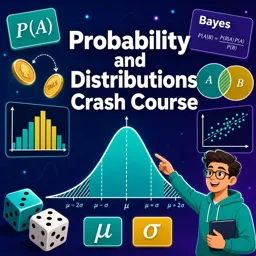
Free CourseProbability and Distributions Crash Course
5
(1)
10h37m
43 exercises

Free CourseStatistics full course
5
(2)
8h15m

Free CourseStatistics
4.8
(31)
12h44m
32 exercises
Free CourseStatistics
4.8
(33)
31h55m
25 exercises

Free CourseStatistics for Data Science
4.5

(2)
8h15m
Free CourseStatistics for Applications
New
28h00m
22 exercises
Thousands of online courses in video, ebooks and audiobooks.
To test your knowledge during online courses
Generated directly from your cell phone's photo gallery and sent to your email

Download our app via QR Code or the links below:.



Carry knowledge in your pocket.
Download the Cursa app.
There are hundreds of free courses available, with a free certificate of completion that is saved in your mobile image gallery.
Download the app to access the Course Completion Certificate for Free.


+ 10 million
students

Free and Valid
Certificate

60 thousand free
exercises

4.8/5 rating in
app stores

Free courses in
video and ebooks