
Exercises
Challenge your understanding of inferential statistics with this knowledge test. Explore essential concepts used to draw conclusions about populations from sample data, including parameters and statistics, confidence intervals, margin of error, significance levels, and p-values. Questions also cover the central limit theorem, normal distribution probabilities, sample size effects, hypothesis testing, and the differences between Type I and Type II errors. Whether you are reviewing for a statistics course or strengthening your data analysis skills, this quiz offers a focused way to assess your grasp of core inferential methods.
Answer the questions below and check the explanation for each answer.
0/10 answered
Auto audio on: the next questions will be read aloud when you click Continue.
Inferential statistics uses sample data to make inferences or predictions about a larger population.
A parameter is a value that describes a characteristic of an entire population, like the mean income of the entire country.
A sample statistic is a numerical measurement that describes a feature of a sample, such as the sample mean or sample variance.
Confidence intervals provide a range of values that is likely to contain the population parameter, giving an estimate along with a degree of certainty.
As sample size increases, the margin of error decreases because a larger sample provides more information and reduces variability.
The significance level, denoted by alpha, is the probability of making a Type I error, or rejecting a true null hypothesis.
In a normal distribution, about 95% of the data falls within two standard deviations of the mean, based on the empirical rule.
A p-value indicates how likely it is to observe the test results if the null hypothesis were true. Low p-values suggest that the null hypothesis may not be valid.
The central limit theorem states that the distribution of sample means will approach a normal distribution, regardless of the shape of the population distribution, as the sample size becomes larger.
A Type I error rejects a true null hypothesis, while a Type II error misses rejecting a false null hypothesis. Both are key considerations in hypothesis testing.

Free CourseStatics course
5

(2)

21h45m

35 exercises

Free CourseStatistics Course for Beginners
5
(2)
9h48m
36 exercises
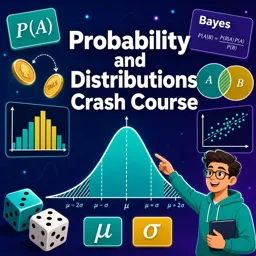
Free CourseProbability and Distributions Crash Course
5
(1)
10h37m
43 exercises

Free CourseStatistics full course
5
(2)
8h15m
Free CourseStatistics
4.8
(31)
12h44m
32 exercises
Free CourseStatistics
4.8
(33)
31h55m
25 exercises

Free CourseStatistics for Data Science
4.5

(2)
8h15m
Free CourseStatistics for Applications
New
28h00m
22 exercises
Thousands of online courses in video, ebooks and audiobooks.
To test your knowledge during online courses
Generated directly from your cell phone's photo gallery and sent to your email

Download our app via QR Code or the links below:.



Carry knowledge in your pocket.
Download the Cursa app.
There are hundreds of free courses available, with a free certificate of completion that is saved in your mobile image gallery.
Download the app to access the Course Completion Certificate for Free.


+ 10 million
students

Free and Valid
Certificate

60 thousand free
exercises

4.8/5 rating in
app stores

Free courses in
video and ebooks