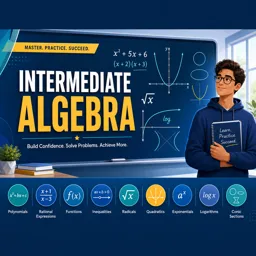
Intermediate Algebra is a vital stage in mathematical learning, bridging basic skills with more advanced concepts. It prepares students for subjects like precalculus and calculus while strengthening critical thinking and problem-solving abilities.
What Is Intermediate Algebra?
Intermediate Algebra expands on foundational algebra, introducing more complex operations and concepts. Students develop proficiency in manipulating algebraic expressions, solving equations, and understanding mathematical relationships that serve as a foundation for higher-level math.
Core Topics Covered
- Polynomials – Addition, subtraction, multiplication, division, and factoring.
- Rational Expressions – Simplifying and solving equations involving polynomial fractions.
- Quadratic Equations – Solving using factoring, completing the square, and the quadratic formula.
- Radical Expressions – Working with square roots and higher-order roots, simplifying and solving related equations.
- Functions And Graphs – Introduction to functions, notation, properties, and graphing linear and quadratic functions.
- Systems Of Equations – Using substitution, elimination, and graphical methods to solve multiple equations.
Why Study Intermediate Algebra?
Learning Intermediate Algebra strengthens analytical skills and prepares students for real-world problem-solving in areas like science, engineering, and economics. It provides the tools necessary to handle advanced mathematical concepts with confidence.
Tips For Success
- Practice regularly – Consistent problem-solving builds mastery and confidence.
- Work on word problems – Applying algebra in real-life contexts reinforces understanding.
- Seek help – Ask questions or pursue tutoring to overcome challenging concepts.
- Utilize online resources – Videos, tutorials, and practice exercises enhance learning.
Conclusion
Intermediate Algebra bridges foundational skills with advanced mathematical thinking. By mastering its key concepts and applying effective study habits, students set themselves up for long-term success in mathematics and beyond.