
It lets a verifier efficiently check claims about sums of multivariate polynomials by querying a prover over several rounds.

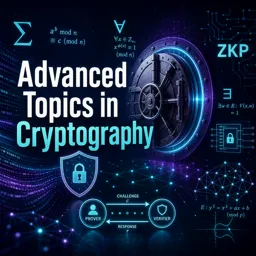
Duration of the online course: 22 hours and 34 minutes
5

(2)
Build modern proof skills in this free cryptography course—interactive proofs, Fiat–Shamir, SNARGs and LWE—ideal for advancing in cybersecurity research.
Strengthen your ability to reason about cutting-edge security systems by mastering the proof techniques that sit behind today’s most powerful cryptographic constructions. This free online course goes beyond introductory primitives and focuses on how modern cryptography is proven secure, how efficiency is achieved, and why certain proof systems have become central to real-world applications in cybersecurity and privacy. If you want to move from knowing definitions to understanding how cryptographers actually build and validate advanced protocols, this course is designed to bridge that gap.
You will explore interactive proofs and the sum-check protocol as a foundational tool for verifying complex statements with limited verifier effort, highlighting why carefully designed randomness is essential for soundness. From there, you will connect these ideas to doubly efficient interactive proofs and the GKR framework, building intuition for how a verifier can be much faster than the prover while still remaining confident in the result. This perspective is especially valuable when thinking about verification in constrained environments such as blockchains, secure computation, and large-scale systems where auditing costs must remain low.
The course then advances to probabilistically checkable proofs and their role in enabling succinct verification, setting the stage for interactive arguments that rely on cryptographic assumptions. You will see how collision-resistant hashing becomes a practical backbone for constructing succinct arguments, and how these components fit together into classical protocols that shaped the field. As the material transitions to the Fiat–Shamir paradigm, the focus turns to making proofs non-interactive while preserving security guarantees, including a careful look at soundness in the standard model—an important lens for evaluating claims you may encounter in papers or implementations.
Finally, you will reach contemporary topics such as succinct non-interactive arguments for batch NP built from LWE and the relationships between BARGs, SNARGs, and non-signaling PCP connections. By engaging with conceptual checkpoints throughout, you will refine your understanding of why these constructions work, what assumptions they depend on, and how to communicate proof ideas clearly. The result is a deeper, more practical cryptography mindset that supports advanced study, security engineering judgment, and research-oriented problem solving.

22 hours and 34 minutes of online video course

Digital certificate of course completion (Free)

Exercises to train your knowledge

100% free, from content to certificate
What does the sum-check protocol prove in interactive cryptography?
It lets a verifier efficiently check claims about sums of multivariate polynomials by querying a prover over several rounds.
How does the Fiat-Shamir paradigm turn an interactive proof into a non-interactive one?
It replaces verifier randomness with hashes of the proof transcript, producing a publicly verifiable non-interactive argument in suitable models.
What is the connection between BARGs, SNARGs, and lattice-based cryptography?
The course examines how batch NP arguments can yield succinct non-interactive arguments, including constructions based on the Learning With Errors assumption.
Ready to get started?Download the app and get started today.
Install the app now
to access the course
Over 5,000 free courses
Programming, English, Digital Marketing and much more! Learn whatever you want, for free.

Study plan with AI
Our app's Artificial Intelligence can create a study schedule for the course you choose.

From zero to professional success
Improve your resume with our free Certificate and then use our Artificial Intelligence to find your dream job.
You can also use the QR Code or the links below.



Free CourseFoundations of Cryptography: Symmetric, Public-Key, Hashing and Signatures
5
(1)

32h51m

57 exercises
Free CourseInformation Security Management Fundamentals
5
(8)
2h55m
15 exercises
Free CourseComputer systems security
4.8
(151)
29h44m
20 exercises
Free CourseIT Security
4.8
(19)
15h04m
18 exercises
Free CourseInformation security lessons
4.8
(49)
7h15m
11 exercises
Free CourseCyber security
4.8
(376)
2h07m
24 exercises
Free CourseCyber Security Masterclass
4.6

(22)
1h36m
6 exercises
Free CourseIntroduction to Cybersecurity
4.6
(18)
7h43m
6 exercises
Free CourseCompTIA Security course
4.4
(5)
26h11m
41 exercises
Free CourseCyber Security full course
4.3
(10)
11h03m
Carry knowledge in your pocket.
Download the Cursa app.
There are hundreds of free courses available, with a free certificate of completion that is saved in your mobile image gallery.
Download the app to access the Course Completion Certificate for Free.


+ 10 million
students

Free and Valid
Certificate

60 thousand free
exercises

4.8/5 rating in
app stores

Free courses in
video and ebooks
Course comments: Advanced Topics in Cryptography
Akash
this app so amazing their lecture is so knowledgeable