The course introduces tools such as Nmap, Nessus, Burp Suite, Hashcat, PsExec, and Python-based scripts for scanning, enumeration, exploitation, and reporting.

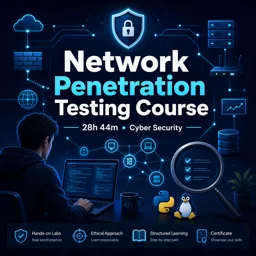
Duration of the online course: 28 hours and 44 minutes
New
Launch your pentesting skills with a free course on network attacks, scanning and AD basics—practice real techniques and boost your cybersecurity career fast.
Build job-ready skills in network penetration testing by learning how attackers think and how defenders can validate real risk. This free online course guides you from essential foundations to hands-on techniques used in real engagements, helping you develop the confidence to assess networks methodically rather than guessing your way through tools. Along the way, you will strengthen the practical habits that matter in security work, such as keeping clear notes, staying organized during testing, and communicating findings responsibly.
You will start by establishing a solid base with Linux fundamentals and scripting concepts, then use Python to understand automation and why small utilities can accelerate reconnaissance and troubleshooting. As the course advances, you will approach penetration testing as a repeatable process: gathering information, mapping an environment, identifying weaknesses, and moving carefully through verification. The emphasis is on learning how and why techniques work so you can adapt to different targets instead of memorizing steps.
As you progress, you will practice scanning and enumeration workflows that help you discover services, versions, and misconfigurations efficiently, while also learning common ways testers reduce noise and avoid drawing unnecessary attention during assessments. You will explore the difference between external and internal perspectives, understand why scope and intent change the approach, and develop a clearer sense of how real organizations validate exposure across their systems.
The course also brings you into the realities of modern enterprise networks, including Active Directory attack paths and the kinds of issues that turn small weaknesses into major compromises. You will learn the logic behind credential-focused techniques, relays, cracking strategies, token-based abuse, and common misconfigurations that can enable lateral movement and privilege escalation. Concepts are tied to practical lab-style thinking so you can connect actions to outcomes and understand the risks being demonstrated.
Finally, you will see how professional testing is completed: transferring files safely in a lab context, pivoting through network segments, and turning technical discoveries into reporting that stakeholders can act on. You will also learn why Rules of Engagement and clear authorization are critical to ethical security testing. By the end, you will have a stronger foundation for interviews, personal labs, and next-step certifications, with a practical mindset geared toward responsible, measurable cybersecurity improvement.

28 hours and 44 minutes of online video course

Digital certificate of course completion (Free)

Exercises to train your knowledge

100% free, from content to certificate
What tools are covered in this Network Penetration Testing Course?
The course introduces tools such as Nmap, Nessus, Burp Suite, Hashcat, PsExec, and Python-based scripts for scanning, enumeration, exploitation, and reporting.
Does the course include Active Directory penetration testing techniques?
Yes. It covers building an Active Directory lab, LLMNR poisoning, NTLM relay, pass-the-hash, token impersonation, Kerberoasting, GPP passwords, and privilege escalation concepts.
What is the purpose of rules of engagement in a penetration test?
Rules of engagement define the authorized scope, targets, testing methods, schedule, communication process, and safety limits for a penetration test.
Ready to get started?Download the app and get started today.
Install the app now
to access the course
Over 5,000 free courses
Programming, English, Digital Marketing and much more! Learn whatever you want, for free.

Study plan with AI
Our app's Artificial Intelligence can create a study schedule for the course you choose.

From zero to professional success
Improve your resume with our free Certificate and then use our Artificial Intelligence to find your dream job.
You can also use the QR Code or the links below.



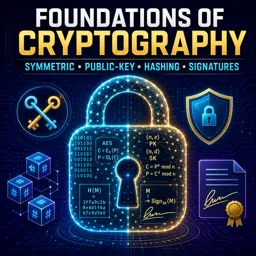
Free CourseFoundations of Cryptography: Symmetric, Public-Key, Hashing and Signatures
5

(1)

32h51m

57 exercises
Free CourseInformation Security Management Fundamentals
5
(8)
2h55m
15 exercises
Free CourseAdvanced Topics in Cryptography
5
(2)
22h34m
9 exercises

Free CourseComputer systems security
4.8
(151)
29h44m
20 exercises
Free CourseIT Security
4.8
(19)
15h04m
18 exercises

Free CourseInformation security lessons
4.8
(49)
7h15m
11 exercises
Free CourseCyber security
4.8
(376)
2h07m
24 exercises

Free CourseCyber Security Masterclass
4.6

(22)
1h36m
6 exercises
Free CourseIntroduction to Cybersecurity
4.6
(18)
7h43m
6 exercises
Free CourseCompTIA Security course
4.4
(5)
26h11m
41 exercises
Carry knowledge in your pocket.
Download the Cursa app.
There are hundreds of free courses available, with a free certificate of completion that is saved in your mobile image gallery.
Download the app to access the Course Completion Certificate for Free.


+ 10 million
students

Free and Valid
Certificate

60 thousand free
exercises

4.8/5 rating in
app stores

Free courses in
video and ebooks