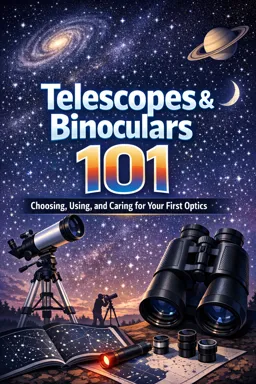

A free ebook on choosing, setting up, using, and caring for beginner telescopes and binoculars for astronomy.
Free ebook content
-

Telescopes & Binoculars 101: What Each Tool Is Best For
+ Exercise: You want the easiest way to locate a deep-sky object and confirm you’re pointed at the correct star field before switching to higher detail viewing. What approach best matches this goal?
-
Optics Basics for Choosing Your First Telescope: Aperture, Focal Length, and F-Ratio
+ Exercise: If you want a brighter and more comfortable view for wide-field scanning, which eyepiece choice is most likely to help by producing a larger exit pupil (assuming the same telescope)?
-
Refractor Telescopes: Strengths, Limitations, and Best Beginner Setups
+ Exercise: A beginner wants a low-cost refractor setup mainly for casual visual observing at low-to-medium magnification. Which approach best matches that goal?
-
Reflector Telescopes (Newtonians and Dobsonians): Maximum Aperture per Dollar
+ Exercise: Which statement best explains why Newtonian reflector telescopes often offer “maximum aperture per dollar” compared with many refractors?
-
Catadioptric Telescopes (SCTs and Maks): Compact Power with Specific Trade-offs
+ Exercise: Why does a compact SCT/Mak often show a narrower true field of view with the same eyepiece than a shorter-focal-length telescope?
-
Binoculars for Astronomy: Specs That Matter and How to Use Them Well
+ Exercise: You are choosing binoculars for astronomy in a light-polluted area and want a view that stays fairly bright without making the sky background overly washed out. Which exit pupil range best matches this goal?


-
Mounts and Tripods: Stability First, Then Convenience
+ Exercise: During a simple stability test, which result most strongly indicates the mount is limiting what you can see and track?
-
Eyepieces and Accessories: Building a Useful Kit Without Overbuying
+ Exercise: When planning a basic eyepiece kit to avoid overbuying, what is the recommended way to choose magnifications?
-
Setup and Alignment: From Unboxing to First Light
+ Exercise: When aligning a finder during daylight, what is the correct sequence to ensure the finder and main telescope point to the same target?
-
Observing Skills: Focusing, Seeing Conditions, and Getting Sharper Views
+ Exercise: While focusing on a star at high magnification, the star never becomes a steady point and instead seems to “boil” and swell even when you think you hit best focus. What is the most likely cause?
-
Realistic Targets by Budget and Aperture: What You Can Expect to See
+ Exercise: If you observe from a bright urban location, which target type is most likely to remain satisfying because it cuts through light pollution better than diffuse nebulae and galaxies?
-
Care and Storage: Cleaning Optics Safely and Preventing Damage
+ Exercise: Which approach best reduces the risk of scratching coated optics when cleaning a lens or corrector plate?
-
Collimation and Troubleshooting: Keeping Your Views Crisp
+ Exercise: A Newtonian telescope reaches focus, but planetary detail looks mushy and a star test shows slightly off-center diffraction rings. What is the most appropriate next step to improve on-axis sharpness?
About the free ebook
Telescopes & Binoculars 101: Choosing, Using, and Caring for Your First Optics
Start exploring the night sky with confidence. This free ebook explains how telescopes and binoculars work, what their specifications mean, and how to choose equipment that suits your observing goals, space, and budget.
Make an informed first purchase
Learn the practical differences between refractors, reflectors, Dobsonians, Schmidt-Cassegrains, Maksutovs, and astronomy binoculars. Clear explanations of aperture, focal length, and focal ratio help you compare optical systems without being distracted by inflated magnification claims.
- Match an instrument to the Moon, planets, star clusters, nebulae, and galaxies.
- Understand why a stable mount is as important as the telescope tube.
- Choose useful eyepieces and accessories while avoiding unnecessary purchases.
Get sharper views from your first night out
Good observing is more than pointing upward. Discover how setup, alignment, focusing, sky darkness, atmospheric seeing, and realistic expectations affect every view. The ebook also explains what different apertures can reveal, helping you plan rewarding sessions with the equipment you own.
Protect your optics and keep them performing well
Use safe routines for storage, transport, and cleaning. Find out when optical surfaces should be cleaned, how to prevent damage from dust and moisture, and how collimation can restore crisp images in reflector telescopes.
A practical astronomy reference
Whether you are comparing your first telescope with binoculars or improving a basic setup, this guide gives you a sound foundation for making careful choices and enjoying the sky for years to come.
What telescope specification matters most for seeing faint objects?
Aperture matters most because a larger objective gathers more light and reveals fainter targets.
Are binoculars useful for astronomy?
Yes. Binoculars provide wide fields of view that work well for the Moon, star fields, clusters, and bright deep-sky objects.
How often should a reflector telescope be collimated?
Check collimation after transport and whenever stars no longer focus into sharp, symmetrical points.
This ebook includes:

13 content chapters

Digital certificate of course completion (Free)

Exercises to train your knowledge

100% free, from content to certificate
Ready to get started?

 recommended
In the app you will also find...

Over 5,000 free courses
Programming, English, Digital Marketing and much more! Learn whatever you want, for free.

Study plan with AI
Our app's Artificial Intelligence can create a study schedule for the course you choose.

From zero to professional success
Improve your resume with our free Certificate and then use our Artificial Intelligence to find your dream job.
You can also use the QR Code or the links below.