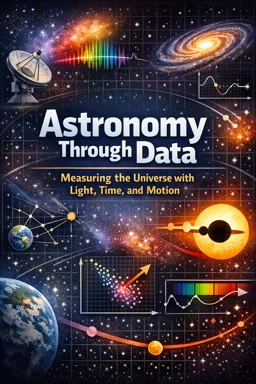


A free ebook on using light, time, spectra, and motion to measure stars, exoplanets, distances, and galaxies.
Free ebook content
-

From Observations to Measurements: Turning Light Into Numbers
+ Exercise: In an imaging calibration pipeline, what is the main purpose of dividing a bias and dark corrected science image by a normalized flat field?
-
Working With Astronomical Data: Tables, Units, Plots, and Uncertainty
+ Exercise: When combining measurements with different uncertainties, what is the main purpose of using weights like 1/sigma^2?
-
Spectra as Physical Evidence: Composition, Temperature, and Stellar Properties
+ Exercise: When estimating a star’s effective temperature from a spectrum’s continuum, what is a key reason to mask strong spectral lines during the fit?


-
Distances With Geometry: Parallax and its Practical Limits
+ Exercise: Which situation best explains why a parallax-based distance can become unreliable even if the geometric method is correct?
-
Distances With Brightness: Standard Candles and the Distance Ladder Logic
+ Exercise: Which scenario best illustrates why overlap between rungs is valuable in a brightness-based distance ladder?
-
Light Curves as Signals: Variability, Noise, and Period Finding
+ Exercise: A light curve shows mostly flat brightness with repeating narrow dips. Which period-finding approach is most appropriate and why?
-
Detecting Exoplanets With Transits: Radius Estimates From Real Light Curves
+ Exercise: When estimating a planet radius ratio from a transit light curve, what is the main effect of extra contaminating light in the photometric aperture if it is not corrected?
-
Mapping Stellar Populations: Building and Interpreting a Hertzsprung–Russell Diagram
+ Exercise: In a color–magnitude diagram, what pattern of movement best describes how extinction affects a stars plotted position?
-
Motion Along the Line of Sight: Doppler Shifts and Radial Velocities
+ Exercise: In a radial-velocity measurement, why is cross-correlation with a template often preferred over measuring the center of a single spectral line?
-
Motion Across the Sky: Proper Motion, Tangential Speed, and Reference Frames
+ Exercise: In small-field imaging, what is the main reason a measured proper motion can differ from an ICRS-tied (absolute) proper motion?
-
Galaxies in Motion: Measuring Redshift and Estimating Recession Speed
+ Exercise: Why is it recommended to measure a galaxy redshift using multiple spectral lines instead of relying on a single line?
About the free ebook
Astronomy Through Data: Measuring the Universe with Light, Time, and Motion
This free ebook introduces astronomy as a science of measurement. Learn how astronomers transform faint points of light, changing brightness, spectral patterns, and apparent motion into evidence about stars, planets, and galaxies.
Read the Sky as Data
Observations become useful when they are recorded in consistent units, displayed in clear plots, and interpreted with attention to uncertainty. The ebook develops practical habits for examining astronomical tables and graphs, recognizing noise, comparing measurements, and deciding what a dataset can genuinely support.
Connect Measurements to Physical Properties
Discover how spectra reveal composition and temperature, how geometric and brightness-based methods estimate cosmic distance, and how light curves expose changing objects. You will also examine how transit dips can indicate exoplanet size and how stellar populations can be interpreted through a Hertzsprung–Russell diagram.
Measure Motion Beyond Earth
Light carries evidence of movement. By working with Doppler shifts, radial velocity, proper motion, and galaxy redshift, you will see how astronomers distinguish motion along the line of sight from motion across the sky and estimate recession speeds.
Build Evidence-Based Conclusions
The final activities emphasize reproducible workflows, error bars, and self-checks. Rather than treating astronomical images as distant scenery, this ebook helps you approach them as measurable signals and form conclusions that match the strength of the available evidence.
- Interpret observations using units, plots, and uncertainty.
- Use light, time, and motion as astronomical evidence.
- Evaluate measurements with clear, repeatable methods.
How does parallax measure the distance to a star?
It uses a star's apparent shift against distant background stars as Earth moves around the Sun.
What can a stellar spectrum reveal?
Spectral lines can reveal chemical composition, temperature, and motion along the line of sight.
How are exoplanets detected with transit light curves?
A planet causes a small, repeating dip in a star's brightness when it passes in front of the star.
This ebook includes:

12 content chapters

Digital certificate of course completion (Free)

Exercises to train your knowledge

100% free, from content to certificate
Ready to get started?

 recommended
In the app you will also find...

Over 5,000 free courses
Programming, English, Digital Marketing and much more! Learn whatever you want, for free.

Study plan with AI
Our app's Artificial Intelligence can create a study schedule for the course you choose.

From zero to professional success
Improve your resume with our free Certificate and then use our Artificial Intelligence to find your dream job.
You can also use the QR Code or the links below.