Hubble’s law states that a galaxy’s recession velocity is proportional to its distance: v = H₀d, where H₀ is the Hubble constant.

Duration of the online course: 19 hours and 52 minutes
New
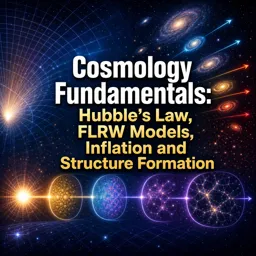
Understand the expanding universe with this free cosmology course: Hubble’s law, FLRW models, redshift, inflation and structure formation—start today.
Turn big cosmological ideas into concepts you can calculate and explain. This free online astronomy course builds a clear path from the discovery of cosmic expansion to the models that describe our universe on the largest scales. You will develop intuition for what observations actually measure, why galaxies appear to recede, and how the language of modern cosmology connects distances, time and the geometry of space.
You begin with the practical foundations needed to talk about the universe with precision: units, dimensions and the meaning of key measurable quantities. From there, Hubble’s law becomes more than a historical statement, helping you relate recession velocity to distance and interpret what expansion implies rather than assume it. With a Newtonian approach as a bridge, you see how a dust-filled universe can already suggest the basic dynamics of cosmic evolution.
Next, the course moves into the relativistic framework that underpins contemporary cosmology. You will review the essential ideas of general relativity and then work with the FLRW metric, the central tool for describing a homogeneous and isotropic universe. This is where expansion histories, matter versus radiation domination, and special cases such as the Milne universe become coherent stories about how different ingredients shape cosmic time.
Observational cosmology takes center stage as you connect theory to data. You will learn how redshift relates to the scale factor, how horizons constrain what can be observed, and how conformal diagrams clarify causal structure. You will also build understanding of distance measures, angular sizes, luminosity, number counts and what these observations reveal about composition and the thermal history of the universe.
Finally, you will explore the early universe and the origin of structure. Inflation is treated as a physical idea with consequences you can reason through, alongside a glimpse of modified gravity via f(R) models. You then examine gravitational instability in both Newtonian terms and within general relativity, linking tiny primordial inhomogeneities to the large-scale structure seen today. By the end, you will be able to read popular explanations more critically and follow technical discussions with far greater confidence.

19 hours and 52 minutes of online video course

Digital certificate of course completion (Free)

Exercises to train your knowledge

100% free, from content to certificate
How does Hubble’s law relate galaxy recession speed to distance?
Hubble’s law states that a galaxy’s recession velocity is proportional to its distance: v = H₀d, where H₀ is the Hubble constant.
What is the FLRW metric used for in cosmology?
The FLRW metric models a homogeneous, isotropic expanding universe and provides the basis for standard relativistic cosmology.
How do inflation and gravitational instability explain cosmic structure formation?
Inflation stretches tiny early-universe fluctuations to large scales, while gravitational instability amplifies them into galaxies, clusters, and cosmic-web structure.
Ready to get started?Download the app and get started today.
Install the app now
to access the course
Over 5,000 free courses
Programming, English, Digital Marketing and much more! Learn whatever you want, for free.

Study plan with AI
Our app's Artificial Intelligence can create a study schedule for the course you choose.

From zero to professional success
Improve your resume with our free Certificate and then use our Artificial Intelligence to find your dream job.
You can also use the QR Code or the links below.



Free CourseAstronomy 101 complete lessons
5

(4)

9h07m

12 exercises
Free CourseCosmology
5
(1)
5h18m
17 exercises
Free CourseExoplanets and the search for Life in the Universe
5
(1)
49m
6 exercises
Free CourseIntroduction to Astronomy - Solar System, Stars and Cosmology
5
(2)
25h55m
49 exercises
Free CourseRocket Science for Everyone
5
(1)
3h31m
23 exercises
Free CourseAstronomy
4.7

(58)
2h56m
24 exercises
Free CourseHow the Universe works
4.7
(7)
43m
8 exercises
Free CourseGeneral Astronomy
New
15h56m
29 exercises
Free CourseDescriptive Astronomy: From Orbits to the Big Bang
New
19h21m
23 exercises
Carry knowledge in your pocket.
Download the Cursa app.
There are hundreds of free courses available, with a free certificate of completion that is saved in your mobile image gallery.
Download the app to access the Course Completion Certificate for Free.


+ 10 million
students

Free and Valid
Certificate

60 thousand free
exercises

4.8/5 rating in
app stores

Free courses in
video and ebooks