The Dark Energy Survey maps galaxies, supernovae, and gravitational lensing to investigate why the universe’s expansion is accelerating.

Duration of the online course: 5 hours and 18 minutes
5

(1)
Explore how the universe works—Big Bang, dark matter, and gravitational waves—in a free online course with quizzes and a certificate option.
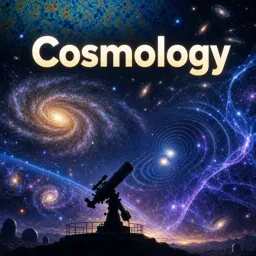
Cosmology is the story of everything: how space and time began, how matter gathered into galaxies, and why the universe’s expansion appears to be speeding up. This free online course is a guided tour through the big ideas and the real observations that shaped modern astronomy, helping you build an intuitive, evidence-based view of the cosmos—from the first fractions of a second to the largest structures we can map today.
You will connect classic questions such as what happened at the Big Bang or how far the universe extends with the measurements scientists actually use to answer them. Along the way, you’ll see why the cosmic microwave background matters, what inflation tries to explain about the early universe, and how cosmologists test competing explanations rather than relying on speculation. The lessons are designed to make complex concepts feel grounded, using clear explanations that emphasize what we know, what we infer, and what remains genuinely mysterious.
The course also highlights how discovery happens in practice through major instruments and surveys. You’ll encounter the Dark Energy Survey and learn why mapping billions of light years can reveal clues about dark energy and the growth of cosmic structure. You’ll also explore how advanced telescope cameras—built for extremely precise measurements—help researchers track subtle signals in the sky, from patterns imprinted soon after the universe became transparent to the explosive counterparts of gravitational wave events.
Modern cosmology is not only about distant galaxies; it also sits at the intersection of particle physics and gravity. The course introduces the puzzle of quantum gravity, explains why gravity is treated differently from the forces in the Standard Model, and shows how ideas about dark matter and dark energy emerged from observations that didn’t fit ordinary matter alone. Short exercises reinforce key takeaways, so you can check your understanding as you go and leave with a sharper sense of how today’s best evidence supports the leading cosmological model—without glossing over its open questions.

Explore free online Cosmology courses and discover how the universe began, evolved, and continues to expand. Study the Big Bang, dark matter, dark energy, galaxies, relativity, and modern astrophysics at your own pace. These flexible courses are free and include a certificate, helping you build valuable knowledge and showcase your achievement.

Explore free online Dark Energy courses and earn a certificate while learning about cosmic acceleration, cosmology, the expanding universe, observational evidence, and leading theories. Study at your own pace with accessible lessons from trusted educators, build valuable astronomy skills, and deepen your understanding of one of the universe's greatest mysteries.

Discover free online courses on Black Holes that include a certificate. Learn about event horizons, singularities, spacetime, gravity, Hawking radiation, and groundbreaking astrophysics discoveries. Study at your own pace with engaging lessons from trusted educators, expand your astronomy knowledge, and explore the science behind the universe's most mysterious objects.

5 hours and 18 minutes of online video course

Digital certificate of course completion (Free)

Exercises to train your knowledge

100% free, from content to certificate
What does the Dark Energy Survey study across billions of light-years of space?
The Dark Energy Survey maps galaxies, supernovae, and gravitational lensing to investigate why the universe’s expansion is accelerating.
What is the cosmic microwave background and why is it important?
The cosmic microwave background is faint radiation left from the early universe, providing a snapshot of conditions shortly after the Big Bang.
How do neutron-star collisions help astronomers study gravitational waves?
They produce gravitational-wave signals and often electromagnetic light, allowing telescopes to locate and study the explosive aftermath.
Ready to get started?Download the app and get started today.
Install the app now
to access the course
Over 5,000 free courses
Programming, English, Digital Marketing and much more! Learn whatever you want, for free.

Study plan with AI
Our app's Artificial Intelligence can create a study schedule for the course you choose.

From zero to professional success
Improve your resume with our free Certificate and then use our Artificial Intelligence to find your dream job.
You can also use the QR Code or the links below.



Free CourseAstronomy 101 complete lessons
5
(4)

9h07m

12 exercises
Free CourseExoplanets and the search for Life in the Universe
5
(1)
49m
6 exercises
Free CourseIntroduction to Astronomy - Solar System, Stars and Cosmology
5
(2)
25h55m
49 exercises
Free CourseRocket Science for Everyone
5
(1)
3h31m
23 exercises
Free CourseAstronomy
4.7

(58)
2h56m
24 exercises
Free CourseHow the Universe works
4.7
(7)
43m
8 exercises
Free CourseGeneral Astronomy
New
15h56m
29 exercises
Free CourseCosmology Fundamentals: Hubble’s Law, FLRW Models, Inflationand Structure Formation
New
19h52m
1 exercises
Free CourseDescriptive Astronomy: From Orbits to the Big Bang
New
19h21m
23 exercises
Carry knowledge in your pocket.
Download the Cursa app.
There are hundreds of free courses available, with a free certificate of completion that is saved in your mobile image gallery.
Download the app to access the Course Completion Certificate for Free.


+ 10 million
students

Free and Valid
Certificate

60 thousand free
exercises

4.8/5 rating in
app stores

Free courses in
video and ebooks