A planet sweeps out equal areas in equal times, so it moves faster when nearer the Sun and slower when farther away.

Duration of the online course: 19 hours and 21 minutes
New
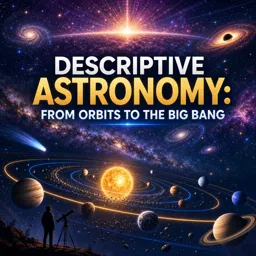
Build real astronomy skills in a free online course: explore orbits, stars, galaxies, black holes, and the Big Bang with bite-sized quizzes and learning support.
If you have ever looked up at the night sky and wondered how astronomers know what they know, this course offers a clear, welcoming path from familiar observations to the biggest ideas in modern science. You will build a descriptive, evidence-based understanding of the universe, learning to connect what we see through telescopes to the physical laws that shape planets, stars, and galaxies.
You will start with motion in the sky and the logic of orbits, developing intuition for how gravity organizes solar systems. From there, you will see how astronomers extract information from faint light using practical methods such as spectroscopy and Doppler shifts, turning color and line patterns into clues about composition, temperature, and motion. Along the way, you will develop confidence reading the kinds of arguments astronomers use, where observations, measurement, and model-building work together.
As you move outward in scale, you will trace the formation and structure of our solar system, compare inner worlds and giant planets, and understand the role of smaller bodies like asteroids and comets. You will also explore our Sun as a representative star, linking what happens at its visible surface to the deeper processes that power it over billions of years. This foundation sets you up to interpret starlight, make sense of stellar lifecycles, and see how clusters and diagrams reveal age and evolution.
The course then expands to dramatic endpoints such as white dwarfs, supernovae, and black holes, clarifying the role of spacetime and extreme gravity without losing sight of the observational evidence behind these ideas. You will step into the structure of the Milky Way, the behavior of galaxies and quasars, and the patterns captured by Hubble’s law. Finally, you will tie it all together with the Big Bang model, the cosmic microwave background, and a thoughtful look at life in the universe and the Fermi paradox. Short exercises throughout help you check understanding and turn big concepts into usable knowledge you can apply to new astronomical questions.

19 hours and 21 minutes of online video course

Digital certificate of course completion (Free)

Exercises to train your knowledge

100% free, from content to certificate
What does Kepler's second law say about a planet's orbital motion?
A planet sweeps out equal areas in equal times, so it moves faster when nearer the Sun and slower when farther away.
How do astronomers detect exoplanets using the radial velocity method?
They measure tiny Doppler shifts in a star's spectrum as an orbiting planet makes the star wobble toward and away from Earth.
What is the cosmic microwave background in the Big Bang model?
It is faint microwave radiation left over from the early universe, released when the universe became transparent to light.
Ready to get started?Download the app and get started today.
Install the app now
to access the course
Over 5,000 free courses
Programming, English, Digital Marketing and much more! Learn whatever you want, for free.

Study plan with AI
Our app's Artificial Intelligence can create a study schedule for the course you choose.

From zero to professional success
Improve your resume with our free Certificate and then use our Artificial Intelligence to find your dream job.
You can also use the QR Code or the links below.



Free CourseAstronomy 101 complete lessons
5

(4)

9h07m

12 exercises
Free CourseCosmology
5
(1)
5h18m
17 exercises
Free CourseExoplanets and the search for Life in the Universe
5
(1)
49m
6 exercises
Free CourseIntroduction to Astronomy - Solar System, Stars and Cosmology
5
(2)
25h55m
49 exercises
Free CourseRocket Science for Everyone
5
(1)
3h31m
23 exercises
Free CourseAstronomy
4.7

(58)
2h56m
24 exercises
Free CourseHow the Universe works
4.7
(7)
43m
8 exercises
Free CourseGeneral Astronomy
New
15h56m
29 exercises
Free CourseCosmology Fundamentals: Hubble’s Law, FLRW Models, Inflationand Structure Formation
New
19h52m
1 exercises
Carry knowledge in your pocket.
Download the Cursa app.
There are hundreds of free courses available, with a free certificate of completion that is saved in your mobile image gallery.
Download the app to access the Course Completion Certificate for Free.


+ 10 million
students

Free and Valid
Certificate

60 thousand free
exercises

4.8/5 rating in
app stores

Free courses in
video and ebooks