It analyzes starlight filtered through exoplanet atmospheres, helping detect gases such as water vapor, carbon dioxide, methane, and oxygen-related compounds.

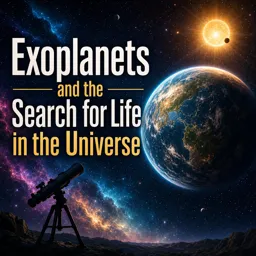
Duration of the online course: 49 minutes
5

(1)
Explore new worlds and learn how scientists detect exoplanets and possible life. Take this free astronomy course online and earn a certificate-worthy skill set.
Thousands of planets have been discovered beyond our solar system, and the question is no longer whether exoplanets exist, but how we can read their faint signals to understand what they are like. This free online course takes you into the heart of one of today’s most exciting scientific frontiers: finding distant worlds and assessing whether any could be habitable. You will build a clear, beginner-friendly understanding of how modern astronomy moved from speculation to evidence, and why the hunt for life has become a testable scientific pursuit.
Through a focused narrative that connects discovery, technology, and big-picture thinking, you will explore why many astronomers are optimistic that signs of life could be detected within our lifetime. You’ll learn what makes an exoplanet a promising target, what kind of clues a planet’s environment can leave in the light we observe, and how researchers weigh competing explanations before claiming anything extraordinary. Along the way, you’ll see how this field extends a long tradition of changing humanity’s place in the cosmos, continuing the shift from a universe centered on Earth to one filled with countless potential homes.
A key theme is how we know what we know. You will become familiar with the observational approaches that have confirmed the vast majority of exoplanets, and what their data can and cannot reveal. You’ll also understand why next-generation instruments matter, especially the James Webb Space Telescope, and how its capabilities bring scientists closer to analyzing atmospheric chemistry on worlds many light-years away. Rather than focusing on memorizing facts, the course helps you think like an astronomer: evaluating evidence, recognizing uncertainty, and appreciating the difference between possibility, probability, and proof.
Designed for curious learners and hobbyists, this astronomy experience fits well whether you are returning to science for fun or looking to strengthen your scientific literacy. By the end, you’ll be able to follow news about exoplanet discoveries with confidence, understand the reasoning behind optimistic predictions, and see why the search for life is one of the most profound and rigorous investigations in modern science.

Explore free online Cosmology courses and discover how the universe began, evolved, and continues to expand. Study the Big Bang, dark matter, dark energy, galaxies, relativity, and modern astrophysics at your own pace. These flexible courses are free and include a certificate, helping you build valuable knowledge and showcase your achievement.

Explore free online Space Exploration courses and earn a certificate while learning about astronomy, rockets, spacecraft, planetary science, satellites, and the future of human spaceflight. Study at your own pace with accessible lessons from leading educators, build valuable skills, and start your journey beyond Earth today.

49 minutes of online video course

Digital certificate of course completion (Free)

Exercises to train your knowledge

100% free, from content to certificate
How does the James Webb Space Telescope help scientists search for life on exoplanets?
It analyzes starlight filtered through exoplanet atmospheres, helping detect gases such as water vapor, carbon dioxide, methane, and oxygen-related compounds.
Which method has confirmed most exoplanets discovered so far?
Most have been confirmed using the transit method, which measures the slight dimming of a star when a planet passes in front of it.
Why are astronomers optimistic that life may exist on planets beyond Earth?
Planets are common around stars, many may lie in habitable zones, and the chemical ingredients for life are widespread in space.
Ready to get started?Download the app and get started today.
Install the app now
to access the course
Over 5,000 free courses
Programming, English, Digital Marketing and much more! Learn whatever you want, for free.

Study plan with AI
Our app's Artificial Intelligence can create a study schedule for the course you choose.

From zero to professional success
Improve your resume with our free Certificate and then use our Artificial Intelligence to find your dream job.
You can also use the QR Code or the links below.



Free CourseAstronomy 101 complete lessons
5
(4)

9h07m

12 exercises
Free CourseCosmology
5
(1)
5h18m
17 exercises
Free CourseIntroduction to Astronomy - Solar System, Stars and Cosmology
5
(2)
25h55m
49 exercises
Free CourseRocket Science for Everyone
5
(1)
3h31m
23 exercises
Free CourseAstronomy
4.7

(58)
2h56m
24 exercises
Free CourseHow the Universe works
4.7
(7)
43m
8 exercises
Free CourseGeneral Astronomy
New
15h56m
29 exercises
Free CourseCosmology Fundamentals: Hubble’s Law, FLRW Models, Inflationand Structure Formation
New
19h52m
1 exercises
Free CourseDescriptive Astronomy: From Orbits to the Big Bang
New
19h21m
23 exercises
Carry knowledge in your pocket.
Download the Cursa app.
There are hundreds of free courses available, with a free certificate of completion that is saved in your mobile image gallery.
Download the app to access the Course Completion Certificate for Free.


+ 10 million
students

Free and Valid
Certificate

60 thousand free
exercises

4.8/5 rating in
app stores

Free courses in
video and ebooks