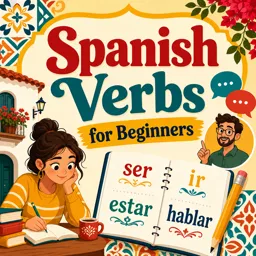

Free ebook on Spanish verb patterns, tenses, subjunctive triggers, stem changes, and practice methods for accurate communication.
Free ebook content
-

Verb Pattern Framework: How Spanish Conjugation Systems Repeat
+ Exercise: In the verb pattern framework, which sequence best describes the layers you identify to predict a Spanish verb form?
-
Present Tense Mastery Through High-Frequency Verbs and Regular Endings
+ Exercise: Which principle best explains why Spanish often omits subject pronouns in the present tense?
-
Stem-Changing Verbs: Recognizing and Applying E→IE, O→UE, and E→I Patterns
+ Exercise: Which option correctly applies the present indicative stress rule for stem-changing verbs?


-
Preterite vs Imperfect: Decision Rules for Past Narration and Description
+ Exercise: In the narration pattern ongoing action plus sudden interruption, which pairing best follows the tense decision rules?
-
Preterite Pattern Sets: Common Irregulars, Spelling Changes, and Sound-Based Rules
+ Exercise: Which sentence correctly applies the preterite spelling-change rule for -car verbs in the yo form?
-
Imperfect Patterns: Habit, Background, and Ongoing Action Structures
+ Exercise: Which sentence best uses the imperfect progressive pattern to emphasize an action in progress at a specific past moment?
-
Perfect Tenses: Building Meaning with Haber + Past Participle
+ Exercise: Which statement best explains how Spanish perfect tenses express meaning?
-
Subjunctive Foundations: Forming the Present Subjunctive from Reliable Patterns
+ Exercise: Which workflow correctly forms the present subjunctive for most verbs?
-
Subjunctive Triggers: Emotion, Doubt, Desire, and Impersonal Expressions
+ Exercise: Which sentence correctly applies the rule that a negative belief expression triggers the subjunctive in the subordinate clause?
-
Moods in Contrast: Indicative vs Subjunctive in Real Communication
+ Exercise: Which sentence best follows the assertion test by using subjunctive because the speaker is not presenting the second clause as a fact?
-
Periphrastic Constructions: High-Frequency Verb Phrases for Fluent Output
+ Exercise: Which sentence correctly follows the key rule of periphrastic constructions that only the first verb is conjugated and the second verb stays non-finite?
-
Spaced Practice Sets: Retrieval Scheduling for Long-Term Verb Accuracy
+ Exercise: What is the best next step after completing a closed-book retrieval round in a spaced practice set for Spanish verb accuracy?
-
Translation Drills: Converting Meaning to Structure Without Word-for-Word Dependence
+ Exercise: In meaning-to-structure translation drills, what is the recommended order for producing a Spanish sentence?
-
Conversation Prompts: Producing Tense and Mood Choices in Context
+ Exercise: When responding to a conversation prompt, what is the main purpose of adding an expansion like porque, pero, así que, or a follow-up question?
-
Error Patterns and Self-Correction: Diagnosing Mistakes to Strengthen Rules
+ Exercise: When you review a recurring Spanish verb mistake, what is the best way to record it in Step 1 of the self-correction loop to make diagnosis easier?
About the free ebook
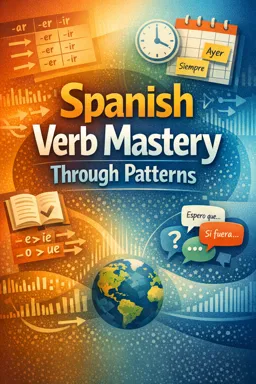
Spanish Verb Mastery Through Patterns: Tenses, Moods, and High-Frequency Structures
This free ebook teaches Spanish verbs through repeatable patterns rather than isolated memorization. Learn to recognize how endings, stem changes, auxiliary verbs, and common structures work together so you can choose forms with greater confidence.
Build reliable tense and mood choices
Practice high-frequency present-tense verbs, regular endings, and the major stem-changing patterns: e→ie, o→ue, and e→i. Clear decision rules help distinguish the preterite from the imperfect when telling stories, describing background situations, or expressing habitual actions.
The ebook also explores preterite irregulars, spelling changes, sound-based rules, and perfect tenses formed with haber + past participle. These connected patterns make verb forms easier to recall and apply.
Use the subjunctive in meaningful contexts
Learn a practical approach to forming the present subjunctive and identifying common triggers related to emotion, doubt, desire, and impersonal expressions. Contrast indicative and subjunctive choices in realistic communication to understand how each mood changes meaning.
Move from rules to fluent output
High-frequency periphrastic constructions help you express actions such as intentions, obligations, and ongoing events. Translation drills and conversation prompts encourage you to produce Spanish by meaning and context instead of relying on word-for-word translation.
Strengthen accuracy through targeted practice
- Recognize recurring conjugation patterns.
- Choose past tenses using clear context clues.
- Apply subjunctive triggers with more precision.
- Use spaced retrieval to retain verb forms.
- Diagnose frequent errors and self-correct effectively.
Use this free ebook as a structured reference and practice companion for building a more accurate, flexible Spanish verb system.
How do I choose between the Spanish preterite and imperfect?
Use the preterite for completed events and the imperfect for habits, descriptions, background, or ongoing past actions.
What are the main Spanish stem-changing verb patterns?
The most common patterns are e→ie, o→ue, and e→i, which affect the stem in specific conjugated forms.
How is the present subjunctive formed in Spanish?
Start with the present-tense yo form, remove the ending, and add the opposite set of present-tense endings.
This ebook includes:

15 content chapters

Digital certificate of course completion (Free)

Exercises to train your knowledge

100% free, from content to certificate
Ready to get started?

 recommended
In the app you will also find...

Over 5,000 free courses
Programming, English, Digital Marketing and much more! Learn whatever you want, for free.

Study plan with AI
Our app's Artificial Intelligence can create a study schedule for the course you choose.

From zero to professional success
Improve your resume with our free Certificate and then use our Artificial Intelligence to find your dream job.
You can also use the QR Code or the links below.