Use ser for identity, origin, characteristics, and main professions; use estar for location, temporary states, and temporary work roles.

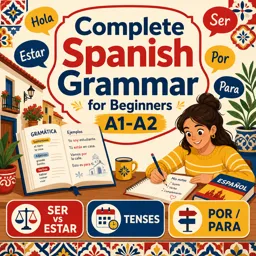
Duration of the online course: 4 hours and 8 minutes
4.7


(3)
Build real Spanish skills fast with this free grammar course: present to past tenses, ser/estar, por/para, and practice quizzes for A1–A2 progress.
Getting started with Spanish is exciting, but grammar can feel like the barrier between recognizing words and actually speaking with confidence. This beginner-friendly A1–A2 course helps you turn scattered knowledge into clear, usable structure so you can form sentences, understand what you hear, and express yourself more naturally in everyday situations.
You will strengthen the essentials of the present tense, including how regular verb endings work and the small but important spelling changes that appear in certain verb groups. You will also learn how stem-changing verbs behave and, crucially, when they do not change. With this foundation, common conversations become easier: talking about routines, preferences, and basic descriptions without constantly second-guessing the verb form.
As you move forward, you will tackle core building blocks that typically confuse beginners, such as expressing possession and choosing between ser and estar depending on meaning and context. Instead of memorizing isolated rules, you will develop practical intuition for identity versus condition, permanent traits versus temporary states, and how Spanish communicates nuance that English often handles differently.
Past and future communication is a major milestone at this level, so the course guides you through the preterite and imperfect in a way that helps you choose the right tense for real messages: completed actions, background descriptions, habits, and ongoing situations. You will also gain control over expressing plans and possibilities with the future and conditional, making it easier to talk about what you will do, what could happen, and what you would do in a given situation.
Throughout the learning path, short checks for understanding reinforce key points and help you spot patterns. By the end, you should feel more confident reading and listening at a beginner level and more capable of writing and speaking with accurate, flexible grammar that supports real communication.

Explore free online Spanish A1 courses designed for complete beginners. Build essential vocabulary, master basic grammar, improve pronunciation, and practice everyday conversations at your own pace. Each course includes a certificate, helping you demonstrate your new language skills and start your journey toward speaking Spanish with confidence.

Explore free online Spanish grammar courses designed to help beginners and advanced learners master verb conjugation, sentence structure, tenses, pronouns, adjectives, and more. Learn at your own pace, strengthen your speaking and writing skills, and earn a certificate with every course to showcase your Spanish language progress.

4 hours and 8 minutes of online video course

Digital certificate of course completion (Free)

Exercises to train your knowledge

100% free, from content to certificate
What is the difference between ser and estar in Spanish?
Use ser for identity, origin, characteristics, and main professions; use estar for location, temporary states, and temporary work roles.
Which Spanish verbs are irregular in the imperfect tense?
The three irregular imperfect verbs are ir, ser, and ver.
How do por and para differ in Spanish?
Para commonly expresses purpose, destination, or a deadline, while por often expresses cause, exchange, movement through a place, or duration.
Ready to get started?Download the app and get started today.
Install the app now
to access the course
Over 5,000 free courses
Programming, English, Digital Marketing and much more! Learn whatever you want, for free.

Study plan with AI
Our app's Artificial Intelligence can create a study schedule for the course you choose.

From zero to professional success
Improve your resume with our free Certificate and then use our Artificial Intelligence to find your dream job.
You can also use the QR Code or the links below.



Free CourseSpanish for Beginners: Essential Grammar and Vocabulary (Season 1)
5
(6)

5h23m

20 exercises
Free CourseSpanish for Kids
5
(3)
53m
Free CourseSpanish course A2
5
(4)
11h23m
Free CourseSpanish Verbs for beginners
5
(3)
3h42m
15 exercises
Free CourseSpanish course A1
4.8
(11)
10h51m
6 exercises
Free CourseSpanish
4.8
(405)
6h22m
11 exercises
Free CourseSpanish full course B1
4.8
(5)
1h29m
15 exercises
Free CourseSpanish
4.7
(56)
8h55m
27 exercises
Free CourseLearn Spanish Naturally
4.7
(172)
4h54m
5 exercises
Free CourseSpanish lessons complete
4.6
(8)
24h52m
23 exercises
Carry knowledge in your pocket.
Download the Cursa app.
There are hundreds of free courses available, with a free certificate of completion that is saved in your mobile image gallery.
Download the app to access the Course Completion Certificate for Free.


+ 10 million
students

Free and Valid
Certificate

60 thousand free
exercises

4.8/5 rating in
app stores

Free courses in
video and ebooks
Course comments: Complete Spanish Grammar for Beginners A1-A2
Mahamoudabdi Muhumed1
7