
Use ser for identity and permanent characteristics, estar for states and locations, and hay to say that something exists or is present.

Duration of the online course: 3 hours and 50 minutes
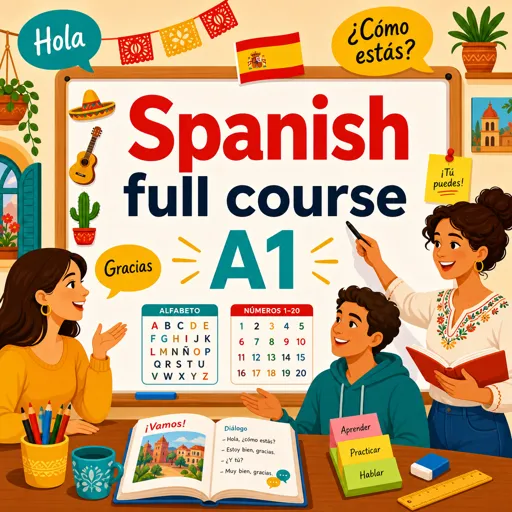
Speak Spanish with confidence from day one—free online course with A1 basics, pronunciation, listening practice and everyday phrases to get you communicating fast.
Start understanding and speaking Spanish from the very first lessons with a practical A1 pathway designed for true beginners. This free online course focuses on the language you actually need to communicate: introduce yourself, greet people naturally, ask for information, talk about routines, describe places and things, and handle simple everyday situations with clarity.
You will build a solid foundation step by step, starting with pronunciation and the alphabet, then moving into the core structures that make Spanish click. Along the way you’ll get comfortable forming simple sentences, using essential verbs in the present tense, and choosing between key forms like ser, estar and hay. You’ll also gain control of articles, gender and agreement, demonstratives and possessives, prepositions, numbers, and useful qualifiers such as muy and mucho so your Spanish sounds accurate and natural.
To help you progress beyond isolated words, the course includes listening and reading practice that mirrors real contexts: shopping, the weather, family, daily habits, restaurants, directions and travel-style conversations. These activities train your ear, expand vocabulary in context, and help you respond faster without translating every phrase in your head.
By the end, you’ll be able to participate in basic conversations, understand common questions, and talk about yourself and your surroundings with greater confidence. Whether you’re learning for travel, work opportunities, or personal growth, this beginner-friendly program gives you structure, repetition, and practical practice so you can keep improving after A1 with a strong base.

3 hours and 50 minutes of online video course

Digital certificate of course completion (Free)

Exercises to train your knowledge

100% free, from content to certificate
What is the difference between ser, estar, and hay in Spanish?
Use ser for identity and permanent characteristics, estar for states and locations, and hay to say that something exists or is present.
When do I use me gusta versus me gustan in Spanish?
Use me gusta with a singular noun or infinitive verb, and me gustan with plural nouns.
How do you ask for directions in Spanish?
Useful questions include “¿Dónde está...?” (Where is...?) and “¿Cómo llego a...?” (How do I get to...?).
Ready to get started?Download the app and get started today.
Install the app now
to access the course
Over 5,000 free courses
Programming, English, Digital Marketing and much more! Learn whatever you want, for free.

Study plan with AI
Our app's Artificial Intelligence can create a study schedule for the course you choose.

From zero to professional success
Improve your resume with our free Certificate and then use our Artificial Intelligence to find your dream job.
You can also use the QR Code or the links below.



Video Courses
 Ideal for beginners
 recommended
 recommended
 recommended
 recommended
 Ideal for beginners
Interactive tutorials

Describe and understand daily routines using Spanish reflexive verbs. Practice pronoun agreement, common stem changes, natural expressions for personal care, and pronoun placement with infinitives, then write a connected routine of your own.
Start tutorial
Use the Spanish imperfect subjunctive accurately in past reports, hypothetical conditions, wishes, and polite requests. Learn to choose forms and moods according to time, speaker perspective, and communicative intent, then apply them in a coherent Spanish message.
Start tutorial
Learn to greet people, exchange names, respond politely, ask how someone is, and say goodbye in Spanish. By the end, you will be able to take part in a short introduction using casual or polite language.
Start tutorialExercises
Test your use of Spanish demonstratives, including distance, gender, number, neuter forms, pronouns, and modern accent rules.
Start exercisesPon a prueba tu comprensión lectora en español con textos sobre reciclaje, clima, historia, tecnología, salud y naturaleza.
Start exercisesTest your Spanish conversational skills with questions on greetings, polite requests, apologies, gratitude, and everyday phrases.
Start exercisesEbooks and audiobooks
Carry knowledge in your pocket.
Download the Cursa app.
There are hundreds of free courses available, with a free certificate of completion that is saved in your mobile image gallery.
Download the app to access the Course Completion Certificate for Free.


+ 10 million
students

Free and Valid
Certificate

60 thousand free
exercises

4.8/5 rating in
app stores

Free courses in
video and ebooks

Course comments: Spanish for beginners A1 level
Los estudiantes valoraron muy positivamente el curso, con calificaciones de 5 estrellas. Practicaron vocabulario, gramática y expresiones básicas en español mediante actividades sobre colores, ciudades, países, idiomas y presentaciones personales.
Ratu Jihan
1. hay seis palabras en el texto : Amarilla, Azul, Roja, Negra, Gris y Blanca. 2. Inés tiene muchas camisetas azules. 3. Camiseta blanca.
Ratu Jihan
1. Sevilla tiene muchos bares 2. En Sevilla hay pocos restaurantes chinos 3. La gente en Sevilla trabajas muchos. 4. Sevilla es muchas bonitas.
Ratu Jihan
1. En mi país, Indonesia tienen muchos islas, idiomas y tradicionales.
Ratu Jihan
1. En norte de Chile hay un desierto muy seco, el desierto se llama Atacama. 2. 14 millones de personas. 3. Está en Sudamérica y es un país muy largo
Ratu Jihan
Mi ciudad es en Indonesia, es un poco turista pero muy bonito y clásico.
Ratu Jihan
1. Barcelona es en España, esta en el norte del pais.
Ratu Jihan
Yo hablo Indonesia, sundanés muy bien. mi inglés es bastante bien, pero mi español es un poco bien.
Ratu Jihan
Hola, mi nombre es Reina, tengo dieciséis años. Soy un estudiante de secundaria.