
Use ser for identity, origin, nationality, occupation, and lasting traits. Use estar for location and temporary states or conditions.

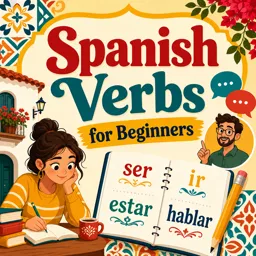
Duration of the online course: 3 hours and 42 minutes
5

(3)
Speak with confidence by mastering Spanish verb tenses and tricky choices like ser vs estar. Free online course with practice for faster progress.
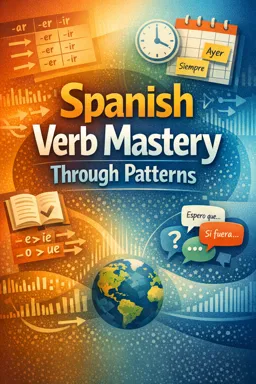
Clear verbs are the difference between knowing Spanish words and actually communicating. This free online course helps beginners build a solid foundation by making Spanish conjugation feel predictable, usable, and easy to practice. You will learn how to form sentences that sound natural in everyday situations, whether you are introducing yourself, talking about where you are, describing how you feel, or explaining what happened in the past.
You will start by untangling one of the biggest beginner challenges: choosing between ser and estar. Instead of relying on confusing rules, you will develop an instinct for when Spanish uses each verb and how meaning changes depending on your choice. From there, you will strengthen your skills with regular -ar, -er, and -ir verbs, so present tense patterns become automatic and you can focus on expressing ideas rather than memorizing endings.
As you progress, the course guides you through common irregularities that learners encounter early on, including high-frequency verbs used in daily conversation. You will also work with stem-changing verbs, helping you recognize what shifts in the verb and when. Past tense is covered with practical emphasis, so you can describe completed actions, tell simple stories, and understand how Spanish talks about permanent characteristics versus temporary states in the past.
To keep learning active, the lessons are paired with questions and exercises that reinforce key decisions and forms. You will also gain confidence with reflexive verbs and meaning-based choices such as saber vs conocer, plus useful verbs that unlock more natural phrasing as your Spanish grows. By the end, you will have a stronger command of core verb systems and a smoother path toward reading, listening, and speaking with real-world accuracy.

3 hours and 42 minutes of online video course

Digital certificate of course completion (Free)

Exercises to train your knowledge

100% free, from content to certificate
What is the difference between ser and estar in Spanish?
Use ser for identity, origin, nationality, occupation, and lasting traits. Use estar for location and temporary states or conditions.
What is the yo form of poner and saber in the Spanish present tense?
The present-tense yo forms are pongo (poner) and sé (saber).
How do reflexive verbs appear in a Spanish dictionary?
They are listed with the pronoun se attached to the infinitive, such as levantarse or vestirse.
Ready to get started?Download the app and get started today.
Install the app now
to access the course
Over 5,000 free courses
Programming, English, Digital Marketing and much more! Learn whatever you want, for free.

Study plan with AI
Our app's Artificial Intelligence can create a study schedule for the course you choose.

From zero to professional success
Improve your resume with our free Certificate and then use our Artificial Intelligence to find your dream job.
You can also use the QR Code or the links below.



Free CourseSpanish for Kids
5
(3)

53m
Free CourseSpanish course A2
5
(4)
11h23m
Free CourseSpanish course A1
4.8
(11)
10h51m

6 exercises
Free CourseSpanish
4.8
(406)
6h22m
11 exercises
Free CourseSpanish full course B1
4.8
(5)
1h29m
15 exercises
Free CourseSpanish for Beginners: Essential Grammar and Vocabulary (Season 1)
4.7

(7)
5h23m
20 exercises
Free CourseSpanish
4.7
(56)
8h55m
27 exercises
Free CourseLearn Spanish Naturally
4.7
(172)
4h54m
5 exercises
Free CourseComplete Spanish Grammar for Beginners A1-A2
4.7
(3)
4h08m
10 exercises
Free CourseSpanish lessons complete
4.6
(8)
24h52m
23 exercises
Carry knowledge in your pocket.
Download the Cursa app.
There are hundreds of free courses available, with a free certificate of completion that is saved in your mobile image gallery.
Download the app to access the Course Completion Certificate for Free.


+ 10 million
students

Free and Valid
Certificate

60 thousand free
exercises

4.8/5 rating in
app stores

Free courses in
video and ebooks
Course comments: Spanish Verbs for beginners
Rahma Cabdiraxmaan Axmed
amazing. I want to learn more Spanish and thank you for your efforts to teach us.