

Free ebook on understanding fast English speech, connected sounds, reductions, rhythm, and common listening patterns.
Free ebook content
-

Spoken English Listening Basics: Why Fast Speech Sounds Different
+ Exercise: When listening to fast spoken English, why can it sound very different from the written sentence even if the speaker uses the same words?
-
Hearing Word Boundaries in Connected Speech
+ Exercise: When listening to fast connected speech, what is the best first step to locate word boundaries within a phrase?
-
Linking Sounds: When Words Connect in Fast English
+ Exercise: In fast, natural English, what usually happens when one word ends with a vowel sound and the next word begins with a vowel sound?


-
Reductions: Hearing the Sounds That Disappear or Change
+ Exercise: When listening to fast natural English, what strategy best helps you understand words that contain reductions?
-
Common Contractions and Informal Forms You Hear Every Day
+ Exercise: In casual conversation, what does the informal spoken form "outta" usually mean?
-
Weak Forms of Function Words: Hearing the Hidden Words
+ Exercise: In fast, natural speech, what is the best way to catch “hidden” function words that use weak forms?
-
Rhythm and Stress Patterns That Drive English Listening
+ Exercise: When listening to fast, stress-timed English, what strategy best helps you understand the message?
-
Assimilation and Sound Changes Across Word Boundaries
+ Exercise: When you hear a clear "ch" sound in the middle of a phrase (like "whatcha"), what is the best written-form guess to test first?
-
Glottal Stops and Flap T: Recognizing Key American English Signals
+ Exercise: In fast American English, you hear a word with a cut-off sound and no clear "t," like "bu’-n" for "button." Which listening strategy best helps you identify the word correctly?
-
Mini-Transcripts for Real Conversations: Putting Connected Speech Together
+ Exercise: In connected speech, what is the main purpose of writing some words in CAPS in the mini-transcripts?
-
Listening Practice Sets: From Slow Clarity to Natural Speed
+ Exercise: When listening to the Fast version of a practice set, what is the recommended focus to understand the message?
-
Everyday Listening Diagnostics: Identifying What You Miss in Fast Speech
+ Exercise: While listening to fast English, you understand the main content words, but the overall meaning becomes wrong because a small grammar word was not heard. In the diagnostic loop, which targeted question best matches this problem?
About the free ebook
English Listening Basics: Understanding Fast Speech and Connected Sounds
This free online ebook helps English learners understand why natural speech can sound very different from the clear, separated words heard in many textbooks. It explains the listening patterns that make everyday conversations seem fast, blended, or difficult to follow.
Train your ear for real spoken English
English speakers connect words, reduce unstressed sounds, and change pronunciation at word boundaries. Learning to recognize these patterns can help you stop trying to hear every word separately and begin understanding the message as it is spoken.
Build practical listening awareness
Explore how linking, contractions, weak forms, rhythm, stress, assimilation, glottal stops, and the American English flap T affect what you hear. Clear examples and mini-transcripts show how familiar words can sound when they occur in natural conversation.
- Recognize where one word ends and the next begins.
- Notice common reduced and informal spoken forms.
- Hear which words carry the main stress and meaning.
- Use focused practice to identify recurring listening gaps.
Rather than treating fast speech as unclear speech, this ebook shows it as a set of predictable sound patterns. Use the practice sets to compare slower pronunciation with natural speed, then apply the diagnostics to discover which features you most often miss.
English Listening Basics is a practical resource for learners who want more confidence with everyday English conversations, videos, and audio.
Why do English words sound joined together in conversation?
Speakers link sounds across word boundaries, so separate written words may sound like one continuous phrase.
What are weak forms in English listening?
Weak forms are unstressed pronunciations of common grammar words such as “to,” “and,” and “of.”
What is the flap T in American English?
It is a quick sound often heard in words such as “water” or “better” when T appears between vowel sounds.
This ebook includes:

12 content chapters

Digital certificate of course completion (Free)

Exercises to train your knowledge

100% free, from content to certificate
Ready to get started?

 recommended
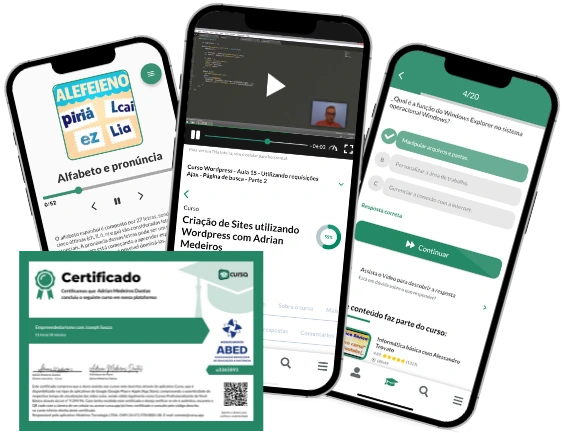
In the app you will also find...

Over 5,000 free courses
Programming, English, Digital Marketing and much more! Learn whatever you want, for free.

Study plan with AI
Our app's Artificial Intelligence can create a study schedule for the course you choose.

From zero to professional success
Improve your resume with our free Certificate and then use our Artificial Intelligence to find your dream job.
You can also use the QR Code or the links below.