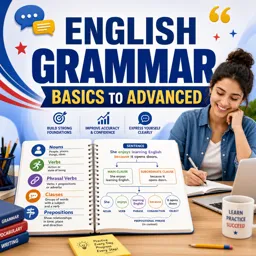
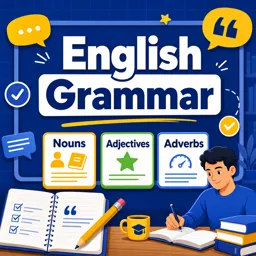
Free Course Image English grammar

Free online course English grammar

Duration of the online course: 4 hours and 20 minutes

4.76

StarStarStarStarStar

(345)

Write clearer English with confidence in this free online grammar course—master tenses, modals, clauses and prepositions with practical exercises and support.

In this free course, learn about

  • Build correct English sentence structure and know what makes a sentence sound natural
  • Identify dependent clauses and how they relate to independent clauses
  • Use present simple correctly for habits/routines and general facts/states
  • Conjugate and use the verb 'to be' accurately in different subjects and sentences
  • Choose and interpret modals (must/have to/should) for obligation, advice, necessity
  • Differentiate should/ought to/supposed to/had better by strength and expectation
  • Apply adjective order rules (opinion vs fact; general vs specific) in noun phrases
  • Understand simple, perfect, and continuous aspects; what continuous means in time
  • Talk about future using the right forms for plans, predictions, and intentions
  • Express possibility with may/might/could/can in present and future contexts
  • Use prepositions to/in/at for destination, time, and location with correct distinctions
  • Use present continuous for actions now and for 'annoying/strange habits' with adverbs
  • Distinguish countable vs uncountable nouns and choose correct quantifiers/articles
  • Use would have/could have/should have and will/would/might for hypotheticals and regrets

About the free online course

Clear, accurate grammar makes everything easier: writing emails that sound professional, speaking without second-guessing yourself, and understanding what you read and hear with far less effort. This free online course helps you build that confidence by strengthening the core rules that shape correct English. Instead of memorizing isolated tips, you will learn how sentences are put together and why certain forms sound natural while others feel incomplete or awkward.

You will start by reinforcing sentence structure and the roles different parts of a sentence play, including how independent and dependent clauses work. From there, you will develop reliable control over everyday verb forms such as the present simple and present continuous, learning when each tense is the best choice and what message it gives to your listener. You will also practice using the verb to be correctly, which is essential for introductions, descriptions, and basic communication.

As you advance, the course clarifies modal verbs and the meanings behind choices like must, have to, should, might, could, would, and had better. These small words carry big differences in obligation, advice, possibility, and certainty, and mastering them helps you sound precise and natural in real conversations. You will also sharpen your accuracy with adjective order, adverbs, and common prepositions such as to, in, and at—areas that often cause mistakes even for strong learners.

To make progress stick, you will complete exercises that prompt you to notice patterns, correct errors, and confirm your understanding in practical contexts. You will also learn simple strategies for spotting your most frequent grammar mistakes so you can improve faster over time. By the end, you will be better equipped to communicate clearly, avoid common traps, and choose grammar forms that match your meaning.

Course content

  • Video class: English Sentence Structure - English Grammar Lesson 21m
  • Exercise: By creating simple sentences, you come to understand whats necessary in some sentence or whats not being necessary. In the following sentence “She likes getting up...” Technicallly, the sentence is complete, but you’d never say that. Why not?
  • Exercise: What is a dependent clause?
  • Video class: Present Simple Verb Form in English - English Verb Tenses 13m
  • Exercise: _What are the two common uses of the present simple verb tense in English?
  • Video class: How to Use To Be in English - Using Be in English Grammar Lesson 07m
  • Exercise: _What is the correct form of the verb "be" for "my brother"?
  • Exercise: Which of the following sentences uses the correct form of the verb 'to be'?
  • Video class: Modal Verbs - How to Use Must, Have to and Should - English Grammar Lesson 11m
  • Exercise: Modal Verbs are very used but yet, very tricky at the same time, since it seems they share the same functions. Having that in mind, what alternative is correct regarding the modal verb’s function?
  • Video class: Adjective Order - English Grammar Lesson 08m
  • Exercise: Concerning adjective order in English, it comes with a few set of rules for basic ordering, that are, “opinion go first, facts go second; general ideas comes before specific ideas”. With that in mind, mark the alternative that is incorrect.
  • Exercise: Which of the following sentences correctly uses the rules for adjective order in English?
  • Video class: English Verb Tenses Guide - Learn About Simple, Perfect, and Continuous Tenses 17m
  • Exercise: _How many verb tenses are there in English according to the lesson?
  • Exercise: Which of the following verb forms typically describes an action that is incomplete and happening at a specific moment in time?
  • Video class: How to Use Should, Ought to, Supposed to and Had Better - English Modal Verbs Lesson 13m
  • Exercise: While seeing the diferences about ‘should and supposed to’, what’s the main idea that differs supposed to from should?
  • Video class: Future in English - How to Talk about the Future 15m
  • Exercise: _What tense can you use to talk about plans for the future in English?
  • Video class: How to Use Must in English - English Modal Verbs 14m
  • Exercise: ‘Must’ is a very used verb that can fit in a lot of situations, which also means that it has different meanings depending on what sentence it takes part in. Mark the alternative that is not correct.
  • Video class: How to Use Should in English - English Modal Verbs 10m
  • Exercise: _What is one of the most common ways to use 'should'?
  • Video class: English Modal Verbs - May, Might, Could, Can - Talking About Possibilities 13m
  • Exercise: _Which modal verbs can be used to talk about possibilities in the present or future according to the video?
  • Video class: English Prepositions - How to Use To, In, and At - English Grammar 16m
  • Exercise: Prepositions helps us greatly to properly form sentences for whatever need we may have to do so. When we have in our hands the prepositions “to, in and at”, what are their main differences? Choose the correct option.
  • Video class: How to Use the Present Continuous - English Verb Tenses - English Grammar Lesson 12m
  • Exercise: In the following example of present continuous “She’s missing something in the meetings!”, this is one of the uncommon situations that it gives off the impression of ‘things you find strange/annoying’. For that to properly happen, you need to use a resource, what resource is that?
  • Video class: How to Improve English Grammar - Tips to Learn English Grammar Faster 17m
  • Exercise: What is one practical method to identify your common grammar mistakes in English?
  • Video class: Uncountable Nouns - English Grammar Lesson 20m
  • Exercise: _What is the difference between countable and uncountable nouns in English?
  • Video class: Using Would Have, Could Have, Should Have - English Grammar Lesson 14m
  • Exercise: Lots of situations can be used by ‘could have’, thus, helping us greatly to make up sentences and so on. Mark the alternative that isn’t correct.
  • Video class: How to Use Will, Would and Might - English Modal Verbs Lesson 16m
  • Exercise: Concerning the lots of situation that “Will vs Would vs Might” can arrange, make the one that is untrue.
  • Video class: Adverbs in English - Learn All About English Adverbs 17m
  • Exercise: Adjectives and Adverbs have a very useful role in sentences. Can you mark the correct alternative with the right description of the Adjective/Adverb?

This free course includes:

Icon for learning via the audio course

4 hours and 20 minutes of online video course

Icon for the digital course completion certificate

Digital certificate of course completion (Free)

Icon for exercises to practice what you've learned

Exercises to train your knowledge

Icon for courses that are 100% free from start to finish

100% free, from content to certificate

What is the difference between the present simple and present continuous in English?

Use the present simple for routines, facts, and regular actions; use the present continuous for actions happening now or around the present time.

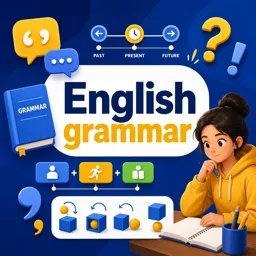
How do must, have to, should, and supposed to differ in English?

Must and have to express necessity, should gives advice, and supposed to describes an expectation, rule, or arranged duty.

What is the correct adjective order in English?

English adjectives usually follow this order: opinion, size, age, shape, color, origin, material, purpose, then noun.

Ready to get started?Download the app and get started today.

Install the app now

to access the course
Icon representing technology and business courses

Over 5,000 free courses

Programming, English, Digital Marketing and much more! Learn whatever you want, for free.

Calendar icon with target representing study planning

Study plan with AI

Our app's Artificial Intelligence can create a study schedule for the course you choose.

Professional icon representing career and business

From zero to professional success

Improve your resume with our free Certificate and then use our Artificial Intelligence to find your dream job.

You can also use the QR Code or the links below.

QR Code - Download Cursa - Online Courses

Course comments: English grammar

Students found the free online course clear, useful, and enjoyable. They appreciated the simple explanations, felt it helped improve their English, and valued the practical lessons and downloadable materials.

AA

Ayat abu krinat

StarStarStarStarStar

The way the lessons are explained is very simple and clear Im so excited to finish it.

BM

Bereket Mulugeta

StarStarStarStarStar

it's good

AP

Aayush Patel

StarStarStarStar

my improve english this videos.

YK

Yousof Kaakar

StarStarStarStarStar

good

DS

dilip shukla

StarStarStarStarStar

wanted it badly

VK

Ven Khemar Cara

StarStarStarStarStar

very nice

R

rouba

StarStarStarStar

she likes food so much. she likes to swim. she likes shopping

JN

Jimma Nyang Mabor

StarStarStarStarStar

thanks you for teaching how can I download them to use for ever day

KI

Khizar Ibrahim

StarStarStarStarStar

she likes bags she likes makeup she likes a room

N

Niamatullah

StarStarStarStarStar

Really help full.

More free courses at English

Free Ebook + Audiobooks! Learn by listening or reading!