
Free ebook on database design basics: turn requirements into clean relational schemas with entities, keys, relationships, and constraints.
Free ebook content
-

From Requirements to Data Facts: Defining the Database Design Problem
+ Exercise: To answer “What price was charged for each product in an order at the time it was placed?”, which stored data is essential?
-
Entities vs. Attributes: Choosing What Becomes a Table
+ Exercise: In a customer database, which situation most strongly indicates that “Address” should be modeled as its own entity (table) rather than as columns on Customer?
-
Modeling Relationships and Cardinality for Relational Databases
+ Exercise: In a clinic database, how would you enforce the rule “a patient may have zero or one insurance policy on file, and each policy belongs to exactly one patient” in the InsurancePolicy table?
-
ER Diagrams That Stay Readable: Notation, Naming, and Layout
+ Exercise: When adding foreign keys to an ER diagram for an ordering flow, which approach best supports readability and clear join paths?


-
Primary Keys and Identifiers: Stable Uniqueness in a Schema
+ Exercise: You want to use a surrogate primary key for Customer but still prevent two customers from sharing the same email. Which design best enforces this rule while keeping a stable internal identifier?
-
Foreign Keys and Referential Integrity: Making Relationships Enforceable
+ Exercise: In a relational schema, how is a many-to-many relationship (such as Order containing Product) typically made enforceable while allowing relationship attributes like quantity?
-
Constraints and Data Quality Rules: Capturing Business Meaning in the Schema
+ Exercise: Which schema feature best enforces the rule “an order cannot contain the same product more than once as separate lines,” while still allowing many orders to include that product?
-
Avoiding Common Modeling Mistakes: Practical Fixes for Cleaner Schemas
+ Exercise: A customer can have multiple phone numbers. Which schema change best avoids repeating columns and makes queries like “find customer by phone number” straightforward?
-
From Draft to Maintainable Schema: Validating Design Decisions with Use Cases
+ Exercise: While validating a draft schema with a core reporting use case, which situation most clearly indicates the schema does NOT support the use case cleanly?
About the free ebook
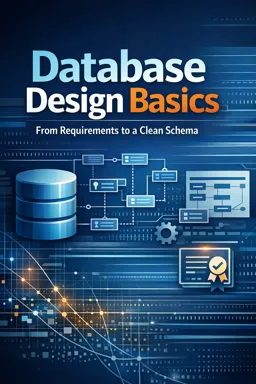
Database Design Basics: From Requirements to a Clean Schema
Build a reliable foundation for relational databases with this free ebook on turning business requirements into clear, maintainable schemas. Learn how to identify the facts a system must store, distinguish entities from attributes, and make design choices that support accurate data and useful queries.
Design data structures with purpose
A clean database begins with understanding the real-world processes behind the data. This ebook explains how to translate requirements into entities, attributes, relationships, and cardinality rules without prematurely creating tables. It helps you model what the business needs while keeping the schema flexible enough for future change.
Make relationships and rules enforceable
Explore primary keys, foreign keys, and referential integrity as practical tools for preserving meaning across related records. You will also learn how constraints can prevent invalid values, duplicate records, missing required information, and inconsistent relationships before they affect an application.
Create diagrams people can use
Entity-relationship diagrams are most valuable when they communicate clearly. Discover approachable guidance for notation, consistent naming, and layout so that developers, analysts, and stakeholders can review a model without getting lost in visual clutter.
Recognize and repair modeling problems
Common mistakes can make a database difficult to query, update, and maintain. The ebook examines practical ways to avoid repeated data, unclear identifiers, overloaded tables, weak relationships, and rules that exist only in application code.
What you will be able to do
- Convert requirements and use cases into data facts.
- Choose appropriate tables, attributes, and identifiers.
- Model one-to-one, one-to-many, and many-to-many relationships.
- Use keys and constraints to protect data quality.
- Validate a draft schema against realistic business scenarios.
Whether you are planning a new application or improving an existing data model, this ebook offers a practical path from an initial idea to a schema that is easier to understand, enforce, and evolve.
How do I decide whether something should be a database table or an attribute?
Use a table when it represents a distinct thing with its own properties, identity, or relationships; use an attribute for a simple property of an entity.
Why are foreign keys important in relational database design?
Foreign keys enforce valid links between tables and prevent records from referencing related data that does not exist.
How can I validate a database schema before development?
Test the model against real use cases, sample records, required queries, and business rules to find missing data or unclear relationships.
This ebook includes:

9 content chapters

Digital certificate of course completion (Free)

Exercises to train your knowledge

100% free, from content to certificate
Ready to get started?

 recommended
In the app you will also find...

Over 5,000 free courses
Programming, English, Digital Marketing and much more! Learn whatever you want, for free.

Study plan with AI
Our app's Artificial Intelligence can create a study schedule for the course you choose.

From zero to professional success
Improve your resume with our free Certificate and then use our Artificial Intelligence to find your dream job.
You can also use the QR Code or the links below.