Install Tailwind CSS and PostCSS, configure the Tailwind content paths, add the Tailwind directives to your CSS file, and run the build process to generate the final stylesheet.

Duration of the online course: 3 hours and 4 minutes
New
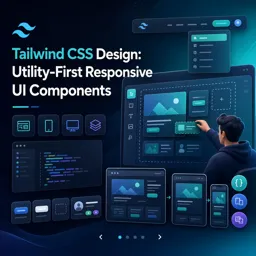
Build responsive UI components faster with this free Tailwind CSS course—utility-first workflows, production optimization, and a shareable certificate.
Designing modern interfaces often gets stuck in endless CSS naming, overrides, and one-off styles. This free online course helps you switch to a cleaner, faster way of building web UI with Tailwind CSS, using a utility-first approach that keeps your styles consistent and your components easy to iterate. You will learn how to move from idea to responsive layout quickly, without sacrificing structure, accessibility, or maintainability.
You will start by setting up Tailwind in a lightweight project with PostCSS, then get comfortable with the workflow that makes Tailwind effective: composing designs directly in your markup with purposeful, reusable utilities. As you build, you will practice responsive patterns, stateful styling for hover/focus/active, and techniques to keep interfaces polished even when content is unpredictable. The course emphasizes how to make text feel designed, handle long titles gracefully, and work with SVG icons in a way that makes color styling straightforward.
As the UI becomes more component-driven, you will explore when and why to extract reusable building blocks, and how to compose utilities with @apply to create semantic component classes without fighting Tailwind’s layering system. You will also customize your design system through configuration, extending theme values safely so your upgrades stay smooth and your defaults remain intact.
Beyond visuals, you will learn how to think about production readiness: keeping CSS bundles small by removing unused styles, structuring cards with full-bleed images and padded content, cropping and positioning media without distortion, and locking imagery to predictable aspect ratios for consistent layouts. You will also create depth with shadows and layering while understanding why stacking contexts sometimes block z-index from working as expected.
To finish, you will assemble practical navigation patterns with Flexbox, including a mobile-first navbar with a toggleable drawer and a dropdown that stays visually contained without changing the navbar’s height. You will also see approaches for handling interactions responsibly and for cases where mobile and desktop designs diverge so much that separate markup becomes the most practical solution.
Explore free online CSS courses designed to help beginners and aspiring web developers master styling, layouts, responsive design, Flexbox, Grid, animations, and modern best practices. Learn at your own pace, build practical front-end skills, and earn a certificate with every course to showcase your CSS expertise.

Explore free online TailwindCSS courses designed to help you build modern, responsive websites faster. Learn utility-first CSS, layouts, components, customization, and best practices through flexible, self-paced lessons. Enroll today, sharpen your front-end development skills, and earn a certificate upon completion at no cost.

Explore free online Responsive Web Design courses and learn to build mobile-friendly, accessible websites that look great on every screen. Master HTML, CSS, flexible layouts, media queries, and modern design best practices at your own pace. Enroll today, develop job-ready web skills, and earn a certificate with every course you complete.

3 hours and 4 minutes of online video course

Digital certificate of course completion (Free)

Exercises to train your knowledge

100% free, from content to certificate
How do you set up Tailwind CSS with PostCSS in a vanilla HTML project?
Install Tailwind CSS and PostCSS, configure the Tailwind content paths, add the Tailwind directives to your CSS file, and run the build process to generate the final stylesheet.
What does theme.extend do in the Tailwind CSS configuration file?
The theme.extend section adds custom colors, spacing, fonts, or other tokens while preserving Tailwind’s default design system.
How can a Tailwind CSS image fill a fixed card area without distortion?
Use object-cover on the image with fixed width and height dimensions. It fills the area while preserving the image ratio, cropping excess content if needed.
Ready to get started?Download the app and get started today.
Install the app now
to access the course
Over 5,000 free courses
Programming, English, Digital Marketing and much more! Learn whatever you want, for free.

Study plan with AI
Our app's Artificial Intelligence can create a study schedule for the course you choose.

From zero to professional success
Improve your resume with our free Certificate and then use our Artificial Intelligence to find your dream job.
You can also use the QR Code or the links below.




Free CourseLaravel
5

(2)

4h04m

20 exercises
Free CourseProgressive Web Application PWA for Beginners
5
(5)
3h24m
15 exercises
Free CourseLearn Laravel in 30 Days: Beginner to Pro
5
(1)
17h00m
30 exercises
Free CoursePHP for Beginners: Learn PHP, MySQL, MVC, Routing, Authentication and Testing
5
(1)
10h45m
49 exercises
Free CourseLaravel Full Course: Build, CRUD, Auth, Email and Deploy to Live Server
5
(1)
3h52m
15 exercises
Free CourseWeb Development Foundations: HTML, CSS, Git and Command Line
5
(3)
14h11m
37 exercises
Free CourseCSS Complete Tutorial
5
(1)
8h30m
49 exercises
Free CoursePHP for Beginners: Learn PHP, MySQL and Login Systems
5
(3)
10h49m
29 exercises
Free CourseJavaScript for beginners
4.9
(27)
1h40m
2 exercises

Free CourseUmbraco CMS
4.9
(22)
6h21m
19 exercises
Carry knowledge in your pocket.
Download the Cursa app.
There are hundreds of free courses available, with a free certificate of completion that is saved in your mobile image gallery.
Download the app to access the Course Completion Certificate for Free.


+ 10 million
students

Free and Valid
Certificate

60 thousand free
exercises

4.8/5 rating in
app stores

Free courses in
video and ebooks