
Exercises
Challenge your understanding of virtual memory handling in operating systems. This quiz covers the core concepts that let programs use memory efficiently, including virtual and physical address spaces, paging, page faults, page replacement algorithms, and swap space. Explore the role of the Memory Management Unit (MMU) in address translation, learn why the Translation Lookaside Buffer (TLB) improves performance, and identify the causes and effects of thrashing. You will also review how operating systems track physical pages and manage memory when RAM is limited. Ideal for students, developers, and anyone preparing for operating systems exams or technical interviews.
Answer the questions below and check the explanation for each answer.
0/10 answered
Auto audio on: the next questions will be read aloud when you click Continue.
Virtual memory is a technique that uses both hardware and software to enable a computer to compensate for physical memory shortages by temporarily transferring data from random access memory (RAM) to disk storage. This process creates the illusion for users of a very large (virtual) memory.
The main advantage of virtual memory is allowing multiple applications to run simultaneously without running out of physical memory. It achieves this by providing a larger addressable memory space managed via page swapping.
The Memory Management Unit (MMU) is critical in virtual memory systems as it dynamically translates virtual addresses used by the CPU to actual physical addresses in the memory. This translation allows for the flexible addressing of larger data spaces than the physically available memory.
A page fault occurs when a program accesses a part of its address space that is not currently in physical memory, prompting the operating system to fetch the data from secondary storage (such as disk) into the RAM.
Paging is a memory management scheme that eliminates the need for contiguous physical memory and divides memory into fixed-size pages, making efficient use of memory and simplifying the process of swapping pages in and out of physical memory.
The Least Recently Used (LRU) page replacement algorithm is used to manage pages in memory by replacing the least recently accessed pages, ensuring better performance and reduced page faults in scenarios of constrained physical memory.
Thrashing occurs when a computer's virtual memory resources are overused, leading to constant page swapping instead of executing processes, resulting in a significant slowdown in system performance.
The page table is a key data structure used to map virtual addresses to physical ones, keeping track of all physical pages allocated by the operating system and thus managing memory ownership and access.
Swap space is a portion of the hard drive allocated to extend the virtual memory. When RAM is depleted, pages are transferred to this swap space to free up memory for other functions, allowing more applications to keep running.
The Translation Lookaside Buffer (TLB) is a highly specialized cache that stores recent translations of virtual memory to physical memory addresses, speeding up the address translation process and improving the overall system performance.
Free CourseOperating Systems and Systems Programming
5

(4)

38h48m

26 exercises
Free CourseOperating System
5
(3)
16h53m
42 exercises

Free CourseHome Networking 101
5
(1)
1h50m
4 exercises
Free CourseBasic Commands in Linux
4.8

(4)
2h15m
6 exercises
Free CourseComputer operating systems
4.7
(109)
6h00m
23 exercises

Free CourseHardware and Network full course
4.6
(17)
20h08m
23 exercises
Free CourseLinux command line tutorial
4.5
(59)
25h01m
40 exercises

Free CourseUbuntu Linux training
4.5
(32)
4h06m
33 exercises
Thousands of online courses in video, ebooks and audiobooks.
To test your knowledge during online courses
Generated directly from your cell phone's photo gallery and sent to your email

Download our app via QR Code or the links below:.


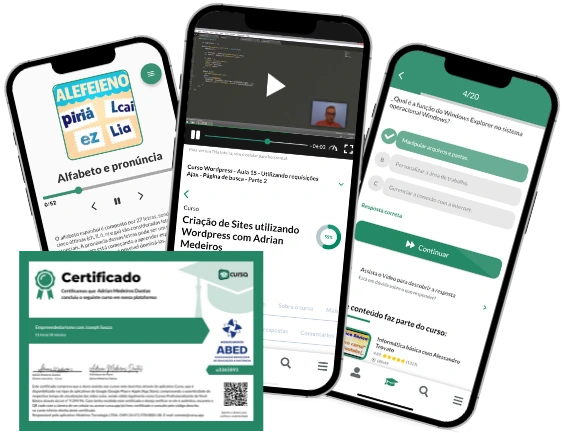
Carry knowledge in your pocket.
Download the Cursa app.
There are hundreds of free courses available, with a free certificate of completion that is saved in your mobile image gallery.
Download the app to access the Course Completion Certificate for Free.


+ 10 million
students

Free and Valid
Certificate

60 thousand free
exercises

4.8/5 rating in
app stores

Free courses in
video and ebooks