
Exercises
Challenge your understanding of process scheduling in operating systems. This quiz covers the goals of CPU scheduling and key concepts such as time-sharing, time slices, context switches, waiting time, and preemptive versus non-preemptive policies. Explore widely used algorithms including First-Come, First-Served (FCFS), Shortest Job First (SJF), and Priority Scheduling. You will also review common scheduling problems, such as the convoy effect and starvation, along with techniques like aging that can improve fairness. Ideal for students learning OS fundamentals or anyone refreshing their knowledge of how an operating system selects processes for CPU execution.
Answer the questions below and check the explanation for each answer.
0/10 answered
Auto audio on: the next questions will be read aloud when you click Continue.
The primary goal of process scheduling is to maximize CPU utilization. This ensures that the CPU is actively working on processes as much as possible.
Round Robin is a commonly used scheduling algorithm, especially in time-sharing systems, as it handles multiple processes in a cyclic order, giving each a time slice.
In time-sharing systems, a time slice is a fixed duration during which a process is allowed to run on the CPU before it is swapped out for another process.
The main disadvantage of FCFS scheduling is that it can lead to long waiting times, especially if a long process is at the front of the queue, causing the 'convoy effect.'
A context switch involves saving the state of the currently running process and loading the state of the next process in the schedule. This is crucial for multitasking.
The Shortest Job Next (SJN) algorithm minimizes the average waiting time because it gives preference to shorter processes, reducing queue time for subsequent processes.
The main drawback of Shortest Job First (SJF) scheduling is the need for prior knowledge of each process’s length, which can be difficult to predict accurately.
First-Come, First-Served (FCFS) is a non-preemptive scheduling policy, meaning once a process starts execution, it runs to completion without being preempted.
Starvation occurs when low-priority processes wait indefinitely due to high-priority processes continually taking CPU time, often in Priority Scheduling.
Aging is a mechanism used to improve Priority Scheduling by gradually increasing the priority of processes that wait in the queue for a long time, thus avoiding starvation.
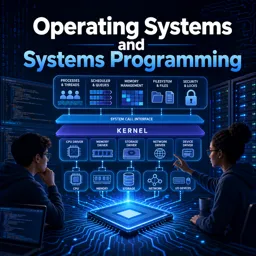
Free CourseOperating Systems and Systems Programming
5

(4)

38h48m

26 exercises

Free CourseOperating System
5
(3)
16h53m
42 exercises

Free CourseHome Networking 101
5
(1)
1h50m
4 exercises

Free CourseBasic Commands in Linux
4.8

(4)
2h15m
6 exercises

Free CourseComputer operating systems
4.7
(109)
6h00m
23 exercises

Free CourseHardware and Network full course
4.6
(17)
20h08m
23 exercises

Free CourseLinux command line tutorial
4.5
(59)
25h01m
40 exercises

Free CourseUbuntu Linux training
4.5
(32)
4h06m
33 exercises
Thousands of online courses in video, ebooks and audiobooks.
To test your knowledge during online courses
Generated directly from your cell phone's photo gallery and sent to your email

Download our app via QR Code or the links below:.



Carry knowledge in your pocket.
Download the Cursa app.
There are hundreds of free courses available, with a free certificate of completion that is saved in your mobile image gallery.
Download the app to access the Course Completion Certificate for Free.


+ 10 million
students

Free and Valid
Certificate

60 thousand free
exercises

4.8/5 rating in
app stores

Free courses in
video and ebooks