
Exercises
Challenge your understanding of memory management in operating systems with this quiz. Explore essential concepts such as physical and virtual memory, paging, segmentation, swapping, demand paging, page faults, and thrashing. Questions also cover the role of the Memory Management Unit (MMU), methods for tracking free memory, and the purpose of effective memory allocation. Ideal for computer science students, IT learners, and anyone reviewing OS fundamentals.
Answer the questions below and check the explanation for each answer.
0/11 answered
Auto audio on: the next questions will be read aloud when you click Continue.
Memory management's main role is to ensure that each process gets adequate memory while optimizing the use of available memory resources to improve overall system performance.
Virtualization involves creating virtual versions of physical components and is not a direct technique for managing memory but rather related to overall system resources.
Paging divides memory into fixed-sized pages, allowing non-contiguous allocation and avoiding fragmentation issues, thereby enhancing efficiency in memory management.
Swapping refers to moving inactive processes to disk storage to free up main memory for active tasks, typically used when memory is insufficient.
The MMU handles the translation of virtual memory addresses, used by applications, into physical memory addresses, thereby facilitating efficient memory use and protection.
Segmentation deals with variable-sized memory blocks based on logical divisions within a program, unlike paging which uses fixed-size pages.
A page fault occurs when a program seeks to access data that is not currently held in the system's memory, leading to a fetch from secondary storage.
Virtual memory creates an abstraction of a large contiguous address space, appearing larger than the physical RAM, enhancing system flexibility and resource utilization.
Thrashing is caused by continuous swapping between the main memory and disk, due to insufficient memory or poor system configuration, degrading performance.
Free memory spaces are effectively managed using a linked list, offering dynamic insertion and removal of blocks, making it ideal for dynamic memory management tasks.
Demand paging loads memory pages into RAM only when they are needed, thus optimizing memory utilization and maintaining efficient system performance.
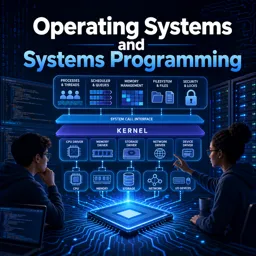
Free CourseOperating Systems and Systems Programming
5

(4)

38h48m

26 exercises

Free CourseOperating System
5
(3)
16h53m
42 exercises

Free CourseHome Networking 101
5
(1)
1h50m
4 exercises

Free CourseBasic Commands in Linux
4.8

(4)
2h15m
6 exercises

Free CourseComputer operating systems
4.7
(109)
6h00m
23 exercises

Free CourseHardware and Network full course
4.6
(17)
20h08m
23 exercises
Free CourseLinux command line tutorial
4.5
(59)
25h01m
40 exercises

Free CourseUbuntu Linux training
4.5
(32)
4h06m
33 exercises
Thousands of online courses in video, ebooks and audiobooks.
To test your knowledge during online courses
Generated directly from your cell phone's photo gallery and sent to your email

Download our app via QR Code or the links below:.



Carry knowledge in your pocket.
Download the Cursa app.
There are hundreds of free courses available, with a free certificate of completion that is saved in your mobile image gallery.
Download the app to access the Course Completion Certificate for Free.


+ 10 million
students

Free and Valid
Certificate

60 thousand free
exercises

4.8/5 rating in
app stores

Free courses in
video and ebooks