
Exercises
Challenge your understanding of operating system kernel development and optimization with this focused quiz. Explore essential concepts including the kernel’s role in resource management, process scheduling, file-creation system calls, runtime-loadable modules, context-switching overhead, memory protection, lightweight threads, syscall interfaces, kernel data structures, and paging. Whether you are studying OS fundamentals, preparing for a systems programming assessment, or sharpening low-level development skills, this quiz helps you assess your knowledge of the core mechanisms that power modern operating systems.
Answer the questions below and check the explanation for each answer.
0/10 answered
Auto audio on: the next questions will be read aloud when you click Continue.
The kernel is the core component of an operating system, responsible for managing system resources like CPU, memory, and device control.
The Scheduler is responsible for determining which processes run at any given time on the CPU, optimizing the use of resources.
The creat() system call is employed for creating files in Unix-like systems. It sets the file size to zero if it already exists.
Modular kernels permit components or modules to be added or removed during runtime, offering increased flexibility and scalability.
Context-switching overhead refers to the time and resources required to switch the CPU's focus from one process to another, impacting performance.
The Memory Manager in the kernel undertakes tasks related to memory protection, ensuring that processes do not interfere with each other's memory spaces.
A thread is considered lightweight because it executes within a process's context and shares the process's resources while operating independently.
The syscall interface provides a controlled means for user applications to interact with the kernel, such as inquiring system state or performing I/O operations.
While the kernel manages a file system and a network stack, an API is not part of the kernel structure. It is a set of functions for applications.
Paging enables more efficient use of RAM by creating a virtual address space, managing memory in fixed-size blocks, and ensuring process isolation.
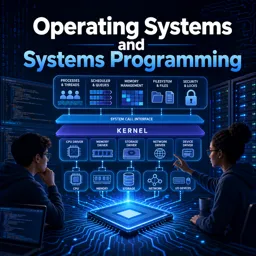
Free CourseOperating Systems and Systems Programming
5

(4)

38h48m

26 exercises
Free CourseOperating System
5
(3)
16h53m
42 exercises

Free CourseHome Networking 101
5
(1)
1h50m
4 exercises
Free CourseBasic Commands in Linux
4.8

(4)
2h15m
6 exercises
Free CourseComputer operating systems
4.7
(109)
6h00m
23 exercises

Free CourseHardware and Network full course
4.6
(17)
20h08m
23 exercises
Free CourseLinux command line tutorial
4.5
(59)
25h01m
40 exercises

Free CourseUbuntu Linux training
4.5
(32)
4h06m
33 exercises
Thousands of online courses in video, ebooks and audiobooks.
To test your knowledge during online courses
Generated directly from your cell phone's photo gallery and sent to your email

Download our app via QR Code or the links below:.



Carry knowledge in your pocket.
Download the Cursa app.
There are hundreds of free courses available, with a free certificate of completion that is saved in your mobile image gallery.
Download the app to access the Course Completion Certificate for Free.


+ 10 million
students

Free and Valid
Certificate

60 thousand free
exercises

4.8/5 rating in
app stores

Free courses in
video and ebooks