
Exercises
Challenge your understanding of advanced operating systems management with this quiz on the core technologies that keep modern systems running. Explore virtual memory, time-sharing scheduling, kernel responsibilities, multithreading and multiprocessing, Unix/Linux process commands, Linux file systems, RAID storage, microkernel architecture, device drivers, and process isolation. Ideal for IT students, system administrators, developers, and anyone preparing to strengthen their OS fundamentals and operational systems expertise.
Answer the questions below and check the explanation for each answer.
0/10 answered
Auto audio on: the next questions will be read aloud when you click Continue.
Virtual memory uses disk space to emulate additional RAM, allowing the OS to run larger applications than physical memory alone would permit. This extends the available memory of the system.
The Round Robin scheduling algorithm is ideal for time-sharing systems as it equally divides CPU time across processes, ensuring fair allocation.
The kernel is the core component that handles resource management, process scheduling, hardware-device interactions, and system calls.
Multi-threading allows multiple threads to exist in a process, which reduces overhead compared to multi-processing and enables faster context switching between threads.
The ps command in Unix/Linux systems displays currently active processes, their status, and their associated resources.
ext4 (fourth extended filesystem) was developed for Linux and is widely used for its performance, reliability, and support for large partitions.
RAID (Redundant Array of Independent Disks) provides data redundancy and can improve performance by spreading data across multiple disks.
Microkernel architecture separates basic services, leading to increased system stability as each component operates independently minimizing failures.
Device drivers act as a bridge between hardware and operating system, enabling them to communicate effectively for device operations.
Memory protection ensures that different processes do not interfere with each other's memory spaces, maintaining process isolation.
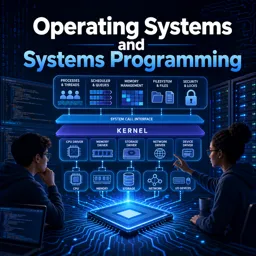
Free CourseOperating Systems and Systems Programming
5

(4)

38h48m

26 exercises
Free CourseOperating System
5
(3)
16h53m
42 exercises

Free CourseHome Networking 101
5
(1)
1h50m
4 exercises
Free CourseBasic Commands in Linux
4.8

(4)
2h15m
6 exercises
Free CourseComputer operating systems
4.7
(109)
6h00m
23 exercises

Free CourseHardware and Network full course
4.6
(17)
20h08m
23 exercises
Free CourseLinux command line tutorial
4.5
(59)
25h01m
40 exercises
Free CourseUbuntu Linux training
4.5
(32)
4h06m
33 exercises
Thousands of online courses in video, ebooks and audiobooks.
To test your knowledge during online courses
Generated directly from your cell phone's photo gallery and sent to your email

Download our app via QR Code or the links below:.



Carry knowledge in your pocket.
Download the Cursa app.
There are hundreds of free courses available, with a free certificate of completion that is saved in your mobile image gallery.
Download the app to access the Course Completion Certificate for Free.


+ 10 million
students

Free and Valid
Certificate

60 thousand free
exercises

4.8/5 rating in
app stores

Free courses in
video and ebooks