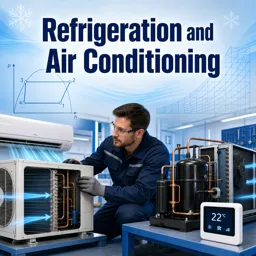
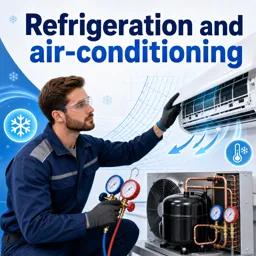
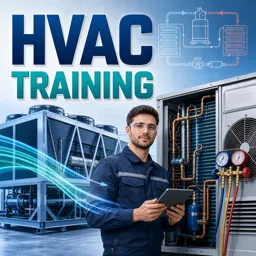
There is no such thing as a “cold machine”. A refrigerator does not manufacture cold and pump it into the food compartment. It does something more interesting: it picks up heat from inside the box and dumps it into your kitchen. Once that idea clicks, almost everything about air conditioners, freezers, heat pumps and cold rooms becomes much easier to understand — including why the back of your fridge is warm and why an air conditioner needs an outdoor unit at all.
The one physical fact everything is built on
When a liquid evaporates, it absorbs heat from its surroundings. When a vapour condenses back into liquid, it releases that heat. You feel this every time you step out of a pool: the water evaporating off your skin pulls heat away and you feel cold, even on a warm day.
Refrigeration takes that effect and puts it on a loop. A working fluid, the refrigerant, is forced to evaporate where we want cooling and to condense where we can get rid of the heat. Pressure is the tool that lets engineers choose where each phase change happens, because the boiling point of a fluid rises with pressure and falls when pressure drops.
The four components of the vapour-compression cycle
Almost every domestic and commercial cooling system uses the same four parts arranged in a closed loop. Follow the refrigerant around it and the logic appears immediately.
| Component | What it does | Refrigerant state going in | Refrigerant state coming out |
|---|---|---|---|
| Compressor | Raises pressure and temperature | Low-pressure vapour | High-pressure hot vapour |
| Condenser | Rejects heat to the outside | High-pressure hot vapour | High-pressure liquid |
| Expansion device | Drops the pressure sharply | High-pressure liquid | Low-pressure cold mixture |
| Evaporator | Absorbs heat from the space | Low-pressure cold mixture | Low-pressure vapour |
Walking the loop, step by step
- Compression. The compressor takes cool, low-pressure vapour and squeezes it. Compressing a gas raises both its pressure and its temperature, so the vapour leaves the compressor hot — typically hotter than the outdoor air.
- Condensation. That hot vapour flows through the condenser coil, where a fan blows ambient air across it. Because the refrigerant is hotter than the air, heat flows outward. As it loses heat, the vapour condenses into liquid. This is the heat that came from inside your fridge, plus the energy the compressor added.
- Expansion. The high-pressure liquid passes through a restriction — a capillary tube, a fixed orifice, or a thermostatic or electronic expansion valve. Pressure falls abruptly, and with it the boiling point. A portion of the liquid flashes into vapour immediately, and the mixture becomes very cold.
- Evaporation. This cold mixture enters the evaporator coil inside the cooled space. Air from the room or cabinet is warmer than the refrigerant, so heat flows into the coil and the remaining liquid boils off. The vapour returns to the compressor and the cycle repeats.
Notice that the refrigerant is never consumed. In a healthy sealed system, the same charge circulates for years. If a system is “low on gas”, it has a leak — topping it up without finding the leak only postpones the problem.
Superheat and subcooling: the technician’s two dials
These two terms sound intimidating but describe simple ideas, and they are how professionals judge whether a system is charged and operating correctly.
- Superheat is how much hotter the vapour is than the temperature at which it boiled, at that pressure. Some superheat is essential: it confirms all the liquid has evaporated before reaching the compressor. Compressors are designed to compress vapour, not liquid.
- Subcooling is how much cooler the liquid is than its condensing temperature, at that pressure. It confirms the condenser produced fully liquid refrigerant before the expansion device, which is what allows the valve to meter flow properly.
Readings that drift away from the manufacturer’s targets point to specific faults: restricted airflow, a blocked filter drier, an undercharge, an overcharge, or a failing metering device. This is why diagnosis in refrigeration is measurement-driven rather than guesswork.
Air conditioners and heat pumps are the same machine
A split air conditioner is a refrigerator whose “inside” is your living room and whose “outside” is the street. The indoor unit contains the evaporator; the outdoor unit contains the compressor and condenser.
A heat pump adds a reversing valve that swaps the roles of the two coils. In heating mode, the outdoor coil becomes the evaporator and absorbs heat from cold outdoor air, while the indoor coil condenses and releases that heat into the room. It sounds impossible to extract heat from cold air, but “cold” air still contains plenty of thermal energy — the refrigerant simply has to be colder still.
Because these systems move heat rather than generating it, they can deliver more heat energy than the electrical energy they consume. That ratio is expressed as the coefficient of performance, or COP.
Common symptoms and what they usually mean
| Symptom | Frequent causes |
|---|---|
| Ice building up on the evaporator | Restricted airflow, dirty filter, low charge |
| Unit runs constantly but cools poorly | Dirty condenser coil, undercharge, failing compressor |
| Compressor short-cycles | Control fault, overcharge, restricted airflow |
| Water leaking indoors | Blocked condensate drain, defrost issue |
Two habits prevent a large share of failures: keeping coils and filters clean so air can move through them, and giving the outdoor unit enough clearance to breathe. A condenser surrounded by shrubbery cannot reject heat, and everything downstream suffers.
A word about refrigerants
Different fluids suit different pressure ranges and applications, which is why you will meet several designations in the field, such as R-134a in some appliances, R-410A and R-32 in air conditioning, and hydrocarbons like R-290 in small sealed systems. Regulations in many countries are steadily shifting the industry toward refrigerants with lower global warming potential, and some are flammable or operate at high pressures. Handling, recovery and charging are regulated activities in most places, and doing them properly requires training, certification and the right equipment.
Why this concept is worth learning properly
Refrigeration and air conditioning sit behind food safety, medicine storage, data centres and everyday comfort. The technicians who work on these systems are diagnosing an invisible fluid through pressures and temperatures — a skill that rewards understanding the cycle rather than memorising procedures.
If you want to build that foundation, the free refrigeration and air conditioning courses on Cursa are a practical starting point, covering components, tools, measurements and safe working practices in a structured way.