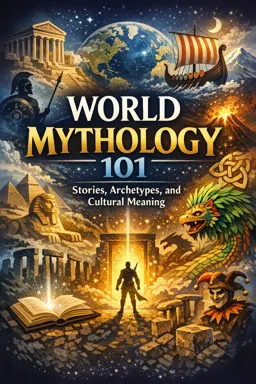

Free ebook on world mythology, exploring archetypes, creation stories, heroes, tricksters, fate, ritual power, and modern storytelling.
Free ebook content
-

How Myths Work: Archetypes, Motifs, and Cultural Meaning in World Mythology
+ Exercise: A student labels “Fox” in Practice Myth C as a Trickster. Which additional step best follows the course’s practical tip for using archetypes?
-
Creation Myths in World Mythology: Origins, Order, and the Shape of the Cosmos
+ Exercise: When mapping a creation story onto the motif grid, which approach best fits the idea that creation myths should be read as patterns rather than timelines?
-
Divine Families and Power: Authority, Conflict, and Social Order in Mythic Pantheons
+ Exercise: In many mythic pantheons, what does describing gods as an extended family primarily help model?


-
The Hero’s Journey in World Mythology: Callings, Trials, and Transformations
+ Exercise: When analyzing a myth with the hero’s journey “toolkit,” which approach best identifies the Threshold Crossing stage?
-
Tricksters and Rule-Breakers in World Mythology: Humor, Disruption, and Hidden Lessons
+ Exercise: When comparing tricksters across cultures, which approach best avoids flattening cultural differences?
-
Monsters and Adversaries in World Mythology: Boundaries, Fear, and the Work of Civilization
+ Exercise: Using the “Boundary–Fear–Tool” method, which interpretation best fits a story where a multi-headed monster keeps regrowing when attacked, and the hero succeeds by sealing or cauterizing the wounds rather than just striking harder?
-
Underworld Journeys in World Mythology: Death, Return, and the Price of Knowledge
+ Exercise: In an underworld journey myth, which situation best illustrates the idea that “return is never free” because the underworld operates as an economy of balance?
-
Fate, Prophecy, and Duty in World Mythology: What Can Be Changed and What Must Be Carried
+ Exercise: A seer states an end-state is unavoidable in a myth. According to the fixed outcomes lens, what is the main focus of a character’s agency?
-
Sacred Objects, Names, and Ritual Power in World Mythology: Tools That Bind Worlds Together
+ Exercise: When analyzing a sacred object or name in myth as a "technology," which approach best captures how it produces reliable effects?
About the free ebook
World Mythology 101: Stories, Archetypes, and Cultural Meaning
This free ebook introduces world mythology as a living way of understanding how communities explain origins, power, identity, fear, duty, and change. Rather than treating myths as simple falsehoods, it explores them as meaningful narratives shaped by cultural values, ritual practices, and historical experience.
Read mythic patterns across cultures
Learn to recognize recurring archetypes and motifs, including creators, divine families, heroes, tricksters, monsters, underworld travelers, and bearers of sacred objects. The ebook shows how similar story patterns can serve very different purposes in different traditions.
Explore conflict, order, and transformation
Creation accounts describe how a cosmos becomes ordered. Pantheon stories examine authority and family conflict. Heroic trials and journeys to the realm of the dead reveal what a society considers courage, loss, knowledge, and renewal. Stories of fate and prophecy ask where personal choice meets obligation.
Connect ancient stories to modern narratives
Mythic structures continue to shape novels, films, games, and popular storytelling. This ebook gives readers a vocabulary for identifying these patterns while avoiding the mistake of reducing every tradition to one universal formula.
What you will examine
- How archetypes, motifs, and cultural context shape myths
- Creation, divine authority, and social order
- Heroes, tricksters, monsters, and underworld journeys
- Fate, ritual power, sacred names, and symbolic objects
- Mythic patterns in contemporary storytelling
Ideal for literature students and curious readers, this resource supports close reading, cross-cultural comparison, and thoughtful discussion of the meanings myths carry.
What are archetypes and motifs in world mythology?
Archetypes are recurring character roles or patterns, while motifs are repeated story elements, symbols, or situations.
How do creation myths reflect cultural values?
They often express a community's ideas about order, divine power, humanity's place, and relationships with nature.
Why do trickster figures appear in myths?
Tricksters disrupt rules through humor or deception, exposing social tensions and revealing unexpected lessons.
This ebook includes:

10 content chapters

Digital certificate of course completion (Free)

Exercises to train your knowledge

100% free, from content to certificate
Ready to get started?

 recommended
In the app you will also find...

Over 5,000 free courses
Programming, English, Digital Marketing and much more! Learn whatever you want, for free.

Study plan with AI
Our app's Artificial Intelligence can create a study schedule for the course you choose.

From zero to professional success
Improve your resume with our free Certificate and then use our Artificial Intelligence to find your dream job.
You can also use the QR Code or the links below.