
Free ebook on reading poetry through imagery, figurative language, sound, rhythm, form, and evidence-based interpretation.
Free ebook content
-

Reading Poetry for Meaning: A Three-Reading Approach
+ Exercise: In a three-reading approach to analyzing a poem, what is the main goal of Reading 2?
-
Imagery in Poetry: Seeing, Hearing, Touching the Line
+ Exercise: Which revision best turns the abstract statement “I feel sad” into sensory imagery using at least three senses, including an internal sensation, without naming the emotion?
-
Metaphor and Simile: How Comparisons Create New Meaning
+ Exercise: When analyzing a metaphor, what is the most evidence-based way to decide whether an interpretation is valid?
-
Diction and Tone: Word Choice, Attitude, and Voice
+ Exercise: A poet wants to keep the basic fact of a line the same (someone spoke) but shift the attitude implied. Which revision best changes connotation while keeping denotation similar?


-
Sound in Poetry: Rhyme, Alliteration, Assonance, and Consonance
+ Exercise: A poet wants a rhyme that almost matches but leaves a slight mismatch to create a subtle, uneasy near-resolution. Which sound device best fits this goal?
-
Rhythm and Meter: Hearing the Beat (Without the Jargon Overload)
+ Exercise: When scanning a poetic line, what should you do before naming the meter pattern (like iamb or trochee)?
-
Line Breaks and Enjambment: Meaning at the Edge of the Line
+ Exercise: How does enjambment most often affect a poem’s pacing and meaning at the end of a line?
-
Poetic Forms and Structure: Sonnet, Ode, Elegy, and Free Verse
+ Exercise: A poem begins by speaking directly to an object (“O …” or “you …”) and returns to it across stanzas, starting with praise but gradually admitting mixed feelings and new understanding. Which form best fits these first-glance signals?
About the free ebook
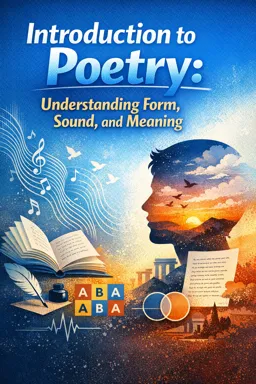
Introduction to Poetry: Understanding Form, Sound, and Meaning
This free ebook offers a practical way to read poetry with confidence. Instead of treating poems as puzzles with one hidden answer, it shows how careful attention to language, sound, structure, and context can lead to interpretations supported by evidence.
Read closely, then build meaning
Learn a flexible three-reading approach: first notice what happens, then examine how the poem creates its effects, and finally develop an interpretation you can defend. The ebook helps readers move from initial reactions to clear observations about imagery, comparisons, diction, and tone.
Hear how a poem works
Poetry is made not only of ideas but also of sound. Explore rhyme, alliteration, assonance, consonance, rhythm, and meter in accessible language. Discover how repeated sounds and patterned beats can shape emphasis, pace, mood, and meaning.
See the importance of form
Line breaks, enjambment, stanza patterns, and poetic forms all affect the way a poem is read. This ebook introduces forms such as the sonnet, ode, elegy, and free verse while showing that form is a meaningful choice rather than a set of rules to memorize.
Use evidence in literary interpretation
By the end, readers can connect details in a poem to a thoughtful claim. Strong interpretation begins with specific observations: a word choice, an image, a sound pattern, a pause, or a line break. This approach supports classroom discussion, analytical writing, and more attentive independent reading.
How does the three-reading approach help with poetry analysis?
It moves from understanding what happens in a poem to noticing craft choices and forming an evidence-based interpretation.
What is the difference between metaphor and simile in poetry?
A metaphor states or implies a comparison, while a simile usually compares using “like” or “as.”
How do line breaks and enjambment affect a poem's meaning?
They control pauses, pacing, emphasis, and the connections readers make between words across lines.
This ebook includes:

9 content chapters

Digital certificate of course completion (Free)

Exercises to train your knowledge

100% free, from content to certificate
Ready to get started?

 recommended
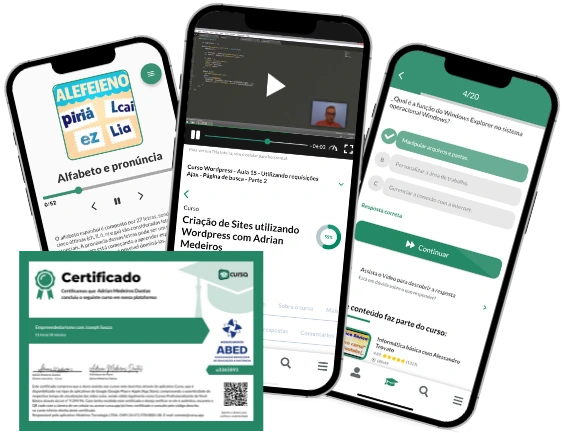
In the app you will also find...

Over 5,000 free courses
Programming, English, Digital Marketing and much more! Learn whatever you want, for free.

Study plan with AI
Our app's Artificial Intelligence can create a study schedule for the course you choose.

From zero to professional success
Improve your resume with our free Certificate and then use our Artificial Intelligence to find your dream job.
You can also use the QR Code or the links below.