
Free ebook for learning to read Shakespeare’s plays through verse, prose, wordplay, context, genre, and performance clues.
Free ebook content
-

Shakespeare for Beginners: How to Read a Scene Without Panic
+ Exercise: When you start a new scene and feel overwhelmed by the language, what approach best helps you read without panic?
-
Shakespeare for Beginners: The Sound of Meaning in Iambic Pentameter
+ Exercise: When using iambic pentameter as a listening tool, what is the most useful way to handle moments where the rhythm is nudged, bent, or broken?
-
Shakespeare for Beginners: Prose vs. Verse and What It Reveals
+ Exercise: In a scene, a character has been plotting privately in prose. When the person they want to influence arrives, they shift into carefully dignified speech. What does this switch most likely signal?
-
Shakespeare for Beginners: Sentence Wrestling—Unpacking Word Order and Logic
+ Exercise: When a Shakespearean sentence feels confusing because clauses and phrases are tangled, what is the best first move in the five-step “sentence-wrestling” method?


-
Shakespeare for Beginners: Wordplay, Insults, and Comic Timing
+ Exercise: When a line in a Shakespearean comedy feels overly formal or oddly specific, what is the most effective next step to uncover the joke?
-
Shakespeare for Beginners: Rhetorical Devices That Drive Conflict
+ Exercise: When a character uses a cluster of related metaphors (an image-system), what is the main power effect of this device in a conflict?
-
Shakespeare for Beginners: Following a Scene Through Context Clues and Paraphrase
+ Exercise: When you meet an unfamiliar word in a scene, which situation best shows it should be treated as a Category A “load-bearing” word?
-
Shakespeare for Beginners: Characters, Conflicts, and What to Listen For in Performance
+ Exercise: While listening to a performance, which approach best helps you figure out what a character is trying to do in the scene?
-
Shakespeare for Beginners: Tragedy—Choice, Consequence, and Pressure Points
+ Exercise: When scanning a tragic scene for a “pressure point,” which combination best indicates the story is nearing an irreversible choice?
-
Shakespeare for Beginners: Comedy—Misunderstanding, Desire, and Social Play
+ Exercise: When you feel lost in a comic scene, which approach best helps you understand why characters act the way they do?
-
Shakespeare for Beginners: Histories—Power, Public Speech, and Leadership Performance
+ Exercise: When analyzing a leader’s public speech versus private talk in a history play, what approach best fits the framework?
About the free ebook
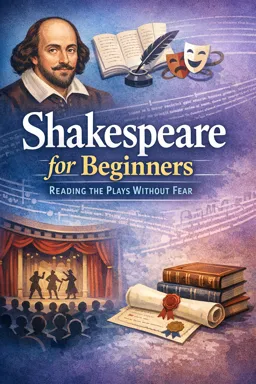
Shakespeare for Beginners: Reading the Plays Without Fear
This free ebook makes Shakespeare’s plays more approachable by treating them as living language written for performance. Instead of trying to understand every word at once, readers learn practical ways to follow a scene, notice clues, and build meaning step by step.
Read Shakespeare with confidence
Discover how verse, prose, rhythm, unusual sentence order, and rhetorical patterns help reveal character, mood, conflict, and intention. Clear explanations show how iambic pentameter works without turning reading into a technical exercise.
- Use context and paraphrase to understand difficult passages.
- Recognize when prose or verse changes the effect of a scene.
- Spot wordplay, insults, repetition, and persuasive language.
- Follow the choices and pressures that shape tragedy, comedy, and history plays.
Listen for the action inside the words
Shakespeare’s language becomes easier when it is read aloud and imagined onstage. This ebook encourages readers to notice who speaks, who interrupts, what a character wants, and how speech changes during moments of tension.
A practical guide for literature study
From sentence “wrestling” to comic misunderstandings and public speeches, each lesson offers a useful reading habit for school assignments, independent study, or first encounters with the plays. Readers will finish with stronger tools for interpreting scenes, discussing characters, and responding to Shakespeare without fear.
How can I understand Shakespeare’s unusual word order?
Find the main subject, verb, and object, then restate the sentence in modern order while keeping its meaning.
What does prose versus verse reveal in Shakespeare?
Verse can signal heightened emotion or status, while prose may suggest everyday speech, comedy, intimacy, or disruption.
How does iambic pentameter help when reading a play?
Its rhythm can emphasize key words, reveal emotional shifts, and make a character’s speech easier to hear aloud.
This ebook includes:

11 content chapters

Digital certificate of course completion (Free)

Exercises to train your knowledge

100% free, from content to certificate
Ready to get started?

 recommended
In the app you will also find...

Over 5,000 free courses
Programming, English, Digital Marketing and much more! Learn whatever you want, for free.

Study plan with AI
Our app's Artificial Intelligence can create a study schedule for the course you choose.

From zero to professional success
Improve your resume with our free Certificate and then use our Artificial Intelligence to find your dream job.
You can also use the QR Code or the links below.