

Free ebook introducing bacteria, archaea, viruses, microbial growth, transmission, microbiomes, antibiotics, and resistance.
Free ebook content
-

Microbiology Foundations: What Microbes Are and How We Study Them
+ Exercise: A researcher finds a 100 nm particle containing RNA in a protein shell. It has no ribosomes and produces new particles only inside host cells. Which classification best fits this entity?
-
Bacterial Cell Biology: Structures, Functions, and Diversity
+ Exercise: A bacterium is Gram-negative, and a small hydrophilic antibiotic must reach an internal target. Which factor most directly limits the drug’s entry compared with Gram-positive bacteria?
-
Archaea Explained: How Archaea Differ from Bacteria
+ Exercise: A prokaryotic microbe shows no peptidoglycan markers and is suspected to be archaeal. Which additional finding would most strongly support that it is an archaeon rather than a bacterium?


-
Viral Biology: Virion Structure and Host Specificity
+ Exercise: A virus can remain silent in a host cell for years and then reactivate later. Which viral genome behavior best supports this long-term persistence?
-
Viral Replication Cycles: Lytic, Lysogenic, and Beyond
+ Exercise: A drug prevents formation of the viral capsid. Cells still produce many viral proteins, but few infectious particles appear. Which replication stage is most directly blocked?
-
Microbial Growth Essentials: Nutrients, Conditions, and Population Dynamics
+ Exercise: A culture is monitored during the last 2 hours of a batch growth curve, when viable counts (CFU/mL) are dropping. Which statement best predicts what would happen to optical density (OD) over the same interval, and why?
-
Transmission and Control: How Microbes Move Between Hosts and Environments
+ Exercise: A slimy sink drain keeps becoming contaminated again even after repeatedly spraying disinfectant. Which control step best targets the underlying problem described?
-
Beneficial Microbes: Microbiomes, Mutualism, and Decomposition
+ Exercise: Which scenario best illustrates why “dysbiosis” should be interpreted cautiously as an association rather than automatic proof of cause?
-
Antibiotics and Resistance: How Treatments Work and Why Resistance Emerges
+ Exercise: Which statement best explains why antibiotics do not shorten the course of a typical viral illness?
-
Putting It Together: Interactions Among Bacteria, Archaea, Viruses, and Hosts
+ Exercise: A stool report says “toxin gene detected” for a gut-associated bacterium after a course of broad-spectrum antibiotics. Which interpretation best matches systems-thinking about what this result does and doesn’t show?
About the free ebook
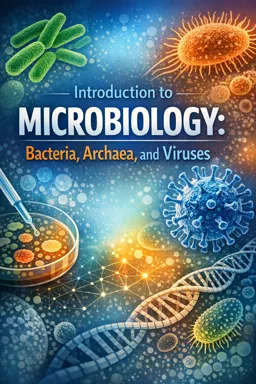
Introduction to Microbiology: Bacteria, Archaea, and Viruses
This free online ebook introduces the invisible organisms and infectious agents that shape ecosystems, health, food systems, and everyday life. Learn how microbiologists observe, classify, and investigate microbes, while building a clear foundation in bacterial, archaeal, and viral biology.
Understand the major forms of microbial life
Explore bacterial cell structures, their functions, and the remarkable diversity found across bacterial species. Discover why archaea are not simply unusual bacteria: their cell chemistry, genetics, and environmental adaptations reveal a distinct branch of life.
The ebook also explains viruses as acellular agents that rely on host cells. It examines virion structure, host specificity, and replication strategies, including lytic and lysogenic cycles.
Connect microbial processes to real-world questions
Microbial populations depend on nutrients and physical conditions, and they move through hosts and environments in many ways. These principles help explain transmission, infection control, and the effects of changing environmental conditions.
- Recognize essential bacterial cell components and their roles.
- Distinguish archaea from bacteria using key biological features.
- Explain how viral structure relates to host infection.
- Describe microbial growth, transmission, and ecological interactions.
- Understand how antibiotics work and why resistance can emerge.
See microbes as both helpful and harmful
Microbes are central to decomposition, nutrient cycling, and beneficial partnerships such as microbiomes. At the same time, some microbes cause disease, and antibiotic resistance can make bacterial infections more difficult to treat. This ebook brings these ideas together to show how bacteria, archaea, viruses, and hosts influence one another in living systems.
For biology learners
Use this resource to strengthen your understanding of foundational microbiology vocabulary, mechanisms, and connections across cell biology, ecology, and health science.
What is the main difference between bacteria and archaea?
Archaea differ from bacteria in cell membrane chemistry, cell-wall features, and genetic machinery.
How do lytic and lysogenic viral cycles differ?
The lytic cycle quickly produces new viruses and ruptures cells; the lysogenic cycle integrates viral genetic material before activation.
Why does antibiotic resistance develop?
Resistance emerges when bacteria gain or evolve traits that let them survive antibiotic exposure and reproduce.
This ebook includes:

10 content chapters

Digital certificate of course completion (Free)

Exercises to train your knowledge

100% free, from content to certificate
Ready to get started?

 recommended
In the app you will also find...

Over 5,000 free courses
Programming, English, Digital Marketing and much more! Learn whatever you want, for free.

Study plan with AI
Our app's Artificial Intelligence can create a study schedule for the course you choose.

From zero to professional success
Improve your resume with our free Certificate and then use our Artificial Intelligence to find your dream job.
You can also use the QR Code or the links below.