The course covers life and classification, basic chemistry, cell structure, biomolecules, cell division, enzymes, respiration, photosynthesis, and cell signaling.

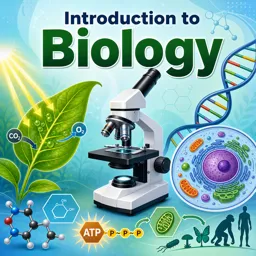
Duration of the online course: 1 hours and 41 minutes
4.7


(62)
Build a strong biology foundation fast with a free online course covering cells, genetics, metabolism and photosynthesis, plus exercises and a certificate option.
Biology is the science of life, but it only feels overwhelming when the basics are shaky. This free online course helps you build a clear, connected understanding of the living world by starting with the big questions: what biology studies, what makes something alive, and how scientists organize organisms through classification. From there, you’ll develop the core language needed to make sense of later topics in school and beyond, whether you’re preparing for exams, returning to study, or simply curious about how life works.
You’ll strengthen your foundation in the chemistry that powers living systems, including atoms, molecules, and the differences between ways of representing compounds. That base quickly becomes practical as you move into cell chemistry and the major organic molecules that keep organisms functioning. Instead of memorizing definitions in isolation, you’ll connect structure to function: why certain molecules store energy, how proteins support biological processes, and how enzymes speed up reactions so cells can survive.
As the course progresses, you’ll explore the cell as the basic unit of life, learning how key parts such as the membrane contribute to transport, protection, and communication. You’ll also make sense of how cells reproduce and pass on information by contrasting binary fission with the eukaryotic cell cycle, then following the logic of mitosis and meiosis and what each process is designed to accomplish.
To tie everything together, you’ll trace energy through life: how cells capture energy through glycolysis and the citric acid cycle, and how plants and other organisms transform light into chemical energy through photosynthesis and the Calvin cycle. You’ll also get an introduction to cell signaling, helping you understand how cells coordinate actions within tissues and respond to their environment. Short exercises along the way let you check your understanding and build confidence step by step.

1 hours and 41 minutes of online video course

Digital certificate of course completion (Free)

Exercises to train your knowledge

100% free, from content to certificate
What topics are covered in an Introduction to Biology course?
The course covers life and classification, basic chemistry, cell structure, biomolecules, cell division, enzymes, respiration, photosynthesis, and cell signaling.
What is the difference between mitosis and meiosis in biology?
Mitosis produces two genetically similar body cells, while meiosis produces four genetically varied sex cells with half the usual chromosome number.
How do photosynthesis and cellular respiration relate to each other?
Photosynthesis uses light energy to make glucose and oxygen, while cellular respiration breaks down glucose with oxygen to release usable energy.
Ready to get started?Download the app and get started today.
Install the app now
to access the course
Over 5,000 free courses
Programming, English, Digital Marketing and much more! Learn whatever you want, for free.

Study plan with AI
Our app's Artificial Intelligence can create a study schedule for the course you choose.

From zero to professional success
Improve your resume with our free Certificate and then use our Artificial Intelligence to find your dream job.
You can also use the QR Code or the links below.



Free CourseBiology Learning
5
(3)

12h23m

43 exercises
Free CourseGenetics Basics
5
(1)
3h26m
21 exercises
Free CourseCell Biology
4.8
(5)
13h41m
18 exercises
Free CourseBiology
4.7
(27)
27h28m
36 exercises
Free CourseIntroductory Biology
4.7
(6)
27h52m
20 exercises
Free CourseBiology course
4.7
(3)
7h09m
28 exercises
Free CourseBiology foundations
4.5
(6)
1h33m
12 exercises
Carry knowledge in your pocket.
Download the Cursa app.
There are hundreds of free courses available, with a free certificate of completion that is saved in your mobile image gallery.
Download the app to access the Course Completion Certificate for Free.


+ 10 million
students

Free and Valid
Certificate

60 thousand free
exercises

4.8/5 rating in
app stores

Free courses in
video and ebooks
Course comments: Introduction to Biology
Marissa Lynn Murphy
great finding
Richardo Mullah
very better
RABAR muhamad
i love this cource