The pH scale measures how acidic or basic a solution is, based on its hydrogen ion concentration.

Duration of the online course: 1 hours and 33 minutes
4.5


(6)
Build strong biology skills fast with a free online course—master scientific thinking, cells’ chemistry, and pH fundamentals to study smarter.
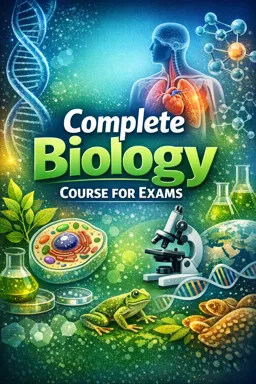
If biology has ever felt like a blur of unfamiliar terms, this course helps you build a clear foundation you can trust. You will connect big-picture ideas about life with the practical tools scientists use to investigate it, so the subject stops feeling like memorization and starts feeling like understanding. Designed for school-level learning, it supports you in developing confidence for homework, exams, and future science classes.
You begin by exploring what biology studies and how scientists turn questions into testable investigations. By focusing on the scientific method, hypotheses, and evidence-based reasoning, you learn how to judge claims using data instead of guesswork. You will also strengthen your ability to think about variables, controls, and fairness in testing, which is essential not only in biology labs but in everyday decision-making where evidence matters.
From there, the course bridges biology with the chemistry that powers living systems. You will make sense of elements and atoms, then move into the molecules of life: carbohydrates, proteins, lipids, and nucleic acids. Rather than treating these as separate definitions, you will see how their structures relate to their roles in organisms—how building blocks like amino acids and nucleotides help explain everything from energy use to heredity. You will also learn the difference between vitamins and minerals and why that distinction matters in human nutrition.
Finally, you focus on water and the chemical environment of cells. You will understand hydrogen bonding, why water is such an effective solvent, and how these properties make life as we know it possible. You will also learn what pH measures and why changes in acidity can affect biological systems. Along the way, practice questions help you check your understanding, spot gaps early, and study more efficiently. By the end, you will have a solid, connected framework that makes the rest of biology far easier to learn.

1 hours and 33 minutes of online video course

Digital certificate of course completion (Free)

Exercises to train your knowledge

100% free, from content to certificate
What does the pH scale measure in biology?
The pH scale measures how acidic or basic a solution is, based on its hydrogen ion concentration.
Why is water a good solvent for living organisms?
Water is polar, so it can surround and dissolve many ionic and polar substances needed for biological reactions.
What are the main components of a nucleotide?
A nucleotide contains a sugar, a phosphate group, and a nitrogenous base.
Ready to get started?Download the app and get started today.
Install the app now
to access the course
Over 5,000 free courses
Programming, English, Digital Marketing and much more! Learn whatever you want, for free.

Study plan with AI
Our app's Artificial Intelligence can create a study schedule for the course you choose.

From zero to professional success
Improve your resume with our free Certificate and then use our Artificial Intelligence to find your dream job.
You can also use the QR Code or the links below.



Free CourseBiology Learning
5
(3)

12h23m

43 exercises
Free CourseGenetics Basics
5
(1)
3h26m
21 exercises
Free CourseCell Biology
4.8
(5)
13h41m
18 exercises
Free CourseBiology
4.7
(27)
27h28m
36 exercises
Free CourseIntroduction to Biology
4.7
(63)
1h41m
16 exercises
Free CourseIntroductory Biology
4.7
(6)
27h52m
20 exercises
Free CourseBiology course
4.7
(3)
7h09m
28 exercises
Carry knowledge in your pocket.
Download the Cursa app.
There are hundreds of free courses available, with a free certificate of completion that is saved in your mobile image gallery.
Download the app to access the Course Completion Certificate for Free.


+ 10 million
students

Free and Valid
Certificate

60 thousand free
exercises

4.8/5 rating in
app stores

Free courses in
video and ebooks
Course comments: Biology foundations
basiru Suleiman
biology
fatima jahan
Amazing teaching style learned so much , would recommend it to other students your notes were great.
Fatima Hussain
fantastic test were fair without being easy
Jade Scott
I am grade 4
Fatima Hussain
great app for students