A typical monohybrid F2 cross produces a 3:1 dominant-to-recessive phenotypic ratio, while a dihybrid F2 cross produces a 9:3:3:1 ratio when genes assort independently.

Duration of the online course: 3 hours and 26 minutes
New
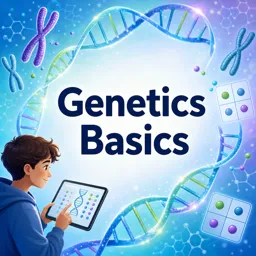
Master core genetics for biology success in this free online course—Mendelian crosses, DNA, chromosomes and mutations, with quizzes to boost exam results.
Build a clear, confident foundation in genetics and start understanding how traits are inherited, how DNA stores information, and how cells turn that information into life. This free online biology course is designed for students and curious learners who want more than memorizing terms: you will learn to reason through genetic problems, interpret classic experiments, and connect big ideas from chromosomes to mutations.
You will begin with the questions that make genetics feel relevant: why heredity matters, what genetics can explain in real organisms, and how scientific thinking shaped the field. From there, you will move into Mendelian genetics with a practical focus on how patterns of inheritance emerge. Instead of treating ratios and crosses as isolated facts, the lessons guide you to predict outcomes, distinguish genotype from phenotype, and use tools like the Punnett square to organize possibilities and check your logic.
As the course progresses, the view expands from inheritance patterns to the physical basis of heredity. You will connect traits to genes, genes to DNA, and DNA to chromosomes, developing a mental model that makes later topics easier. Key milestones in genetics are explained through the experiments that changed biology, showing how evidence led scientists to identify DNA as the genetic material and to uncover the structure and replication of the double helix.
You will also explore the flow of genetic information from DNA to RNA to proteins, linking the central dogma to real biological outcomes. With a strong grasp of chromosome structure and sex determination, you can see how inheritance operates at both the molecular and chromosomal levels. Finally, the course introduces mutations and their major types, helping you understand how genetic change arises and why it matters for variation, health, and evolution.
Throughout, quick questions and exercises reinforce learning and help you test yourself the way exams often do. By the end, you will be able to approach genetics with structure and confidence, whether you are preparing for school biology, strengthening a science foundation, or exploring a future in life sciences.

3 hours and 26 minutes of online video course

Digital certificate of course completion (Free)

Exercises to train your knowledge

100% free, from content to certificate
What phenotypic ratios are expected in Mendel’s monohybrid and dihybrid F2 crosses?
A typical monohybrid F2 cross produces a 3:1 dominant-to-recessive phenotypic ratio, while a dihybrid F2 cross produces a 9:3:3:1 ratio when genes assort independently.
How do DNA, genes, and chromosomes relate to inherited traits?
DNA carries genetic information; genes are DNA segments that influence traits, and chromosomes are DNA-protein structures that package and transmit genes.
What did the Hershey–Chase and Meselson–Stahl experiments prove about DNA?
Hershey–Chase showed that DNA is the genetic material, while Meselson–Stahl confirmed that DNA replicates by the semiconservative model.
Ready to get started?Download the app and get started today.
Install the app now
to access the course
Over 5,000 free courses
Programming, English, Digital Marketing and much more! Learn whatever you want, for free.

Study plan with AI
Our app's Artificial Intelligence can create a study schedule for the course you choose.

From zero to professional success
Improve your resume with our free Certificate and then use our Artificial Intelligence to find your dream job.
You can also use the QR Code or the links below.



Video Courses
Exercises
Test your knowledge of immune barriers, antigen presentation, antibodies, lymphocytes, complement, memory, and vaccination.
Start exercisesTest your zoology knowledge with this animal behavior quiz on migration, communication, camouflage, tool use, hibernation, and mating.
Start exercisesTest advanced evolutionary biology knowledge on natural selection, speciation, homologous structures, genetic drift, the Cambrian explosion, and founder effects.
Start exercisesCarry knowledge in your pocket.
Download the Cursa app.
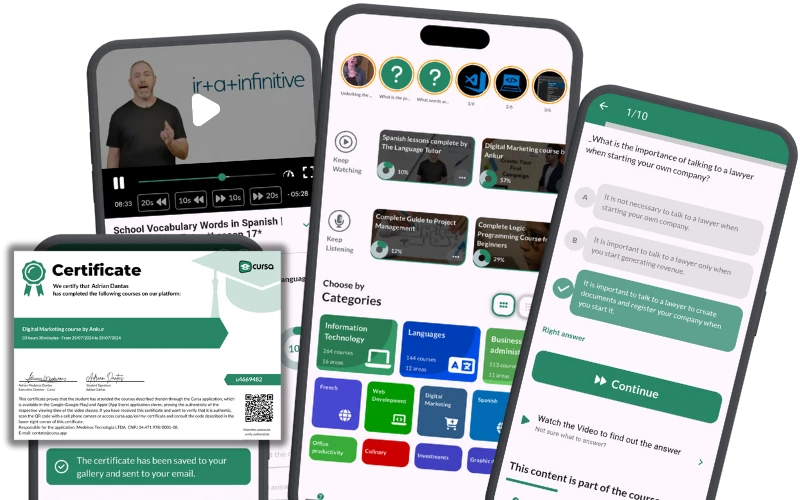
There are hundreds of free courses available, with a free certificate of completion that is saved in your mobile image gallery.
Download the app to access the Course Completion Certificate for Free.

+ 10 million
students

Free and Valid
Certificate

60 thousand free
exercises

4.8/5 rating in
app stores

Free courses in
video and ebooks