
A free ebook for journalists on preparing interviews, asking sharper questions, verifying claims, and handling sensitive sources ethically.
Free ebook content
-

Journalistic Interviewing: Defining the Purpose and Angle
+ Exercise: When planning a journalistic interview, what is the main benefit of clearly defining both the interview’s purpose and its angle?
-
Interview Preparation for Journalists: Research, Backgrounding, and Source Mapping
+ Exercise: Which approach best reflects effective interview preparation for a journalist?
-
Planning a Journalist’s Interview: Building a Question Ladder
+ Exercise: Why does a “question ladder” typically place challenge/verification questions after narrative and detail drilling?
-
Building Rapport and Professional Boundaries in Reporting Interviews
+ Exercise: A source asks to review the entire story draft before it runs to approve it. What is the most boundary-safe response?


-
Asking Better Questions: Open vs. Closed, Neutral vs. Leading
+ Exercise: Which approach best follows the recommended Open → Closed → Open sequence in an interview?
-
Follow-Ups That Work: Probing for Detail, Evidence, and Chronology
+ Exercise: A source says: “The rollout was a mess and people were furious.” Which follow-up best matches the goal of expanding detail into reportable specifics?
-
Handling Evasive Answers, Spin, and Hostility in Interviews
+ Exercise: When an interviewee responds with vague generalities like “We take this seriously” without describing actions, what is the most effective next move?
-
Interview Formats for Journalists: In-Person, Phone, Video, and Email
+ Exercise: You need an interview format that allows some observation of facial cues and also lets you walk through documents together remotely. Which format best fits this goal?
-
Accuracy and Verification: Testing Claims During and After the Interview
+ Exercise: During an interview, what approach best supports real-time verification of a source’s important claim?
-
Capturing Quotes Ethically: Notes, Recording, and Attribution
+ Exercise: Which approach best matches ethical quote capture when your notes include a vivid phrase but you didn’t catch every surrounding word?
-
Sensitive Interviews: Trauma, Minors, and Vulnerable Sources
+ Exercise: In a sensitive interview, which approach best reflects “real” informed consent?
-
Wrapping Up and Using the Material: Confirming Facts and Building the Story
+ Exercise: Which wrap-up approach best protects accuracy while maintaining editorial independence?
About the free ebook
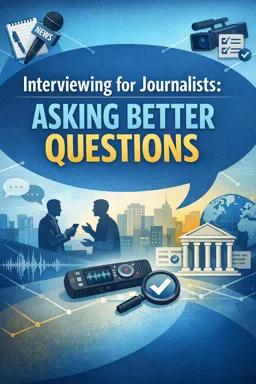
Interviewing for Journalists: Asking Better Questions
This free ebook helps journalists conduct purposeful, accurate, and ethical interviews. Learn how to define a reporting angle, prepare with credible background research, map sources, and design questions that move from essential facts to revealing detail.
Ask with clarity, listen with intent
Strong interviews depend on more than a prepared list. This guide explains how to use open and closed questions appropriately, avoid leading language, build rapport without losing professional boundaries, and recognize when a follow-up is needed. Develop techniques for probing claims, evidence, timelines, motives, and missing context.
Respond to difficult interview situations
Sources may evade, spin, become defensive, or challenge the premise of a question. Explore practical ways to stay calm, restate questions fairly, test assertions, and pursue relevant answers without becoming confrontational. The ebook also addresses interviews involving trauma, minors, and vulnerable sources, with attention to care, consent, and newsroom ethics.
Protect accuracy from interview to publication
Learn how to capture quotes responsibly through notes and recordings, handle attribution, verify statements during and after an interview, and distinguish an allegation from a confirmed fact. Guidance covers in-person, phone, video, and email interviews, helping you adapt your approach while preserving accuracy.
Turn conversations into stronger reporting
Use each interview to gather material that supports a clear, well-evidenced story. By confirming key facts, identifying gaps, and organizing usable quotes and context, you can report with greater confidence and fairness.
How can journalists avoid asking leading questions?
Use neutral wording, avoid assumptions in the question, and invite the source to explain facts in their own words.
What should a journalist do when an interviewee gives an evasive answer?
Return to the unanswered point, ask for specific evidence or dates, and state the question clearly and fairly.
How should journalists verify quotes and claims from an interview?
Check recordings and notes, confirm names and key facts, seek documents or independent sources, and attribute unverified claims clearly.
This ebook includes:

12 content chapters

Digital certificate of course completion (Free)

Exercises to train your knowledge

100% free, from content to certificate
Ready to get started?

 recommended
In the app you will also find...

Over 5,000 free courses
Programming, English, Digital Marketing and much more! Learn whatever you want, for free.

Study plan with AI
Our app's Artificial Intelligence can create a study schedule for the course you choose.

From zero to professional success
Improve your resume with our free Certificate and then use our Artificial Intelligence to find your dream job.
You can also use the QR Code or the links below.