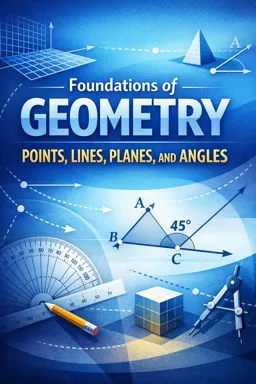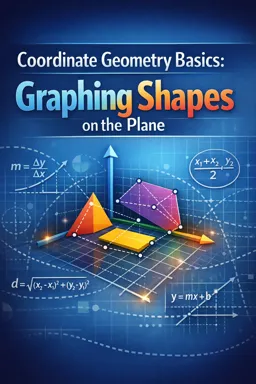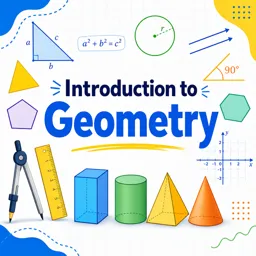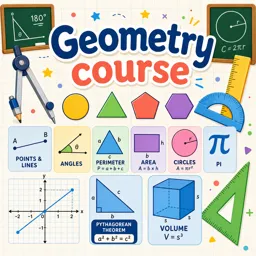

Free ebook on practical geometry: measure perimeter, area, surface area, volume, circles, composite shapes, and unit conversions with confidence.
Free ebook content
-

Measurement Foundations: Units, Tools, and Reliable Estimation
+ Exercise: A room measures 4.1 m by 3.8 m, and you want a fast check that a computed area is reasonable. Which approach best fits reliable estimation described here?
-
Lines and Angles for Real Spaces: Reading Corners, Turns, and Layouts
+ Exercise: When planning how a long object (like a board or cart) will move around a corner, what is the most useful geometric focus?
-
Triangles as Building Blocks: Breaking Irregular Shapes into Simple Parts
+ Exercise: When triangulating a concave polygon with an inward dent, what is the most reliable way to avoid including area outside the shape?


-
Perimeter in Practice: Borders, Fencing, Baseboards, and Room Outlines
+ Exercise: When planning baseboards for a room, which approach best matches real-world perimeter use?
-
Area Made Practical: Flooring, Tiles, Fabric, and Paint Coverage
+ Exercise: When planning how much material to buy for a coverage-based project, which workflow best prevents common mistakes like missing sections or using the wrong units?
-
Circles and Curves: Measuring Round Tables, Pipes, and Circular Rooms
+ Exercise: You need the outside diameter of a pipe, but you cannot measure straight across it. Which method best fits this situation?
-
Polygons and Composite Shapes: Handling Cutouts, Alcoves, and L-Shaped Rooms
+ Exercise: When calculating the area of an L-shaped room, which approach is best when the overall maximum length and width are easy to measure and the missing corner is a simple rectangle?
-
Surface Area of 3D Objects: Wrapping, Painting, and Material Estimates
+ Exercise: When estimating paint or wrap for an assembled object made of two solids that touch (for example, a smaller box sitting on a larger box), what should you do with the area where the two pieces meet?
-
Volume Without Fear: Boxes, Storage, Concrete, and Liquid Capacity
+ Exercise: You are estimating the liquid capacity of a rectangular tank. Which approach best avoids a meaningless result when calculating its volume?
-
Unit Conversions and Scaling: Metric–Imperial, Square and Cubic Units, and Plan Measurements
+ Exercise: A plan uses a 1:50 scale. Which method correctly finds the real area of a rectangular room that measures 60 mm by 40 mm on the plan?
-
Common Mistakes and Quick Checks: Avoiding Misreadings, Wrong Units, and Calculation Traps
+ Exercise: You are measuring for material to cover a floor, but your final result is in cubic units (like m³). What is the best quick interpretation of this red flag?
-
Mini-Quizzes with Answers: Practice Sets for Perimeter, Area, and Volume
+ Exercise: A rectangular garden is 9 m by 6 m, and one 9 m side is already fenced by a wall. How much fencing is needed for the other three sides?
About the free ebook
Geometry in Real Life: Perimeter, Area, and Volume Without Fear
This free ebook makes geometry practical, clear, and useful for everyday decisions. Learn how to measure spaces and objects accurately, choose appropriate units, estimate sensibly, and check whether an answer makes sense.
Turn measurements into useful answers
Geometry appears when planning a fence, ordering flooring, painting a wall, fitting baseboards, covering a box, measuring a round table, or calculating storage capacity. The lessons connect core formulas to realistic situations so that perimeter, area, surface area, and volume feel less abstract.
Skills explored
- Measure lengths with suitable tools and make reliable estimates.
- Read lines, angles, triangles, circles, polygons, and composite shapes.
- Calculate perimeter for borders, room outlines, and fencing.
- Find area for tiles, fabric, flooring, walls, and irregular layouts.
- Use circle measurements for curved and round objects.
- Calculate surface area for wrapping, painting, and material planning.
- Find volume for boxes, liquids, storage, and concrete.
- Convert metric and imperial units, including square and cubic units.
Build confidence through checks and practice
Clear examples show how to split complicated shapes into familiar parts, handle cutouts and alcoves, and avoid common errors such as mixing units or using a linear unit for area. Quick checks help you spot unreasonable results before they cause waste or extra cost.
The ebook closes with practice questions and answers that reinforce the methods. Whether you are working on school geometry or applying measurements at home, Geometry in Real Life provides a friendly path from diagrams and formulas to confident problem solving.
How do I calculate the area of an L-shaped room?
Split it into two rectangles, calculate each area, and add them together. Subtract any excluded cutout areas.
What is the difference between perimeter, area, and volume?
Perimeter is the distance around a shape, area covers a flat surface, and volume measures space inside a 3D object.
Why are square and cubic units important in geometry?
Area must use square units, such as m², while volume uses cubic units, such as m³. Linear units measure length only.
This ebook includes:

12 content chapters

Digital certificate of course completion (Free)

Exercises to train your knowledge

100% free, from content to certificate
Ready to get started?

 recommended
In the app you will also find...

Over 5,000 free courses
Programming, English, Digital Marketing and much more! Learn whatever you want, for free.

Study plan with AI
Our app's Artificial Intelligence can create a study schedule for the course you choose.

From zero to professional success
Improve your resume with our free Certificate and then use our Artificial Intelligence to find your dream job.
You can also use the QR Code or the links below.