
Free ebook on geometry foundations: points, lines, planes, segments, rays, angles, notation, and protractor measurement.
Free ebook content
-

Geometry Foundations: Points, Lines, and Planes as Building Blocks
+ Exercise: In a diagram, a straight drawing has arrowheads on both ends. What does this indicate about the geometric object?
-
Geometry Notation and Naming: Reading and Writing Geometric Statements
+ Exercise: Which statement correctly uses = and ≅ to compare a measure versus a geometric object?


-
Angles from Rays: Vertex, Sides, Interior, and Angle Notation
+ Exercise: In a diagram, an angle is named ∠ABC. Which statement must be true for this name to correctly match the angle?
-
Types of Angles and Special Angle Relationships
+ Exercise: Two angles form a linear pair. One angle measures 35°. What is the measure of the other angle?
-
Measuring Angles with a Protractor: Degrees, Setup, and Common Errors
+ Exercise: When measuring an angle with a semicircular protractor, how do you decide whether to read the inner scale or the outer scale?
-
Putting It Together: Writing Clear Geometric Descriptions from Diagrams
+ Exercise: In a diagram, angles AOB and BOC have matching arc marks, and angle AOC is labeled 120°. Which statement is guaranteed?
About the free ebook
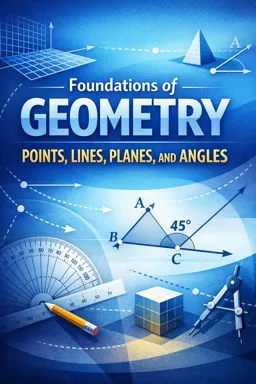
Foundations of Geometry: Points, Lines, Planes, and Angles
Build essential geometry skills with this free online ebook on the objects, notation, and measurements used to describe figures accurately. Learn how points, lines, and planes form the language of geometry and how diagrams communicate mathematical relationships.
Understand geometric building blocks
Explore how points identify locations, lines extend endlessly in two directions, and planes represent flat surfaces. Practice recognizing collinear points and using standard notation to read and write clear geometric statements.
Work with segments, rays, and distance
Learn to distinguish a line segment from a ray, identify endpoints, and find the meaning of length and midpoint. The ebook also explains opposite rays and how they create a straight path from a shared endpoint.
Describe and measure angles
See how two rays form an angle, with a shared vertex and sides that define its interior. Study acute, right, obtuse, straight, and reflex angles, along with important relationships such as complementary and supplementary angles.
Use a protractor with confidence
Follow practical guidance for aligning a protractor, selecting the correct scale, and avoiding common measurement errors. Apply these skills to diagrams and write precise descriptions of the figures you observe.
- Identify points, lines, planes, segments, and rays
- Use geometry symbols and naming conventions correctly
- Find and describe midpoints and opposite rays
- Classify angles and measure them in degrees
- Translate diagrams into clear geometric language
This resource supports students who need a strong, organized introduction to foundational geometry concepts for classwork, homework, and future study.
What is the difference between a line, a ray, and a line segment?
A line extends forever in both directions, a ray has one endpoint, and a segment has two endpoints.
How do you name an angle in geometry?
Use three points with the vertex in the middle, such as ∠ABC, where B is the vertex.
What are complementary and supplementary angles?
Complementary angles add to 90°, while supplementary angles add to 180°.
This ebook includes:

8 content chapters

Digital certificate of course completion (Free)

Exercises to train your knowledge

100% free, from content to certificate
Ready to get started?

 recommended
In the app you will also find...

Over 5,000 free courses
Programming, English, Digital Marketing and much more! Learn whatever you want, for free.

Study plan with AI
Our app's Artificial Intelligence can create a study schedule for the course you choose.

From zero to professional success
Improve your resume with our free Certificate and then use our Artificial Intelligence to find your dream job.
You can also use the QR Code or the links below.