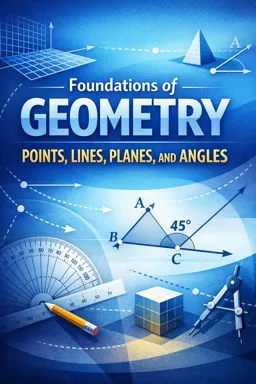
Angle relationships: linear pairs, vertical angles, complementary/supplementary; transversals
Polygons: definitions, classifications, and interior/exterior angle sums (e.g., heptagon)
Inductive vs deductive reasoning; forming conjectures and validating with logic
Proof skills: properties of equality/congruence; paragraph and flowchart proofs
Triangle theorems: Triangle Sum, exterior angle theorem, and Pythagorean Theorem
Triangle congruence (ASA, etc.) and applications incl. isosceles triangle properties
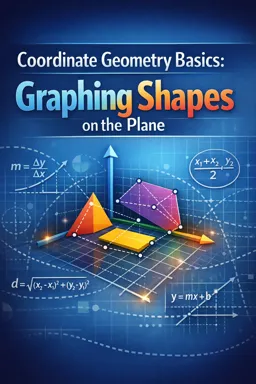
Coordinate geometry: distance formula, midpoint, and coordinate proofs; bisector theorems
Points of concurrency in triangles: circumcenter, incenter, centroid, orthocenter; coordinates
Ratios, proportions, triangle inequality; similar polygons and similarity criteria
Proportionality theorems with parallel lines in triangles; transformations and similarity
Special right triangles (45-45-90) and right-triangle problem solving
Quadrilaterals: properties of rectangles, rhombi, kites, squares; perimeter applications
Circles: arc length/central angle, equations, chord theorems, and secant/tangent angles
About the free online course
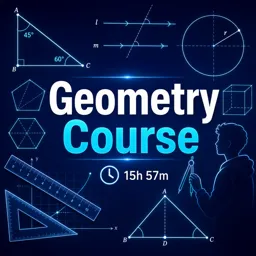
Geometry gets easier when you can see how the rules connect. This free online geometry course is designed to help you move from memorizing formulas to understanding why they work, so you can solve problems with confidence in class, on exams, or while catching up after a tough unit. From the first lessons, you’ll build a clean foundation in the language of geometry and the habits that make studying more efficient: organized notes, clear diagrams, and step-by-step reasoning.
As you progress, you’ll strengthen core skills such as working with angles, transversals, polygons, and triangle relationships, while learning how to justify each step using definitions, properties, and theorems. A major focus is mathematical reasoning and proof, helping you turn observations into solid arguments and recognize which facts actually support a conclusion. This makes a big difference not only for traditional proofs, but also for multi-step questions where one small mistake can derail the entire solution.
The course also connects geometry to coordinate methods, bringing in distance, midpoint, and coordinate proofs so you can translate shapes into equations and verify results algebraically. You’ll continue into similarity, proportional reasoning, and transformations, which are essential for scale problems, real-world measurements, and comparing figures accurately. Later lessons expand into circles, where angle relationships, arcs, chords, and secants become a coherent system rather than a list of separate rules.
To round out your toolkit, you’ll practice area and volume in a way that emphasizes smart decomposition and choosing efficient strategies. Throughout the course, frequent exercises and multiple tests mirror typical school assessments, so you can identify weak spots, improve accuracy, and track your progress over time. If your goal is a stronger grade, better test performance, or a complete refresher, this course provides a structured path to mastering geometry with steady practice and clear explanations.
Course content
Video class: Geometry Course--Class 1: An Introduction, Staying Organized, and Course Content1h09m
Video class: Geometry Course--Class 2: Fundamental Geometry (Part I)1h30m
Exercise: In the study of geometry, certain concepts like points, lines, and planes are fundamental. Which of the following is NOT true about these concepts?
Video class: Geometry Course--Class 3: Fundamental Geometry (Part II)1h31m
Exercise: If two angles form a linear pair and one of the angles measures 110 degrees, what is the measure of the other angle?
Video class: Geometry Course--Class 4: Fundamental Geometry (Part III)44m
Exercise: Identify the following statement that accurately describes a polygon.
Video class: Geometry Course--Class 5: Inductive and Deductive Reasoning1h31m
Exercise: What is the core difference between inductive and deductive reasoning as discussed in the geometry course?
Video class: Geometry Course--Class 6: Proofs and Properties of Equality and Congruence (Part I)1h28m
Exercise: Which property is illustrated by the statement: If a = b and b = c, then a = c?
Video class: Geometry Course--Class 7: Proofs and Properties of Equality and Congruence (Part II)1h10m
Exercise: What concept helps in proving equal angles when they are opposite each other?
Video class: Geometry Course--Class 8: Proofs and Properties of Equality and Congruence (Part III)1h03m
Exercise: In a geometry class, you are asked to prove that two angles are congruent. If angle X and angle Y are both complementary to angle Z, what can be concluded about angle X and angle Y?
Video class: Geometry Course--Class 10: Test I11m
Exercise: What is the total possible score for the geometry test described in the text?
Video class: Geometry Course--Class 11: Angles Formed by Transversals1h15m
Exercise: In a given geometric figure, two lines are cut by a transversal. If one of the angles formed measures 120 degrees on the exterior of one line, what is the measure of the corresponding angle on the other line when these lines are not specified as parallel?
Video class: Geometry Course--Class 12: Triangles (The Pythagorean Theorem and the Triangle Sum Theorem).1h38m
Exercise: What is the classification of a triangle where two of its angles are given as 45 degrees and the third angle is unknown?
Video class: Geometry Course--Class 13: Triangle Congruence Postulates and Theorems.1h31m
Exercise: Given that two triangles are congruent based on Angle-Side-Angle (ASA) postulate, which of the following statements is true?
Video class: Geometry Course--Class 14: Applications of Triangle Congruence and More Triangle Theorems1h28m
Exercise: Given a triangle ABC, where angle A and angle B are congruent, which side must be congruent to side AC for triangle ABC to be isosceles?
Video class: Geometry Course--Class 15: The Distance Formula and the Midpoint in Two Dimensions2h06m
Exercise: Given two points on a coordinate grid, if the coordinates of point A are (2, 3) and point B are (8, y), and the distance between the two points is 10 units, what are the possible values of y?
Video class: Geometry Course--Class 16: Coordinate Proofs and Bisector Theorems2h00m
Exercise: Given triangle ABC, point D is on the perpendicular bisector of segment AB. Which property must be true about segment AD and segment BD?
Video class: Geometry Course--Class 17: Review for Test 21h37m
Exercise: In an isosceles triangle, two sides are known to be congruent. If the measure of one of the base angles is 40 degrees, what is the measure of the vertex angle?
Video class: Geometry Course--Class 18: Test 210m
Exercise: In a triangle, the sum of the measures of two consecutive interior angles is 120 degrees. What is the measure of the third angle?
Video class: Geometry Course--Class 19: Points of Concurrency Generated by Triangles1h37m
Exercise: In a triangle, which of the following is true about the circumcenter?
Video class: Geometry Course--Class 20: Review on Linear Equations, Linear Graphs, and Systems of Equations.1h31m
Exercise: If we have the equations y = 2x + 3 and 4x - y = 5 in a system of equations, which substitution should we use to find the values of x and y?
Video class: Geometry Course--Class 21: Finding the Coordinates of Points of Concurrency Generated by Triangles1h44m
Exercise: What are the coordinates of the orthocenter for a triangle with vertices at A(-4, 0), B(4, 4), and C(0, 8)?
Video class: Geometry Course--Class 22: Ratios, Proportions, and Triangle Inequality Theorems1h26m
Exercise: In a triangle, if the sides of different lengths are 5 cm, 12 cm, and x cm, which of the following must be true for the values of x to form a triangle?
Video class: Geometry Course--Class 23: Similar Polygons and Similarity Postulates and Theorems1h34m
Exercise: Which condition is necessary to prove that two polygons are similar using the concept of similarity in geometry?
Video class: Geometry Course--Class 24: Proportionality Theorems, Transformations, and More on Similar Polygons1h21m
Exercise: In geometry, when a line segment is drawn parallel to one side of a triangle and intersects the other two sides, how are the segments formed on these two sides related?
Video class: Geometry Course--Class 25: Review for Test 31h29m
Exercise: Given a triangle with sides measuring x, 12, and 16, what is the range of values for x so that these sides can form a triangle?
Video class: Geometry Course--Class 26: Test 312m
Exercise: A triangle has two sides measuring 7 cm and 11 cm. Which of the following could be the length of the third side to form a valid triangle?
Video class: Geometry Course--Class 27: Right Triangles (Part I)1h24m
Exercise: In a 45-45-90 triangle, if the length of one leg is 8, what is the length of the hypotenuse?
Video class: Geometry Course--Calss 29: Special Quadrilaterals (Part I) and Angles of Polygons1h46m
Exercise: A polygon is a seven-sided figure. What is the measure of the sum of its interior angles?
Video class: Geometry Course--Class 30: Special Quadrilaterals (Part II)1h51m
Exercise: Which property is true for all rectangles, but not necessarily for all rhombi?
Video class: Geometry Course--Class 31: Special Quadrilaterals (Part III)1h24m
Exercise: In a geometry class focusing on special quadrilaterals, we learned that certain properties can be derived from the definition of a kite, which is a quadrilateral with two pairs of congruent adjacent sides. If a quadrilateral ABCD is identified as a kite, which of the following statements must be true?
Video class: Geometry Course--Class 32: Review for Test 41h24m
Exercise: A quadrilateral is classified as a rectangle. If the length of one side is given as 8 units and the length of the adjoining side is 5 units, what is the perimeter of the rectangle?
Video class: Geometry Course--Class 33: Test 408m
Exercise: In a triangle, the exterior angle is equal to the sum of the two non-adjacent interior angles. If one of these interior angles is 40 degrees, and the exterior angle is 110 degrees, what is the measure of the other non-adjacent interior angle?
Video class: Geometry Course--Class 34: Circles (Part I).2h00m
Exercise: Given a circle with center K, arc AB has a length of 15 units and the radius of the circle is 9 units. What is the measure of the central angle (in degrees) subtended by arc AB?
Video class: Geometry Course--Class 35: Circles (Part II)2h04m
Exercise: If a circle has a center at (3, -2) and its radius is 5, what is the equation of the circle?
Video class: Geometry Course--Class 36: Circles (Part III)1h17m
Exercise: Which angle theorem is used when the vertex of an angle is outside a circle and involves two secants or a secant and a tangent?
Video class: Geometry Course--Class 37: Review for Test 51h09m
Exercise: In a circle, a chord is equidistant from the center. If one chord's length is 14 cm, and another chord is set at the same distance from the center, which statement is true about the second chord?
Video class: Geometry Course--Class 38: Test 507m
Exercise: A square has an area of 64 square units. If its side length is increased by 2 units, what is the new area of the square?
Video class: Geometry Course--Class 39: Area (Part I)1h43m
Exercise: For a composite shape consisting of a rectangle with a length of 10 units and a width of 4 units, and a triangle on top with a base of 10 units and a height of 6 units, calculate the total area of the shape.
Video class: Geometry Course--Class 40: Area (Part II)1h35m
Exercise: In the video, a method to find the area of a segment of a circle is discussed. Which of the following steps is NOT mentioned as part of the process?
Video class: Geometry Course--Class 41: Area (Part III)1h23m
Exercise: A regular hexagon is inscribed in a circle with a radius of 6 cm. What is the area of one of the triangles formed by drawing segments from the center to its vertices?
Video class: Geometry Course--Class 42: Volume1h33m
Exercise: What is the correct volume formula for a right rectangular prism?
Video class: Geometry Course--Class 43: Paragraph Proofs and Flowchart Proofs48m
Exercise: In geometry proof methods, which of the following statements describes the basic purpose of a flowchart proof?
Video class: Geometry Course--Class 46: Review for Part I of the Final Test1h22m
Exercise: If the length of segment AB is 8x - 3 and the length of segment BC is 5x + 12, and point B is the midpoint of segment AC, what is the value of x?
Video class: Geometry Course--Class 48: Review for Part II of the Final Test1h42m
Exercise: In a circle, two chords, AB and CD, intersect at point E inside the circle. If AE = 3 cm, BE = 5 cm, CE = 2 cm, and DE = x cm, find the length of DE.
Video class: Geometry Course--Class 49: The Final Test (Part II)05m
Exercise: In a triangle, the sum of the internal angles is always:
Video class: Geometry Course--Class 50: Calculating Your Final Grade10m
Exercise: In the presented geometry course grading system, how many total points are possible from the homework, tests, and final exam combined?
This free course includes:
59 hours and 56 minutes of online video course
Digital certificate of course completion (Free)
Exercises to train your knowledge
100% free, from content to certificate
What geometry proof methods are taught in the Geometry Complete Course?
The course teaches deductive reasoning, properties of equality and congruence, paragraph proofs, flowchart proofs, coordinate proofs, and triangle-congruence proofs.
Does the Geometry Complete Course cover circle equations, arcs, chords, secants, and tangents?
Yes. The circle units cover equations of circles, central angles, arcs, chords, secants, tangents, and related angle theorems.
Which coordinate geometry skills are included in this free geometry course?
It covers the distance formula, midpoint formula, coordinate proofs, perpendicular bisectors, systems of equations, and finding triangle concurrency-point coordinates.
Ready to get started?Download the app and get started today.