
Free ebook for absolute beginners covering atoms, periodic trends, chemical bonds, equations, reactions, acids, and bases.
Free ebook content
-

Matter and Measurement: Particles, Properties, and Units
+ Exercise: Which statement best distinguishes an intensive property from an extensive property?
-
Atomic Structure: Protons, Neutrons, Electrons, and Ions
+ Exercise: A particle has 17 protons and 18 electrons. What is its ion charge and type?
-
Periodic Table Patterns: Groups, Periods, and Predicting Behavior
+ Exercise: Which periodic table approach best predicts the formula of an ionic compound like calcium chloride?


-
Chemical Bonding: Why Atoms Stick Together
+ Exercise: A student observes that a substance conducts electricity when melted but not as a solid. Which bonding model best explains this behavior?
-
Ionic Bonding: Electron Transfer, Charges, and Formula Writing
+ Exercise: Which formula correctly represents calcium nitrate while showing that nitrate stays as a single polyatomic ion unit?
-
Covalent Bonding: Sharing Electrons, Molecules, and Polarity
+ Exercise: Why can a molecule with polar bonds still be nonpolar overall?
-
Naming and Interpreting Compounds: From Symbols to Substances
+ Exercise: Which name correctly follows the rules for naming the hydrate CuSO4·5H2O?
-
Chemical Equations: Reactants, Products, and Conservation of Mass
+ Exercise: When balancing a chemical equation to satisfy conservation of mass, which change is valid?
-
Balancing Equations: Step-by-Step Practice with Simple Reactions
+ Exercise: When balancing a chemical equation, what change is allowed to make atom counts match on both sides?
-
Reaction Types: Synthesis, Decomposition, Replacement, and Combustion
+ Exercise: A reaction in aqueous solution is classified as double replacement. Which condition best explains when it will actually proceed rather than just being a paper swap of ions?
-
Acids and Bases: pH, Indicators, and Neutralization
+ Exercise: Which statement best explains why a solution at pH 3 is considered more acidic than a solution at pH 4?
-
Common Misconceptions: Frequent Mix-Ups and How to Fix Them
+ Exercise: Which statement correctly distinguishes between a subscript and a coefficient in a chemical expression?
-
Essential Chemistry Glossary: Core Terms for Beginners
+ Exercise: A reaction speeds up when a substance is added, and that substance is still present afterward. Which term best fits?
About the free ebook
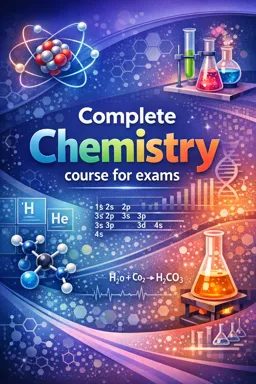
Chemistry Foundations: Atoms, Bonds, and Reactions for Absolute Beginners
This free online ebook introduces the essential ideas of chemistry in clear, practical language. Build a reliable foundation for understanding what matter is, how it is measured, and why substances have different properties.
Understand atoms and the periodic table
Explore protons, neutrons, electrons, ions, and the patterns that make the periodic table a useful tool. Learn how an element's position can help predict its likely behavior and interactions.
See how compounds form
Discover why atoms bond, how ionic and covalent bonds differ, and how charges, electron transfer, and electron sharing affect chemical formulas and molecular polarity. Practice interpreting symbols and naming common compounds.
Read and balance chemical reactions
Learn to identify reactants and products, apply the conservation of mass, and balance simple chemical equations step by step. The ebook also explains major reaction types, including synthesis, decomposition, replacement, and combustion.
Connect chemistry to observable changes
Use pH, indicators, and neutralization to understand acids and bases. Helpful explanations address frequent chemistry mix-ups, while an essential glossary supports confident use of core scientific vocabulary.
What you will be able to do
- Distinguish elements, compounds, mixtures, atoms, and ions.
- Use periodic table groups and periods to recognize patterns.
- Write and interpret basic formulas and equations.
- Balance straightforward reactions without changing subscripts.
- Explain key differences between ionic and covalent bonding.
Designed for absolute beginners, this ebook turns foundational chemistry concepts into manageable steps for school study and independent learning.
What is the difference between an ionic bond and a covalent bond?
Ionic bonds form through electron transfer and attraction between charged ions; covalent bonds form when atoms share electrons.
How do you balance a chemical equation?
Add coefficients in front of formulas until each element has the same number of atoms on both sides of the equation.
What do groups and periods mean on the periodic table?
Groups are vertical columns with similar chemical behavior, while periods are horizontal rows that reflect electron-shell patterns.
This ebook includes:

13 content chapters

Digital certificate of course completion (Free)

Exercises to train your knowledge

100% free, from content to certificate
Ready to get started?

 recommended
In the app you will also find...

Over 5,000 free courses
Programming, English, Digital Marketing and much more! Learn whatever you want, for free.

Study plan with AI
Our app's Artificial Intelligence can create a study schedule for the course you choose.

From zero to professional success
Improve your resume with our free Certificate and then use our Artificial Intelligence to find your dream job.
You can also use the QR Code or the links below.