
Free ebook on electrochemistry covering redox reactions, cell potentials, batteries, corrosion prevention, electrolysis, and electroplating.
Free ebook content
-

Electrochemistry Essentials: Oxidation–Reduction as Electron Transfer
+ Exercise: In the redox reaction Zn(s) + Cu2+(aq) → Zn2+(aq) + Cu(s), which statement correctly describes the electron transfer and charge balance?
-
Electrochemistry Essentials: Assigning Oxidation Numbers with Confidence
+ Exercise: Which statement correctly explains why oxygen has an oxidation number of −1 in H2O2?
-
Electrochemistry Essentials: Identifying Redox Reactions and Electron Accounting
+ Exercise: During an electron audit of the reaction Zn(s) + 2 HCl(aq) → ZnCl2(aq) + H2(g), which statement correctly describes the electron transfer?
-
Electrochemistry Essentials: Balancing Redox Reactions in Aqueous Solution (Half-Reaction Method)
+ Exercise: When converting a redox equation balanced in acidic solution to basic conditions, what procedure should be applied to remove H+ correctly?


-
Electrochemistry Essentials: From Redox Reactions to Cells—Galvanic vs Electrolytic
+ Exercise: In an electroplating setup, a key is connected to the negative terminal of a DC power supply in a CuSO4 solution and copper builds up on the key. Which statement correctly describes what is happening?
-
Electrochemistry Essentials: Cell Diagrams, Notation, and Reading Electrochemical Schematics
+ Exercise: In cell notation, what do the symbols | and || represent?
-
Electrochemistry Essentials: Standard Reduction Potentials and How to Use the Table
+ Exercise: When building a galvanic cell from two standard reduction half-reactions, which procedure correctly uses E° values to choose the cathode/anode and handle electron balancing?
-
Electrochemistry Essentials: Predicting Cell Reactions and Practical Outcomes
+ Exercise: When predicting whether an electrochemical reaction is spontaneous under standard conditions, which procedure correctly calculates E°cell from standard reduction potentials?
-
Electrochemistry Essentials: Batteries—From Half-Reactions to Real Devices
+ Exercise: When a battery is delivering power (discharge), which statement correctly matches terminal labels to the electrochemical processes and charge flow?
-
Electrochemistry Essentials: Corrosion as an Unwanted Galvanic Cell
+ Exercise: A steel surface has a stationary water droplet on it. The droplet edge is oxygen-rich while the center is oxygen-poor. Where will corrosion be most concentrated and why?
-
Electrochemistry Essentials: Corrosion Prevention—Coatings, Cathodic Protection, and Material Choices
+ Exercise: For a coated steel structure that has small scratches (defects) and is exposed to an electrolyte, which pairing best explains how to reduce corrosion at those defects?
-
Electrochemistry Essentials: Electrolysis and Electroplating—Driving Nonspontaneous Reactions
+ Exercise: In an electrolytic electroplating setup using an active metal anode and a metal-ion solution, which statement best describes what happens at each electrode during plating?
-
Electrochemistry Essentials: Integrated Practice—Reading Tables, Balancing Reactions, and Explaining Observations
+ Exercise: When combining two balanced half-reactions to form a net ionic equation, which check is essential before adding them together?
About the free ebook
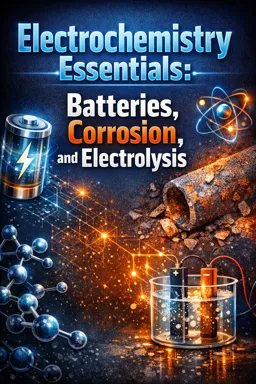
Electrochemistry Essentials: Batteries, Corrosion, and Electrolysis
This free online ebook introduces the chemistry of electron transfer and shows how redox reactions explain batteries, metal corrosion, and electrolysis. Build a reliable foundation for solving school chemistry problems while connecting equations to familiar technologies and observations.
Understand redox reactions step by step
Learn to recognize oxidation and reduction, assign oxidation numbers, track electron movement, and balance aqueous redox equations with the half-reaction method. Clear explanations help distinguish the species oxidized from the species reduced and relate electron accounting to chemical change.
Connect chemical equations to electrochemical cells
Explore galvanic and electrolytic cells, including anodes, cathodes, salt bridges, electron flow, and cell notation. Use standard reduction potentials to predict whether a reaction is spontaneous and calculate the direction of a cell reaction.
Apply electrochemistry to real materials
See how batteries convert chemical energy into electrical energy, why corrosion behaves like an unwanted galvanic cell, and how coatings, cathodic protection, and material selection can limit damage. The ebook also explains electrolysis and electroplating as processes driven by an external power source.
What you will be able to do
- Identify oxidation, reduction, oxidizing agents, and reducing agents.
- Balance redox reactions in aqueous solution.
- Read cell diagrams and interpret electrochemical schematics.
- Use reduction-potential data to predict cell behavior.
- Explain corrosion prevention and electroplating outcomes.
Integrated practice brings these ideas together through reaction analysis, table reading, and observation-based explanations.
How do you identify the anode and cathode in a galvanic cell?
Oxidation occurs at the anode and reduction occurs at the cathode. In a galvanic cell, the anode is negative and the cathode is positive.
How are standard reduction potentials used to predict a spontaneous reaction?
Combine the cathode reduction potential with the reversed anode value. A positive cell potential indicates a spontaneous reaction under standard conditions.
Why does iron rust faster when it is in contact with another metal?
Contact between dissimilar metals can form a galvanic cell. The more easily oxidized metal becomes the anode and may corrode more rapidly.
This ebook includes:

13 content chapters

Digital certificate of course completion (Free)

Exercises to train your knowledge

100% free, from content to certificate
Ready to get started?

 recommended
In the app you will also find...

Over 5,000 free courses
Programming, English, Digital Marketing and much more! Learn whatever you want, for free.

Study plan with AI
Our app's Artificial Intelligence can create a study schedule for the course you choose.

From zero to professional success
Improve your resume with our free Certificate and then use our Artificial Intelligence to find your dream job.
You can also use the QR Code or the links below.