Duration of the online course: 6 hours and 14 minutes
New
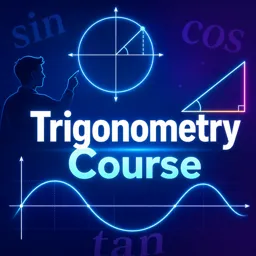
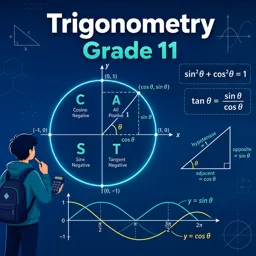
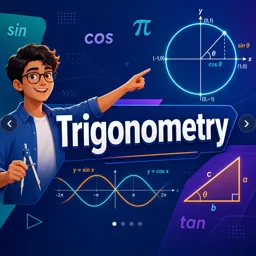
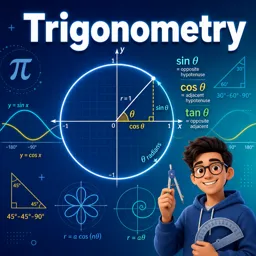
Master angles, radians, unit circle, and identities in a free online trigonometry course with practice exercises—boost math grades and problem-solving fast.
In this free course, learn about
Angle basics: standard position, angle types (quadrantal), and relationships (adjacent, etc.)
Degree measure incl. DMS and conversions to decimal degrees
Radian measure: definition via arc length and converting degrees ↔ radians
Pythagorean theorem: use, proof idea, and recognizing Pythagorean triples
Distance formulas in 2D and 3D using coordinates
Trig ratios (SOHCAHTOA), cofunction relationships, and unit circle definitions
Exact sin/cos values for common angles; tangent from sine/cosine
Calculator skills: degree/radian modes, evaluating trig and inverse trig functions
Modeling with trig: components of vectors and solving right triangles
Graphs of trig functions: sin/cos/tan/cot/sec/csc plus domain, range, asymptotes
Inverse trig functions: principal values, ranges, and inverse-function algebra
Solving non-right triangles: Law of Sines/Cosines, SSA ambiguity, triangle area
Trig identities and proofs: Pythagorean, even/odd, sum-diff, double/half-angle
Trig transformations and polar coordinates/equations (e.g., r=4 is a circle)
About the free online course
Strengthen your math foundation by learning how to use trigonometry with confidence, from the first idea of an angle to the tools needed to solve real problems. This free online course is built to help you move beyond memorizing formulas and start understanding what the functions mean, how they relate to triangles and circles, and why they behave the way they do.
You will develop a clear sense of angles in standard position, the difference between degrees and radians, and how to convert and interpret each in practical settings. With a solid geometry refresh, you connect right-triangle thinking to coordinate geometry, distance formulas, and the Pythagorean theorem, creating the bridge that makes trig ratios feel intuitive instead of abstract. From there, the course guides you into the unit circle, showing how sine, cosine, and tangent extend to all quadrants and how common angle values can be understood, verified, and used efficiently.
As you progress, you will gain skill with calculators in both degree and radian modes, learn how trigonometric functions behave on graphs, and understand domain, range, and key features such as zeros, asymptotes, and periodicity. This knowledge makes it easier to interpret models and predict how changing parameters affects a curve, which is essential for many school topics and exam problems.
The course also builds mathematical maturity through inverse functions and inverse trigonometric functions, helping you interpret answers correctly and avoid common traps with principal values. You then apply trigonometry to triangle solving beyond right triangles, using laws of sines and cosines and understanding when solutions are unique, ambiguous, or impossible. To finish, you develop fluency with identities, including Pythagorean, sum and difference, double-angle, and half-angle relationships, reinforcing the logic of proofs and the algebraic flexibility needed in advanced math.
With short checks and exercises throughout, this course is ideal for students who want stronger grades, test readiness, or a reliable path into precalculus, physics, and engineering fundamentals.
Course content
Video class: TR-00: Introduction to Trigonometry Series by Dennis F. Davis05m
Exercise: What is the primary focus of the trigonometry series described?
Video class: TR-01: Introduction to Angles (Trigonometry series by Dennis F. Davis)06m
Exercise: What is the standard position of an angle on the Cartesian coordinate system?
Video class: TR-02: Types of Angles (Trigonometry series by Dennis F. Davis)05m
Exercise: What is a quadrantal angle?
Video class: TR-03: Angle Relationships (Trigonometry series by Dennis F. Davis)03m
Exercise: When two angles share a vertex and one side but do not overlap, what is this pair of angles called?
Video class: TR-04: Angle Measurement in Degrees (Trigonometry series by Dennis F. Davis)05m
Exercise: In trigonometry, which angle is often referred to as a common angle and represents a quarter of a full circle?
Video class: TR-04Z: Degrees Minutes and Seconds (Trigonometry series by Dennis F. Davis)06m
Exercise: What is the decimal equivalent of an angle measured as 37 degrees, 25 minutes, and 50 seconds?
Video class: TR-05: Introduction to Radians (Trigonometry series by Dennis F. Davis)05m
Exercise: What is the angle in radians subtended by an arc of length 5 meters on a circle with a radius of 5 meters?
Video class: TR-06: Angle Measurement in Radians (Trigonometry series by Dennis F. Davis)07m
Exercise: Which of the following is equivalent to 120 degrees when expressed in radians?
Video class: TR-07: Geometry Review of Triangles (Trigonometry series by Dennis F. Davis)07m
Exercise: In a triangle, if the vertex angle is 50 degrees, what are the measures of the base angles in an isosceles triangle?
Video class: TR-07Z: First Proof Thales' Theorem (Trigonometry series by Dennis F. Davis)02m
Exercise: Given a circle with a diameter AB, if a point C is placed on the circumference of the circle, what type of angle does triangle ABC form at point C?
Video class: TR-08: Similar and Congruent Triangles (Trigonometry series by Dennis F. Davis)04m
Exercise: What makes two triangles similar?
Video class: TR-09: The Pythagorean Theorem (Trigonometry series by Dennis F. Davis)03m
Exercise: In a right triangle, if the lengths of the two shorter sides are 5 meters and 12 meters, what is the length of the hypotenuse?
Video class: TR-09Z: Proof of Pythagorean Theorem (Trigonometry series by Dennis F. Davis)02m
Exercise: In a right triangle, which of the following equations represents the Pythagorean theorem?
Video class: TR 10: Pythagorean Triples (Trigonometry series by Dennis F. Davis)03m
Exercise: Which of the following sets of numbers is a Pythagorean triple?
Video class: TR-11: Distance Between Points in a Plane (Trigonometry series by Dennis F. Davis)03m
Exercise: What is the distance between the points (3, 4) and (7, -2) on a Cartesian coordinate plane?
Video class: TR-12: Distance Between Points in Space (Trigonometry series by Dennis F. Davis)03m
Exercise: If a point in 3D space has coordinates (3, 4, 5), what is the distance from the origin to this point?
Video class: TR-13: The Trigonometric Ratios (Trigonometry series by Dennis F. Davis)06m
Exercise: Using the mnemonic SOHCAHTOA for trigonometric ratios, what is the cosine of an angle in a right triangle with an adjacent side of 6 units and a hypotenuse of 10 units?
Video class: TR-13Z: How the Co- Trig Functions got their Names03m
Exercise: In a right triangle, if angle theta is the complement of angle beta, which of the following expressions is true regarding their trigonometric functions?
Video class: TR-14: The Unit Circle (Trigonometry series by Dennis F. Davis)06m
Exercise: What is the value of the tangent function for an angle θ on the unit circle where the sine of θ is 0.6 and the cosine of θ is 0.8?
Video class: TR-15: Sine and Cosine of Common Angles (Trigonometry series by Dennis F. Davis)06m
Exercise: Which of the following values is the sine of 135 degrees?
Video class: TR-15Z: Proof of the Common Sine and Cosine Values04m
Exercise: Using a unit circle, which of the following represents the sine of a 45-degree angle?
Video class: TR-16: Trig Functions on a Calculator (Trigonometry series by Dennis F. Davis)09m
Exercise: If you want to find the tangent of 45 degrees using a calculator, which steps must you follow if your calculator is currently set to radians mode?
Video class: TR-17: Most Common Use of Trigonometry (Trigonometry series by Dennis F. Davis)04m
Exercise: If you have a vector with a magnitude of 20 units making an angle of 30 degrees with the horizontal axis, what is the length of the component in the vertical direction?
Video class: TR-18: Graphing Sine and Cosine (Trigonometry series by Dennis F. Davis)08m
Video class: TR-19: Graphing Tangent and Cotangent (Trigonometry series by Dennis F. Davis)10m
Exercise: Which of the following statements about the tangent function is true?
Video class: TR-20: Graphing Secant and Cosecant (Trigonometry series by Dennis F. Davis)03m
Exercise: In trigonometry, what happens to the secant function at angles where the cosine of the angle equals zero?
Video class: TR-21: Domain and Range of Trig Functions (Trigonometry series by Dennis F. Davis)05m
Exercise: For the function f(x) = x^2, what are the constraints on its range?
Video class: TR-22: Algebra Review of Inverse Functions (Trigonometry series by Dennis F. Davis)04m
Exercise: Consider a function f(x) = (3x - 4)/(5x + 2). Which of the following is an inverse function of f(x)?
Video class: TR-23: Inverse Sine and Cosine Functions (Trigonometry series by Dennis F. Davis)09m
Exercise: What is the value of arc sine of a ratio within the defined range for inverse sine functions?
Video class: TR-23X: Inverse Sine and Cosine Functions (Trigonometry series by Dennis F. Davis)06m
Exercise: If the sine of an angle is 0.5, which of the following represents the arc sine of sine 5π/6?
Video class: TR-24: Other Inverse Trig Functions (Trigonometry series by Dennis F. Davis)03m
Exercise: What is the range of the inverse secant (arcsecant) function?
Video class: TR-25: Inverse Trig Functions on a Calculator (Trigonometry series by Dennis F. Davis)05m
Exercise: When using a scientific calculator to determine inverse trigonometric functions, what is the result of calculating the arc sine of 0.777?
Video class: TR-26: Solving Right Triangles (Trigonometry series by Dennis F. Davis)09m
Exercise: In a right triangle, if one of the angles is 35 degrees and the length of the side adjacent to this angle is 12 units, what is the length of the hypotenuse?
Video class: TR-27: Triangle Types to Solve (Trigonometry Series by Dennis F. Davis)06m
Exercise: In solving triangles, which of the following configurations represents a scenario where two sides and the included angle are known, resulting in a unique solution?
Video class: TR-28: The Law of Sines (Trigonometry series by Dennis F. Davis)08m
Exercise: In a triangle, if you know two sides, c and b, and the included angle A, what formula would you use to find the area of this triangle?
Video class: TR-29: The Law of Cosines (Trigonometry series by Dennis F. Davis)08m
Exercise: Given a triangle with sides a, b, and c, and an angle heta opposite to side c, how can the law of cosines be used to find the length of side c?
Video class: TR-29Z: Proof of the Law of Cosines02m
Video class: TR-30: SSA Triangles Overview (Trigonometry series by Dennis F. Davis)02m
Exercise: When solving SSA triangles, which scenario results in two solutions?
Video class: TR-31: Solving SSA Triangles (Trigonometry series by Dennis F. Davis)08m
Exercise: When applying the law of sines to an SSA triangle and you find that the sine of an angle is greater than 1, what does this indicate?
Video class: TR-32: Intro to Identities and Proofs (Trigonometry series by Dennis F. Davis)07m
Exercise: Which of the following expressions is an example of a trigonometric identity?
Video class: TR-33: Pythagorean Trig Identities (Trigonometry series by Dennis F. Davis)04m
Exercise: Which of the following is a Pythagorean identity in trigonometry?
Video class: TR-33Z: All Trig Functions on the Unit Circle (Trigonometry series by Dennis F. Davis)07m
Exercise: On the unit circle, what is the geometric interpretation of the length corresponding to the tangent of an angle?
Video class: TR-34: Using Pythagorean Identities (Trigonometry series by Dennis F. Davis)09m
Exercise: Given an acute angle \( \theta \) where \\( \cos(\theta) = 0.6 \\), what is \( \sin(\theta) \)?
Video class: TR-35: Using Conjugate Identities in Trig Proofs (Trigonometry series by Dennis F. Davis)08m
Exercise: What is the result when multiplying two conjugates like (a + b) and (a - b)?
Video class: TR-36 - Even and Odd Trig Functions (Trigonometry series by Dennis F. Davis)06m
Exercise: What is the defining characteristic of an odd function?
Video class: TR-37: More Trig Reflections (Trigonometry series by Dennis F. Davis)08m
Exercise: If angle theta is in standard position, which of the following identities is always true?
Video class: TR-38: Angle Sum and Difference Identities (Trigonometry series by Dennis F. Davis)07m
Exercise: Given the angle sum identities, what is the expression for the sine of the sum of two angles, alpha and beta?
Video class: TR-39: Using Sum and Diff Identities (Trigonometry series by Dennis F. Davis)07m
Exercise: Using the angle sum identities, what is the cosine of (π/4 + π/3)?
Video class: TR-40: Double Angle Identities (Trigonometry series by Dennis F. Davis)06m
Exercise: Using the double angle identities, which of the following expressions is equivalent to \(\sin(2\theta)\)?
Video class: TR-41: Half Angle Identities (Trigonometry series by Dennis F. Davis)10m
Exercise: Which identity is used to express the cosine of theta over 2 in terms of the cosine of theta?
Video class: TR-42: Trig Graph Variations (Trigonometry series by Dennis F. Davis)07m
Exercise: Which of the following describes the effect of adjusting the amplitude of a sine wave function used to model a physical phenomenon?
Video class: TR-43: Trig Graph Variations 2 (Trigonometry series by Dennis F. Davis)11m
Exercise: What happens to the period of the sine wave y = sin(b * theta) when the parameter b is set to 3?
Video class: TR-44: Trig Graph Variations 313m
Exercise: In the general trigonometric equation y = a sin(bθ + c) + d, what does the 'c' parameter primarily affect?
Video class: TR-45: Polar Coordinates (Trigonometry Series by Dennis F. Davis)10m
Video class: TR-46: Polar Equations (Trigonometry Series by Dennis F. Davis)24m
Exercise: In polar coordinates, what is the graph of the equation r = 4?
This free course includes:
6 hours and 14 minutes of online video course
Digital certificate of course completion (Free)
Exercises to train your knowledge
100% free, from content to certificate
How do you convert degrees to radians in trigonometry?
Multiply the degree measure by π/180. For example, 120° = 2π/3 radians.
When should I use the Law of Sines versus the Law of Cosines?
Use the Law of Sines for ASA, AAS, or SSA cases; use the Law of Cosines for SAS or SSS triangles.
What does the unit circle help you find in trigonometry?
It shows sine and cosine values, trig-function signs, and common-angle coordinates for any angle.
Ready to get started?Download the app and get started today.