Duration of the online course: 16 hours and 32 minutes
New
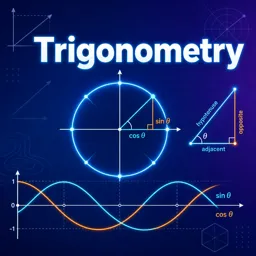
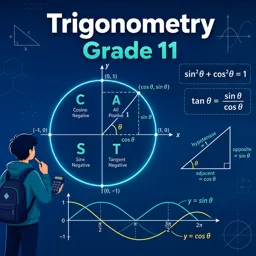
Master trig fast—unit circle, identities, graphs, and equations—with a free online course plus practice problems to boost grades and confidence.
In this free course, learn about
Angle notation: standard position, coterminal angles, quadrants, and reference angles
Convert degree↔radian and handle DMS (degrees-minutes-seconds) measures
Build/use the unit circle to evaluate trig values and signs for any angle
Arc length and linear speed from angular speed (s = rθ, v = rω) applications
Right-triangle trig: SOHCAHTOA, inverse trig for angles, and cofunction relations
Graph transformations for sin/cos/tan/sec: amplitude, period, phase/vertical shifts
Inverse trig functions: principal values and ranges (e.g., arccos range)
Simplify expressions using fundamental identities (reciprocal, quotient, Pythagorean)
Prove/verify identities, including algebraic manipulation and substitutions
Apply sum/difference, double-angle, half-angle, and product↔sum formulas
Solve trigonometric equations on [0,2π] and for all solutions (general solutions)
Oblique triangles: Law of Sines/Cosines, ambiguous SSA case, and area formulas
Polar coordinates & equations; convert between polar/rectangular; symmetry tests
Complex numbers in polar form: De Moivre for powers/roots; vectors & dot/projection
About the free online course
Trigonometry feels much easier once you can see how angles, triangles, and circles tell the same story. This free online course helps you build that connected understanding, step by step, so you can move from memorizing to actually reasoning. You will start by making sense of standard position angles, coterminal angles, and the everyday conversions between degrees and radians, including degree-minute-second notation. With those fundamentals in place, you will be able to interpret angle measure fluently and avoid the common mistakes that slow students down.
From there, the unit circle becomes a powerful tool rather than a diagram to recite. You will learn how reference angles and quadrants control signs, and how sine and cosine correspond to coordinates on the circle. This leads naturally into evaluating trig functions accurately, connecting angular speed and linear speed, and applying arc length ideas to real scenarios. As your confidence grows, you will practice rewriting and simplifying expressions using reciprocal, quotient, and Pythagorean identities, including strategies for evaluating expressions without relying on a calculator.
The course also strengthens your right-triangle skills: solving for missing sides, finding acute angles with inverse trig, and using cofunctions and complementary relationships correctly. Then you will expand to trigonometric functions of any angle, where quadrant reasoning becomes essential, and you will develop intuition for graphs. By working with transformations, periods, and key features of sine, cosine, tangent, and secant, you will learn to read and build equations from graphs and to model real situations with periodic functions.
As you progress, you will practice proving and verifying identities, using sum and difference formulas, half-angle and double-angle relationships, and product-to-sum techniques. You will also solve trigonometric equations with both restricted intervals and general solutions, learning how to capture every valid angle. Finally, the course broadens into applications that often appear in advanced classes: oblique triangles with the Law of Sines and Law of Cosines, area formulas including Heron’s method, polar coordinates and conversions, complex numbers in polar form with De Moivre’s Theorem, and vectors with dot products, projections, and navigation-style bearing problems. By the end, you will have a complete, practical trigonometry toolkit built through explanation, repetition, and targeted exercises.
Course content
Video class: Standard Position Angles13m
Exercise: What is the definition of a coterminal angle in trigonometry?
Video class: Standard Position Angles Pt2 Converting Degrees and Radians11m
Exercise: How do you convert 40 degrees to radians?
Video class: Angle Measures in Degrees Minutes18m
Exercise: What is the DMS notation for the number of seconds in one minute?
Video class: Setting up the Unit Circle Part 1 and Reference Angle14m
Exercise: What is the cosine of a 150-degree angle based on the unit circle?
Video class: Setting Up the Unit Circle Part 214m
Exercise: In the context of trigonometry and the unit circle, what represents the Sine of an angle on the unit circle?
Video class: Linear13m
Exercise: What is the arc length of a circle with a radius of 10 and a central angle of 225° in radians?
Video class: Linear06m
Exercise: If the front sprocket of a bicycle has a radius of 15 centimeters and is pedaled at an angular speed of 5pi/3 radians per second, what is the linear speed of the chain moving around the front sprocket?
Video class: Evaluating Trig Functions w/ Unit Circle Degrees13m
Exercise: What is the cosine of an angle of 60 degrees or pi/3 radians on the unit circle?
Video class: Fundamental Trigonometric Identities Intro14m
Exercise: What is the correct expression for the reciprocal identity of the cotangent function in terms of the tangent function?
Video class: Trig Expressions13m
Exercise: How can the expression cos(2.3) * sec(2.3) be evaluated without a calculator?
Video class: Right Triangle Trigonometry Part 1: Finding Missing Sides13m
Exercise: In right triangle trigonometry, which of the following is the correct representation of the tangent of an angle θ?
Video class: Right Triangle Trigonometry Part 2: Solving for Acute Angles04m
Exercise: What is the measure of the angle theta in degrees using inverse tangent?
Video class: Trigonometric Cofunctions10m
Exercise: In right triangle trigonometry, the term 'cofunction' is related to complementary angles. Which of the following represents a correct pair of cofunctions?
Video class: Trigonometric Functions of Any Angle14m
Exercise: In what quadrant is the angle if cosine is negative and cosecant is positive?
Video class: Understanding Basic Sine14m
Exercise: According to the passage, what is the value of cos(π)?
Video class: Graphing Sine14m
Exercise: What happens to the sine graph of y = sin(2x)?
Video class: Graphing Sine15m
Exercise: What is the common denominator used to simplify the expression for plotting the function y = sine(2x - π)?
Video class: Equation of Sine and Cosine from a Graph33m
Exercise: What is the correct equation for a given cosine graph with specified transformations?
Video class: Water Depth Word Problem Modeled with Cosine Sine Function17m
Video class: Intro Tangent14m
Exercise: What is the period of the tangent function compared to sine and cosine?
Video class: Tangent11m
Exercise: In the function y = 4*tan(πx), what is the amplitude commonly referred to as and what value does it have?
Video class: Graphing Secant15m
Video class: Evaluating Inverse Trigonometric Functions23m
Exercise: What is the range of the function inverse cosine (\(\arccos(x)\))?
Video class: Verifying Trigonometric Identities Pt 114m
Video class: Verifying Trigonometric Identities Pt 113m
Exercise: Which of the following is a correct Pythagorean identity used in trigonometry proofs?
Video class: Verifying Trigonometric Identities Pt215m
Video class: Verifying Trigonometric Identities Pt309m
Exercise: When simplifying the expression one over one minus sine theta plus one over one plus sine of theta, and showing that it equals two times secant squared theta, which trigonometric identity is primarily used to substitute one minus sine squared theta?
Video class: Sum and Difference Trigonometric Identities14m
Video class: Verifying Trigonometric Identities Involving Sum14m
Exercise: In trigonometry, the sine of sum identity is given as sin(a + b) = sin(a)cos(b) + cos(a)sin(b). Using this identity, what is sin(x + 3π/2)?
Video class: Evaluating Trigonometry Expressions with Half and Double Angles Pt116m
Video class: Evaluating Trigonometry Expressions with Half and Double Angles Pt213m
Exercise: You are given the trigonometric identity for cosine of a half angle, which is cos(θ/2) = ±√(1 + cos(θ)) / 2. If cos(θ) is -√2/2, which is in quadrant 3, determine the value of cos(θ/2) when θ/2 lies in quadrant 2.
Video class: Trigonometry Proofs Involving Half and Double Angles17m
Video class: Product to Sum and Sum to Product Formulas26m
Exercise: Which of the following correctly expresses the product-to-sum trigonometric identity for the sine of an angle (α) times the sine of a different angle (β)?
Video class: Trigonometric Equations Single Angle 0 to 2pi Restriction 5 Examples18m
Video class: Single Angle Trigonometric Equations All Solutions19m
Exercise: For the trigonometric equation 2cos^2(x) - cos(x) - 1 = 0, after factoring, what are the solutions for x in terms of cosine?
Video class: Trigonometric Equations Multiple Angles 0 to 2pi Restriction21m
Video class: Trigonometric Equations Multiple Angles All Solutions12m
Exercise: In trigonometric equations, when the equation contains a trigonometric function with a multiple angle like sin(x/2), and we are looking for all possible solutions, what do we have to add to the specific solutions to express that we are considering every possible case?
Video class: Oblique Triangles Law of Sines READ DESCRIPTION:D19m
Video class: Ambiguous Case for Law of Sines, Please read description22m
Exercise: In the case of the ambiguous law of sines (also known as the SSA condition), how do we know if there are zero, one, or two possible solutions for the triangle given two sides and a non-included angle?
Video class: Law of Cosines14m
Video class: Area of oblique triangles SAS SSS Heron's Formula05m
Exercise: Which formula cannot be used to directly calculate the area of a triangle when only the lengths of the three sides are known, and not the angles?
Video class: Applications of Law of Sines and Cosines24m
Video class: Law of Cosine14m
Exercise: When using the formula for the area of a triangle as one half of the product of two sides and the sine of the included angle (1/2 * a * b * sin(θ)), which of the following is true for a triangle with a side length of 'a' = 4 cm, another side of 'b' = 6 cm, and an area of 12√3 cm²?
Video class: Understanding Polar Coordinates22m
Exercise: In the polar coordinate system, when graphing the point (r, θ), what does it mean if r is negative?
Video class: Converting Coordinates between Polar and Rectangular Form10m
Video class: Converting Equations Between Polar24m
Exercise: What is the standard form equation of a circle with a center at (2,4) and a radius of \\( ext{the square root of 20}\)?
Video class: Graphing Polar Equations, Test for Symmetry1h00m
Video class: Complex Numbers in Polar Form12m
Exercise: Which of the following is true regarding the transformation from rectangular coordinates to polar coordinates of a complex number?
Video class: Product07m
Video class: De Moivre's Theorem powers of Polar Complex Numbers14m
Exercise: According to DeMoivre's Theorem, what is the result of raising a complex number in polar form, r(cos θ + i sin θ), to the power 'n'?
Video class: De Moivre's Theorem Roots of Polar Complex Numbers19m
Video class: Introduction to Vectors42m
Exercise: In the context of vectors in trigonometry, what is the magnitude of a vector that has a horizontal component of 6 units and a vertical component of 8 units?
Video class: Writing Vector in terms of Magnitude09m
Video class: Vector Application Examples PLEASE READ DESCRIPTION34m
Exercise: A wagon is pulled by a handle making a certain angle with a force of a known magnitude. What formula would you use to calculate the horizontal component of the force pulling the wagon along level ground?
Video class: Dot Product14m
Video class: Projection of a Vector onto another Vector19m
Exercise: What is the correct formula to calculate the projection of vector V onto vector W when given in component form?
Video class: Trigonometry Bearing Problems Navigation 4 Examples33m
This free course includes:
16 hours and 32 minutes of online video course
Digital certificate of course completion (Free)
Exercises to train your knowledge
100% free, from content to certificate
How do you convert degrees to radians in trigonometry?
Multiply the degree measure by π/180. For example, 40° = 40π/180 = 2π/9 radians.
What does a negative radius mean in polar coordinates?
A negative radius plots the point in the direction opposite the given angle, equivalent to using a positive radius and adding π radians.
How does the ambiguous SSA case work with the Law of Sines?
Compare the known opposite side to the height formed by the given angle; depending on the lengths, SSA can produce zero, one, or two triangles.
Ready to get started?Download the app and get started today.