Use the Pythagorean theorem: a² + b² = c². For c = 450 and a = 225, b = √(450² − 225²) ≈ 389.7.

Duration of the online course: 45 minutes
4

(2)
Build confidence with trigonometry basics in this free online course—solve right triangles, work with sine, vectors and angles, and learn faster with practice.
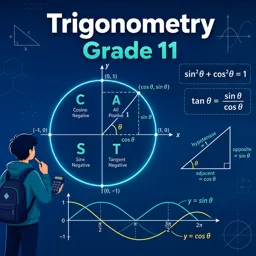
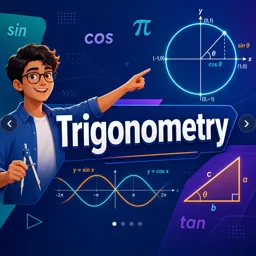
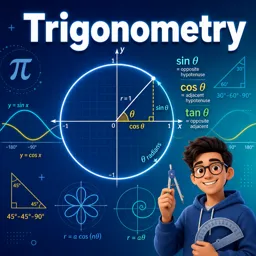
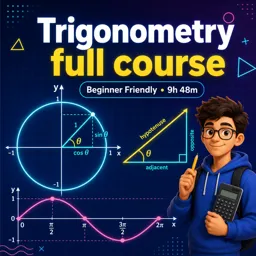
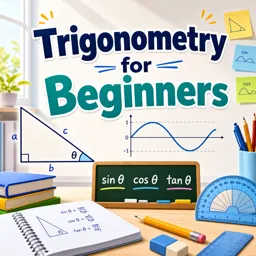
Trigonometry can feel intimidating at first, but it becomes much easier once you understand what the ratios and angles are really describing. This beginner-friendly course is designed to help you build that intuition step by step, using clear explanations and practical problem-solving. You will move from simply recognizing the parts of a right triangle to confidently using sine relationships and interpreting angle information in a way that actually makes sense.
Instead of memorizing disconnected formulas, you will learn how trigonometry links geometry to measurement. You will practice identifying opposite, adjacent, and hypotenuse, and see how those relationships help you find missing side lengths. The exercises focus on common real-world calculations, such as determining an unknown side from a known hypotenuse, or working backward from an angle and a side to compute a value using sine.
As you progress, the course also introduces the idea of quadrants and why they matter. This is a key turning point for many learners, because understanding quadrants helps explain where signs and angle positions come from, and why results change depending on direction. That context makes later trig topics far less confusing, even if you are just starting out now.
You will also explore how trigonometry applies beyond triangles through simple vector concepts. By converting between forms and working with x and y components, you will get a useful glimpse into how angles and magnitudes show up in physics, engineering, and technical problem solving. If you have ever wondered how an angle measurement can become two perpendicular components, this course will help you connect those dots with guided practice.
Whether you are reviewing for school, preparing for more advanced math, or strengthening fundamentals for STEM studies, this free online course gives you a solid foundation. By the end, you should feel more comfortable reading trig notation, solving basic problems, and applying trigonometric thinking to angles, triangles, and vectors.

45 minutes of online video course

Digital certificate of course completion (Free)

Exercises to train your knowledge

100% free, from content to certificate
How do you find a missing side in a right triangle when the hypotenuse is known?
Use the Pythagorean theorem: a² + b² = c². For c = 450 and a = 225, b = √(450² − 225²) ≈ 389.7.
How do you calculate the opposite side using sine and an angle?
Use opposite = hypotenuse × sin(θ). With a hypotenuse of 750 and θ = 67°, the opposite side is approximately 690.4.
How do you convert a vector from polar form to rectangular form?
Use x = r cos(θ) and y = r sin(θ). A vector of 35 V at 35° is approximately 28.7 + j20.1 V.
Ready to get started?Download the app and get started today.
Install the app now
to access the course
Over 5,000 free courses
Programming, English, Digital Marketing and much more! Learn whatever you want, for free.

Study plan with AI
Our app's Artificial Intelligence can create a study schedule for the course you choose.

From zero to professional success
Improve your resume with our free Certificate and then use our Artificial Intelligence to find your dream job.
You can also use the QR Code or the links below.



Carry knowledge in your pocket.
Download the Cursa app.
There are hundreds of free courses available, with a free certificate of completion that is saved in your mobile image gallery.
Download the app to access the Course Completion Certificate for Free.


+ 10 million
students

Free and Valid
Certificate

60 thousand free
exercises

4.8/5 rating in
app stores

Free courses in
video and ebooks