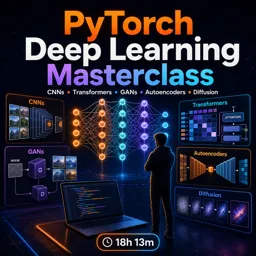
Free Course Image PyTorch Deep Learning Masterclass: CNNs, Transformers, GANs, Autoencoders and Diffusion

Free online coursePyTorch Deep Learning Masterclass: CNNs, Transformers, GANs, Autoencoders and Diffusion

Duration of the online course: 18 hours and 13 minutes

New

Free PyTorch deep learning masterclass covering CNNs, transformers, GANs, autoencoders and diffusion with hands-on projects in vision and NLP.

In this free course, learn about

  • PyTorch Fundamentals and Core Training Loop
  • Feedforward Networks: Classification, Regression, and Activations
  • Convolutional Neural Networks and Practical Vision Training
  • Improving Generalization and Unsupervised Pretraining for CNNs
  • Vision Tasks: Detection and Segmentation
  • Interpretability and Autoregressive MLPs
  • Sequence Modeling with RNNs and LSTMs
  • Attention Mechanisms and Self-Attention in Practice
  • Transformers: Text, Vision, and Encoder-Decoder Models
  • Deployment and Multimodal Transformers
  • Advanced Diffusion: Latent Diffusion and Diffusion Transformers
  • Applied NLP with Pretrained Transformers
  • Discrete Latent Generative Models: VQ-VAE

Course Description

Learn modern deep learning with PyTorch in a free, hands-on masterclass built for anyone who wants to go from core tensor operations to advanced generative and transformer-based models. This course guides you through the essential building blocks of neural networks, including classification and regression with multilayer perceptrons, choosing effective activation functions, and training reliable models with strong foundations in practical experimentation.

Move from fundamentals into computer vision workflows with convolutional networks, deeper architectures such as ResNets, transfer learning, and data augmentation strategies that help models generalize. You will also explore unsupervised approaches alongside practical projects such as object detection and U-Net style image segmentation, giving you a clear path from theory to implementation.

For generative modeling, the course covers autoencoders and variational autoencoders, GANs, and diffusion-based image generation, including latent diffusion with U-Net components and in-painting concepts. On the NLP side, you will build sequence models with RNNs and LSTMs for text classification, text generation, and sequence-to-sequence tasks, then implement attention mechanisms and progress to transformer architectures, including decoder-only next-token prediction and full encoder-decoder designs. You will also work with vision transformers, image captioning with transformers, and representation learning techniques such as semantic text clustering using pretrained models.

Beyond model training, you will gain exposure to interpretability with LIME, practical deployment considerations such as running PyTorch networks on a Raspberry Pi, and applied workflows like sentiment analysis with large language models. By the end, you will have a broad, practical understanding of how to build, train, and adapt deep learning systems in PyTorch across vision, text, and generative AI.

Course content

  • Video class: Introduction to the Pytorch Deep Learning Tutorial Series 02m
  • Exercise: How is each section of the course repository organized?
  • Video class: Pytorch Deep Learning Tutorial: Deep Dive into Basics (Part 1) 28m
  • Exercise: In PyTorch, why is adding a leading batch dimension (often via unsqueeze(0)) commonly needed?
  • Video class: Pytorch Deep Learning Tutorial: Building Strong Foundations (Part 2) 22m
  • Exercise: When manually updating a tensor parameter during gradient descent in PyTorch, why is the update typically wrapped in torch.no_grad()?
  • Video class: Pytorch Deep Learning Tutorial: Advanced Techniques Unveiled (Part 3) 22m
  • Exercise: Which sequence matches the typical 5-step PyTorch training loop for one iteration?
  • Video class: Performing Neural Network Linear Classification: Pytorch Deep Learning Tutorial 36m
  • Exercise: Why is BCEWithLogitsLoss often preferred over using a sigmoid output with MSELoss for binary classification?
  • Video class: Understanding Neural Network Activation Functions: Pytorch Deep Learning Tutorial 28m
  • Exercise: Why are non-linear activation functions (e.g., sigmoid) needed between linear layers in a neural network?
  • Video class: Multilayer Perceptron Regression: Pytorch Deep Learning Tutorial 35m
  • Video class: Multilayer Perceptron Classification: Pytorch Deep Learning Tutorial 36m
  • Exercise: When using PyTorch's CrossEntropyLoss for MNIST classification, what should the model output and target labels look like?
  • Video class: What are Convolution layers? : Pytorch Deep Learning Tutorial 37m
  • Exercise: In PyTorch, what kernel tensor shape is expected for a 2D convolution weight when manually using a convolution function?
  • Video class: Performing Classification with a CNN (Start HERE!): Pytorch Deep Learning Tutorial 33m
  • Exercise: In a basic LeNet-style CNN for MNIST, why is a validation split created in addition to the test set?
  • Video class: Creating DEEP CNNs with ResNets: Pytorch Deep Learning Tutorial 42m
  • Video class: Using Transfer Learning With Neural Networks: Pytorch Deep Learning Tutorial 31m
  • Exercise: In transfer learning with a pre-trained ResNet-18 on a new 10-class dataset, what is the typical best practice for adapting the model output?
  • Video class: Pytorch Data Augmentation for CNNs: Pytorch Deep Learning Tutorial 39m
  • Exercise: What is the main purpose of applying data augmentation during training for an image classifier?
  • Video class: Unsupervised Learning Strategies for a CNN: Pytorch Deep Learning Tutorial 23m
  • Exercise: In rotation-based pre-training, what target label does the model learn to predict for each image?
  • Video class: Creating and Training Autoencoders: Pytorch Deep Learning Tutorial 44m
  • Exercise: In an autoencoder, what is the main purpose of the bottleneck (latent code) between the encoder and decoder?
  • Video class: Creating and Training Variational Autoencoders: Pytorch Deep Learning Tutorial 26m
  • Exercise: In a Variational Autoencoder (VAE), what key change is made to the bottleneck compared to a vanilla autoencoder?
  • Video class: Simple Object Detection with a CNN (From Scratch): Pytorch Deep Learning Tutorial 38m
  • Video class: U-net Image Segmentation the basics (From Scratch!): Pytorch Deep Learning Tutorial 28m
  • Exercise: In a U-Net used for image segmentation, what is the main purpose of the skip connections between encoder and decoder layers?
  • Video class: Generative Adversarial Networks (GANs) the basics from scratch! : PyTorch Deep Learning Tutorial 32m
  • Exercise: In a GAN training setup, what is the discriminator primarily learning to decide?
  • Video class: Generative Image Diffusion from Scratch! PyTorch Deep Learning Tutorial 44m
  • Exercise: In diffusion-based image generation, what is the forward process?
  • Video class: Local Interpretable Model-agnostic Explanations (LIME): PyTorch Deep Learning Tutorial 36m
  • Exercise: In LIME, how is a complex neural network explained for a single input instance?
  • Video class: Training Autoregressive MLPs, the basics! PyTorch Deep Learning Tutorial 22m
  • Video class: Creating and Training Recurrent Neural Networks! : PyTorch Deep Learning Tutorial 23m
  • Exercise: Why is a tanh activation used when producing the recurrent summary/buffer vector?
  • Video class: Long-Short Term Memory and how to use it! PyTorch Deep Learning Tutorials 42m
  • Exercise: What key design choice in an LSTM helps reduce the vanishing-gradient problem compared with a basic RNN?
  • Video class: Creating a Text Classifier With LSTM! PyTorch Deep Learning Tutorial 32m
  • Exercise: In an LSTM text classification pipeline, what is the main purpose of building a vocabulary (vocab) after tokenizing the sentences?
  • Video class: Building a Text Generator With LSTM, From Scratch!: PyTorch Deep Learning Tutorial 30m
  • Exercise: In next-token prediction training for an LSTM text generator, how are the input and target sequences typically formed from a tokenized sentence?
  • Video class: Sequence to Sequence Processing with LSTMs, From Scratch: PyTorch Deep Learning Tutorial 15m
  • Exercise: In a sequence-to-sequence LSTM question-answering setup, when is the training loss calculated?
  • Video class: Implementing the Attention Mechanism from scratch: PyTorch Deep Learning Tutorial 47m
  • Exercise: In the attention mechanism described, why is a softmax applied to the attention scores before multiplying by the values (V)?
  • Video class: Let's Add Attention to a LSTM Network! PyTorch Deep Learning Tutorial 18m
  • Exercise: In an LSTM enhanced with attention for text generation, what is stored and later used as the keys and values for the attention mechanism?
  • Video class: Adding Self-Attention to a Convolutional Neural Network! PyTorch Deep Learning Tutorial 14m
  • Exercise: In a CNN with added self-attention, how is a 2D feature map typically prepared so it can be fed into PyTorch multi-head attention?
  • Video class: Classifying Text with a Transformer LLM, From Scratch! : PyTorch Deep Learning Tutorial 18m
  • Exercise: Why are positional embeddings needed in a Transformer encoder for text?
  • Video class: Decoder-Only Transformer for Next Token Prediction: PyTorch Deep Learning Tutorial 15m
  • Exercise: In a decoder-only Transformer for next-token prediction, what is the main purpose of causal masking in self-attention?
  • Video class: Building an Encoder-Decoder Transformer from Scratch!: PyTorch Deep Learning Tutorial 15m
  • Exercise: In an encoder-decoder Transformer, what is the main purpose of the decoder’s cross-attention layer?
  • Video class: Classify Images with a Vision Transformer (ViT): PyTorch Deep Learning Tutorial 10m
  • Exercise: In a Vision Transformer for image classification, what is the main reason for splitting an image into patches before applying the Transformer encoder?
  • Video class: Deploying Pytorch Neutral Networks On the Raspberry Pi! 11m
  • Exercise: When exporting a PyTorch model to ONNX, why is an example input tensor required?
  • Video class: Captioning Images with a Transformer, from Scratch! PyTorch Deep Learning Tutorial 18m
  • Exercise: In a Transformer-based image captioning model, what is the main purpose of using a vision encoder together with a text decoder?
  • Video class: Latent Diffusion for Image Generation with a Unet: PyTorch Deep Tutorial 13m
  • Exercise: What is the key difference between latent diffusion and image diffusion?
  • Video class: Diffusion with Transformers AND Diffusion In-Painting from Scratch! PyTorch Deep Tutorial 20m
  • Exercise: In a diffusion transformer for latent diffusion, what is the key architectural change compared to a vision transformer used for image classification?
  • Video class: Semantic Clustering of Text using pre-trained HuggingFace models! 12m
  • Exercise: In semantic clustering with a pre-trained text transformer, what does it mean when two reviews have embeddings that are close together in the embedding space?
  • Video class: Stock Market Sentiment Analysis with LLMs! 09m
  • Exercise: How is the daily sentiment score constructed from the model’s outputs?
  • Video class: Creating a Vector Quantized VAE from Scratch! PyTorch Deep Tutorial 29m
  • Exercise: In a Vector-Quantized VAE (VQ-VAE), how is an encoder output vector chunk mapped to the codebook during quantization?

This free course includes:

18 hours and 13 minutes of online video course

Digital certificate of course completion (Free)

Exercises to train your knowledge

100% free, from content to certificate

Ready to get started?Download the app and get started today.

Install the app now

to access the course
Icon representing technology and business courses

Over 5,000 free courses

Programming, English, Digital Marketing and much more! Learn whatever you want, for free.

Calendar icon with target representing study planning

Study plan with AI

Our app's Artificial Intelligence can create a study schedule for the course you choose.

Professional icon representing career and business

From zero to professional success

Improve your resume with our free Certificate and then use our Artificial Intelligence to find your dream job.

You can also use the QR Code or the links below.

QR Code - Download Cursa - Online Courses

More free courses at Artificial Intelligence and Machine Learning

Free Ebook + Audiobooks! Learn by listening or reading!

Download the App now to have access to + 5000 free courses, exercises, certificates and lots of content without paying anything!

  • 100% free online courses from start to finish

    Thousands of online courses in video, ebooks and audiobooks.

  • More than 60 thousand free exercises

    To test your knowledge during online courses

  • Valid free Digital Certificate with QR Code

    Generated directly from your cell phone's photo gallery and sent to your email

Cursa app on the ebook screen, the video course screen and the course exercises screen, plus the course completion certificate