Probability helps machine learning models represent uncertainty, learn from noisy historical data, and estimate likely outcomes.

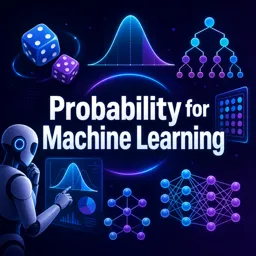
Duration of the online course: 46 minutes
New
Build intuition for ML uncertainty with a free online course in probability—events, independence, and combinatorics—ideal prep for interviews and certificates.
Strong machine learning isn’t only about picking the right model or tuning hyperparameters. It’s about making reliable decisions under uncertainty: What could happen, how likely it is, and how confident you should be in what the data suggests. This free online course builds the probability foundations that sit beneath modern AI and machine learning, helping you reason clearly about randomness, variability, and outcomes you can’t predict with certainty.
You will develop a practical grasp of probability as a language for data-driven systems. Instead of treating metrics and model outputs as magic numbers, you’ll learn to interpret them as probabilities connected to events, assumptions, and evidence. The course connects core ideas to the way machine learning actually works, clarifying why probability matters for learning from historical data and for modeling non-deterministic behavior where identical inputs do not always lead to identical outputs.
Through guided explanations and applied exercises, you’ll train your intuition with familiar scenarios like cards and coin tosses. These examples are more than puzzles: they reinforce the mindset you need to understand model evaluation, uncertainty in predictions, and the logic behind learning from multiple observations. You’ll practice thinking in terms of sample spaces and events, and you’ll see how independence changes what you can infer when observations accumulate.
The course also strengthens your combinatorics toolkit, a skill that frequently appears in ML interviews and in day-to-day reasoning about probability distributions. By working through carefully chosen problems, you’ll become faster and more accurate at calculating probabilities for exact outcomes, while also learning how to structure solutions so they scale beyond toy examples. If you want a solid foundation for deeper topics like Bayesian thinking, stochastic optimization, and probabilistic modeling, this course is a clear next step.
Explore the best free online machine learning courses with certificates and build job-ready AI skills at your own pace. Learn supervised and unsupervised learning, neural networks, data analysis, Python, and real-world model development through beginner-friendly and advanced classes from trusted learning platforms.

Explore free online Mathematics for Machine Learning courses covering linear algebra, calculus, probability, statistics, and optimization. Build the essential math skills needed for AI, data science, and machine learning through flexible, self-paced lessons. Enroll at no cost, complete practical coursework, and earn a certificate to showcase your knowledge.

46 minutes of online video course

Digital certificate of course completion (Free)

Exercises to train your knowledge

100% free, from content to certificate
Why is probability theory essential for machine learning?
Probability helps machine learning models represent uncertainty, learn from noisy historical data, and estimate likely outcomes.
What is the probability of drawing an ace or a spade from a standard deck?
There are 4 aces and 13 spades, with the ace of spades counted twice, so the probability is 16/52, or 4/13.
What is the probability of exactly two heads in three fair coin tosses?
There are 3 favorable outcomes out of 8 possible outcomes, so the probability is 3/8.
Ready to get started?Download the app and get started today.
Install the app now
to access the course
Over 5,000 free courses
Programming, English, Digital Marketing and much more! Learn whatever you want, for free.

Study plan with AI
Our app's Artificial Intelligence can create a study schedule for the course you choose.

From zero to professional success
Improve your resume with our free Certificate and then use our Artificial Intelligence to find your dream job.
You can also use the QR Code or the links below.



Free CourseDeep Learning With PyTorch
5

(6)

3h39m

19 exercises
Free CourseMachine Learning tutorial
5
(2)
10h20m
6 exercises
Free CourseGoogle Prompting Essentials
4.8
(5)
3h24m
10 exercises

Free CourseData Science
4.8

(4)
5h58m
38 exercises
Free CourseArtificial intelligence
4.7
(69)
12h40m
7 exercises
Free CourseFundamentals of Artificial Intelligence
4.6
(11)
25h26m
34 exercises
Free CourseGenerative AI
4.6
(5)
1h43m
11 exercises
Free CourseArtificial Intelligence Masterclass: Search, Logic, Machine Learning and Deep Learning
4.6
(9)
31h57m
57 exercises
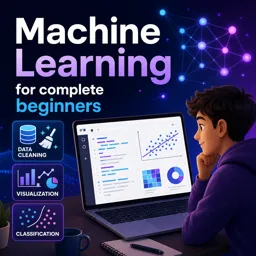
Free CourseMachine Learning for complete beginners
4.6
(9)
1h09m
17 exercises
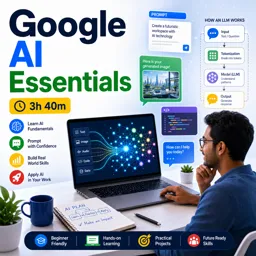
Free CourseGoogle AI Essentials
4.5
(17)
3h40m
13 exercises
Carry knowledge in your pocket.
Download the Cursa app.
There are hundreds of free courses available, with a free certificate of completion that is saved in your mobile image gallery.
Download the app to access the Course Completion Certificate for Free.


+ 10 million
students

Free and Valid
Certificate

60 thousand free
exercises

4.8/5 rating in
app stores

Free courses in
video and ebooks