A class is a blueprint, while an object is an instance of that class. Instance attributes store data specific to each object, usually through self.

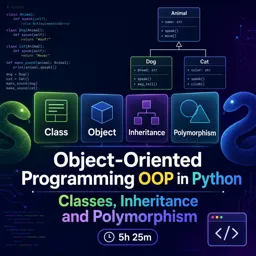
Duration of the online course: 5 hours and 25 minutes
New
Build real-world Python OOP skills fast: classes, inheritance, polymorphism, magic methods, and quizzes in a free course—level up your code and career.
Writing Python that scales is not just about making code work, it is about making it easy to extend, test, and maintain. This course helps you move from script-style programming to a clean object-oriented mindset by teaching how to design programs around well-structured classes and objects. You will practice turning real problems into reusable models, so your code stays readable even as projects grow.
You will start by building your first classes and understanding how objects and classes relate, then learn how Python actually stores and resolves attributes. Along the way, you will make your objects feel natural to use by implementing string representations and by working with computed attributes through property. You will also see when to use instance methods, class methods, and utility-style static methods so responsibilities stay clear and your design avoids unnecessary coupling.
As you gain confidence, you will step into encapsulation and controlled access with getters and setters, then learn polymorphism and operator overloading to make custom types interact smoothly with Python syntax. You will also explore comparisons, rich behavior through magic methods, and the role of NotImplementedError in defining contracts during development. These skills are essential when building libraries, frameworks, and team-friendly codebases.
The course then moves into modeling relationships between multiple classes, using patterns that prevent common pitfalls such as unsafe default parameters. You will work with structured representations like Enum, connect entities in a clear way, and see how dictionaries and keys can support practical object management. Challenges around polygons and geometry provide a hands-on way to practice organizing collaborating objects rather than writing tangled logic.
Finally, you will learn inheritance in depth, including method resolution order, super(), multilevel and multiple inheritance, and when inheritance is the wrong tool compared to composition. You will also be introduced to abstract classes to enforce consistent interfaces across related types. By the end, you will be prepared to design Python programs that are easier to evolve, with OOP choices that are intentional rather than accidental.

Explore free online Python courses and build in-demand programming skills at your own pace. Learn Python basics, data analysis, automation, web development, and more through flexible beginner-friendly lessons. Enroll today, study from anywhere, and earn a free certificate to showcase your Python skills and boost your career.

Explore free online Object Oriented Programming courses and build practical skills in classes, objects, inheritance, polymorphism, encapsulation, and popular OOP languages. Learn at your own pace with beginner-friendly lessons, hands-on projects, and expert guidance. Enroll today and earn a certificate to showcase your programming skills.

5 hours and 25 minutes of online video course

Digital certificate of course completion (Free)

Exercises to train your knowledge

100% free, from content to certificate
How do Python classes, objects, and instance attributes work?
A class is a blueprint, while an object is an instance of that class. Instance attributes store data specific to each object, usually through self.
What is the difference between @staticmethod, @classmethod, and @property in Python?
@staticmethod uses neither instance nor class data, @classmethod receives cls for class-level data, and @property lets a method be accessed like a controlled attribute.
How do inheritance, polymorphism, and magic methods work in Python OOP?
Inheritance lets child classes extend parent behavior, polymorphism lets different objects use a shared interface, and magic methods such as __add__ and __lt__ customize operators.
Ready to get started?Download the app and get started today.
Install the app now
to access the course
Over 5,000 free courses
Programming, English, Digital Marketing and much more! Learn whatever you want, for free.

Study plan with AI
Our app's Artificial Intelligence can create a study schedule for the course you choose.

From zero to professional success
Improve your resume with our free Certificate and then use our Artificial Intelligence to find your dream job.
You can also use the QR Code or the links below.



Free CourseLearn Python
5

(3)

13h00m

17 exercises
Free CourseCreate Desktop App
5
(4)
5h33m
30 exercises
Free CourseRuby on Rails
5
(7)
9h39m
34 exercises
Free CourseJava Programming
5
(4)
9h15m
48 exercises
Free CoursePython Ultimate Course: Learn Python from Scratch
5
(1)
12h31m
42 exercises
Free CourseJava
4.8
(56)
22h17m
28 exercises
Free CourseC# Sharp for beginner
4.8
(37)
3h55m
15 exercises
Free CourseC++ as your first Programming Language
4.8
(107)
5h12m
23 exercises
Free CourseJava for beginners
4.8
(183)
26h50m
49 exercises
Free CourseComputer science and Java
4.8
(65)
9h15m
31 exercises
Carry knowledge in your pocket.
Download the Cursa app.
There are hundreds of free courses available, with a free certificate of completion that is saved in your mobile image gallery.
Download the app to access the Course Completion Certificate for Free.


+ 10 million
students

Free and Valid
Certificate

60 thousand free
exercises

4.8/5 rating in
app stores

Free courses in
video and ebooks