You can install Linux in a virtual machine, allowing it to run alongside your existing operating system.

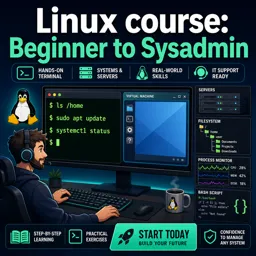
Duration of the online course: 3 hours and 58 minutes
3

(2)
Build practical Linux sysadmin skills fast with this free online course: command line, packages, processes, filesystems, and bash scripting—certificate-ready.
Want the confidence to navigate Linux like a sysadmin, even if you are starting from zero? This free online course guides you from your first safe setup in a virtual machine to the day-to-day skills used in IT support, operations, DevOps, and junior system administration roles. You will learn how to work efficiently in a terminal, understand what is happening inside the system, and build habits that transfer to any Linux distribution.
You will begin by creating a Linux environment without replacing your current operating system, so you can practice freely while keeping your main computer intact. From there, you will develop command line fluency: moving through directories, creating and managing files, and using text editors comfortably. As your workflow grows, you will discover why shells are powerful tools, using pipes, redirection, filtering, and search techniques to turn raw output into clear answers.
Administration becomes real when you can maintain software and keep systems stable. You will practice package management with common Ubuntu-style tooling, understanding updates, installs, and the role of repositories. You will then move into the operating system core: what processes are, how to inspect them, how signals work, and how to interpret state and priority. You will also explore the /proc filesystem to connect command output to what the kernel is tracking under the hood, an essential perspective when troubleshooting performance and reliability issues.
To tie everything together, the course explains the Linux filesystem layout so you can locate configuration, binaries, and key system directories with purpose rather than guesswork. Finally, you will take a first step into automation with bash scripting. You will learn why scripts matter, how quoting and variables prevent mistakes, how scripts run, how to pass arguments, and how to make decisions with tests, functions, and reusable logic. By the end, you will have a solid foundation for real-world system work and a clear path to keep leveling up your Linux and automation skills.

3 hours and 58 minutes of online video course

Digital certificate of course completion (Free)

Exercises to train your knowledge

100% free, from content to certificate
How can I set up Linux without replacing my current operating system?
You can install Linux in a virtual machine, allowing it to run alongside your existing operating system.
What Linux command updates packages on Ubuntu?
Use sudo apt-get update to refresh package lists, then sudo apt-get upgrade to install available updates.
What is the purpose of the /proc filesystem in Linux?
The /proc filesystem provides virtual files with real-time information about the kernel, hardware, and running processes.
Ready to get started?Download the app and get started today.
Install the app now
to access the course
Over 5,000 free courses
Programming, English, Digital Marketing and much more! Learn whatever you want, for free.

Study plan with AI
Our app's Artificial Intelligence can create a study schedule for the course you choose.

From zero to professional success
Improve your resume with our free Certificate and then use our Artificial Intelligence to find your dream job.
You can also use the QR Code or the links below.



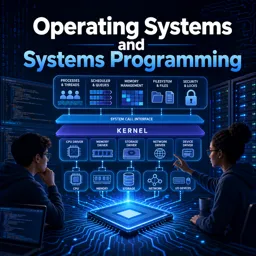
Free CourseOperating Systems and Systems Programming
5
(4)

38h48m

26 exercises
Free CourseOperating System
5
(3)
16h53m
42 exercises

Free CourseHome Networking 101
5
(1)
1h50m
4 exercises
Free CourseBasic Commands in Linux
4.8

(4)
2h15m
6 exercises
Free CourseComputer operating systems
4.7
(109)
6h00m
23 exercises

Free CourseHardware and Network full course
4.6
(17)
20h08m
23 exercises
Free CourseLinux command line tutorial
4.5
(59)
25h01m
40 exercises
Free CourseUbuntu Linux training
4.5
(32)
4h06m
33 exercises

Free CourseHardware
4.4
(46)
8h40m
15 exercises
Free CourseKali Linux: Beginner to Advanced
3.9
(7)
15h57m
35 exercises
Carry knowledge in your pocket.
Download the Cursa app.
There are hundreds of free courses available, with a free certificate of completion that is saved in your mobile image gallery.
Download the app to access the Course Completion Certificate for Free.


+ 10 million
students

Free and Valid
Certificate

60 thousand free
exercises

4.8/5 rating in
app stores

Free courses in
video and ebooks