Use transposition and axis-based reductions (e.g., sum over axis=0) and predict resulting shapes
Compute norms (L2, Frobenius), unit vectors, and properties of bases: orthogonal vs orthonormal
Perform core tensor ops: Hadamard product, dot product, and matrix multiplication with shape rules
Know key matrix types and effects: identity, diagonal, symmetric, and orthogonal matrices
Solve y = Xw via matrix inversion; know when inversion is feasible and its limitations
Apply matrices as linear/affine transformations and identify preserved geometric properties
Compute determinants, relate them to invertibility and volume scaling, and handle larger-matrix recursion
Work with eigenvalues/eigenvectors, eigendecomposition (esp. symmetric), and interpret zero eigenvalues
Use SVD for non-square matrices; know factor dimensions and why truncation enables compression
Compute the Moore-Penrose pseudoinverse via SVD and apply it to least-squares regression (w = X^+ y)
Use the trace operator, including expressing Frobenius norm via trace, and connect to PCA basics
About the free online course
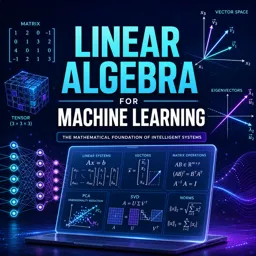
Machine learning becomes far less mysterious when you can read the math it is built on. This free online course helps you develop the linear algebra intuition and practical fluency that power modern AI, from understanding how data is represented to explaining why familiar algorithms behave the way they do.
You will move from the basics of linear systems to the language used in ML libraries: scalars, vectors, matrices, and higher-dimensional tensors. Instead of treating shapes as error messages, you learn to think in dimensions, transposition, indexing, and batch representations that show up in real projects such as images and datasets. Along the way, you practice core operations like dot products, element-wise arithmetic, and reductions, so computations feel predictable and easy to debug.
The course also builds a strong geometric understanding of matrices as transformations. You connect multiplication, identity, symmetry, diagonals, and orthogonality to concrete consequences like efficiency, stability, and what it means to preserve structure. From there, you tackle the ideas that repeatedly surface in machine learning: determinants and invertibility, eigenvectors and eigenvalues, and how decomposition methods reveal what a model can and cannot learn from data.
Finally, you bring it together with tools that are essential for real ML work with non-square, noisy, or overdetermined data: singular value decomposition, the Moore-Penrose pseudoinverse, and least-squares regression. You will also see how concepts like trace and Frobenius norm connect neatly, and why PCA is naturally expressed in linear algebra terms. With frequent questions and exercises to reinforce each step, you finish with a clearer mental model, stronger computational instincts, and a foundation you can immediately apply to machine learning pipelines and interviews.
Course content
Video class: Machine Learning Foundations: Welcome to the Journey02m
Exercise: Which pair forms the linear algebra component of the ML foundations series?
Video class: What Linear Algebra Is — Topic 1 of Machine Learning Foundations24m
Exercise: Which statement about solutions to a system of linear equations is correct?
Video class: Plotting a System of Linear Equations — Machine Learning Foundations Bonus Video09m
Exercise: Intersection of two linear motions
Video class: Linear Algebra Exercise — Topic 2 of Machine Learning Foundations02m
Exercise: A system models cumulative energy as two linear functions: Design A starts on April 1 generating 1 kJ/day; Design B starts on May 1 generating 4 kJ/day. On which day do their total energies become equal?
Video class: Tensors — Topic 3 of Machine Learning Foundations02m
Exercise: What best describes a tensor in machine learning and linear algebra?
Video class: Scalars — Topic 4 of Machine Learning Foundations13m
Exercise: Which statement best describes a scalar tensor in linear algebra and ML libraries?
Video class: Vectors and Vector Transposition — Topic 5 of Machine Learning Foundations12m
Exercise: What is the shape after transposing a 1D NumPy vector of length 3?
Video class: Norms and Unit Vectors — Topic 6 of Machine Learning Foundations15m
Exercise: Which norm measures Euclidean distance from the origin
Video class: Basis, Orthogonal, and Orthonormal Vectors — Topic 7 of Machine Learning Foundations04m
Exercise: Properties of Orthonormal Basis Vectors
Video class: Matrix Tensors — Topic 8 of Machine Learning Foundations08m
Exercise: Which statement about matrix notation and indexing is correct?
Video class: Generic Tensor Notation — Topic 9 of Machine Learning Foundations06m
Exercise: Which shape matches a batch of 32 RGB images at 28x28 pixels in the [batch, height, width, channels] format?
Video class: Exercises on Algebra Data Structures — Topic 10 of Machine Learning Foundations00m
Exercise: If matrix Y has 3 rows and 5 columns, what are its dimensions in algebraic notation?
Video class: Tensor Operations — Segment 2 of Subject 1, Intro to Linear Algebra, ML Foundations01m
Exercise: Which set of activities best describes Segment 2 in Linear Algebra for Machine Learning?
Video class: Tensor Transposition — Topic 11 of Machine Learning Foundations03m
Exercise: Under matrix transposition, where does the element at position (i, j) move?
Video class: Basic Tensor Arithmetic (The Hadamard Product) — Topic 12 of Machine Learning Foundations06m
Exercise: Element wise vs matrix multiplication in tensor libraries
Video class: Tensor Reduction — Topic 13 of Machine Learning Foundations03m
Exercise: What is the result of applying a sum reduction with axis=0 to an m×n matrix?
Video class: The Dot Product — Topic 14 of Machine Learning Foundations05m
Exercise: Compute the dot product of two vectors
Video class: Exercises on Tensor Operations — Topic 15 of Machine Learning Foundations00m
Exercise: Choose the operation that multiplies two same-shaped matrices element-wise
Video class: Solving Linear Systems with Substitution — Topic 16 of Machine Learning Foundations04m
Exercise: Use substitution to solve the system y = 3x and -5x + 2y = 2. What is x?
Video class: Solving Linear Systems with Elimination — Topic 17 of Machine Learning Foundations05m
Exercise: Which method is typically best when no variable in a linear system has a coefficient of 1?
Video class: Visualizing Linear Systems — Machine Learning Foundations Bonus Video10m
Exercise: Solve the linear system y = 3x and y = 1 + 5x/2. What is the intersection point
Video class: Matrix Properties — Final Segment of Subject 1, Intro to Linear Algebra, ML Foundations02m
Exercise: Which concept quantifies the size of a matrix?
Video class: The Frobenius Norm — Topic 18 of Machine Learning Foundations05m
Exercise: Which statement best defines the Frobenius norm of a matrix?
Video class: Matrix Multiplication — Topic 19 of Machine Learning Foundations25m
Exercise: If A is an m x n matrix and B is an n x p matrix, what is the shape of the product AB?
Video class: Symmetric and Identity Matrices — Topic 20 of Machine Learning Foundations04m
Exercise: Effect of the identity matrix on a vector
Video class: Matrix Multiplication Exercises — Topic 21 of Machine Learning Foundations00m
Exercise: Effect of the 3x3 Identity Matrix on a 3x1 Vector
Video class: Matrix Inversion — Topic 22 of Machine Learning Foundations17m
Exercise: Solving for w in y = X w using matrix inversion
Video class: Diagonal Matrices — Topic 23 of Machine Learning Foundations03m
Exercise: What operation is equivalent to multiplying a diagonal matrix diag x by a vector y
Video class: Orthogonal Matrices — Topic 24 of Machine Learning Foundations05m
Exercise: Which property makes inverting an orthogonal matrix computationally cheap
Video class: Orthogonal Matrix Exercises — Topic 25 of Machine Learning Foundations02m
Exercise: Proving that I3 is an orthogonal matrix
Video class: Linear Algebra II: Matrix Operations — Subject 2 of Machine Learning Foundations17m
Exercise: Best method to solve overdetermined linear systems in ML
Video class: Applying Matrices — Topic 26 of Machine Learning Foundations07m
Exercise: Applying a matrix to a concatenated matrix of column vectors
Video class: Affine Transformations — Topic 27 of Machine Learning Foundations18m
Exercise: Which geometric property is preserved by affine transformations applied via matrices?
Video class: Eigenvectors and Eigenvalues — Topic 28 of Machine Learning Foundations26m
Exercise: Interpreting eigenvalues under flipping and scaling
Video class: Matrix Determinants — Topic 29 of Machine Learning Foundations08m
Exercise: Compute the determinant of X where X equals [[4, 2], [-5, -3]]
Video class: Determinants of Larger Matrices — Topic 30 of Machine Learning Foundations08m
Exercise: Recursion rounds needed for a 6x6 determinant
Video class: Determinant Exercises — Topic 31 of Machine Learning Foundations01m
Exercise: Determinant and Invertibility
Video class: Determinants and Eigenvalues — Topic 32 of Machine Learning Foundations16m
Exercise: Which statement best describes the relationship between determinant, eigenvalues, and volume scaling for a square matrix X?
Video class: Eigendecomposition — Topic 33 of Machine Learning Foundations12m
Exercise: Eigendecomposition of real symmetric matrices
Video class: Eigenvector and Eigenvalue Applications — Topic 34 of Machine Learning Foundations13m
Exercise: Implication of a zero eigenvalue
Video class: Matrix Operations for Machine Learning — Final Segment of Subject 2, Linear Algebra II03m
Exercise: Which operation decomposes rectangular matrices and is critical in machine learning because data matrices are often non-square?
Video class: Singular Value Decomposition — Topic 35 of Machine Learning Foundations10m
Exercise: For a real matrix A with 3 rows and 2 columns, which SVD factor dimensions are correct in A = U D V^T?
Video class: Data Compression with SVD — Topic 36 of Machine Learning Foundations11m
Exercise: Why does truncating an SVD to the first k components enable strong image compression?
Video class: The Moore-Penrose Pseudoinverse — Topic 37 of Machine Learning Foundations12m
Exercise: Moore-Penrose pseudoinverse via SVD
Video class: Regression with the Pseudoinverse — Topic 38 of Machine Learning Foundations18m
Exercise: In an overdetermined linear model y ≈ Xw, what does computing w = X^+ y achieve?
Video class: The Trace Operator — Topic 39 of Machine Learning Foundations04m
Exercise: How can the Frobenius norm of matrix A be computed using the trace operator?
Video class: Principal Component Analysis (PCA) — Topic 40 of Machine Learning Foundations08m
Exercise: In PCA, what does the first principal component represent
Video class: Linear Algebra Resources — Topic 41 of Machine Learning Foundations06m
Exercise: Which operation provides a pseudo-inverse for non-square matrices, enabling least-squares solutions to systems common in machine learning?